
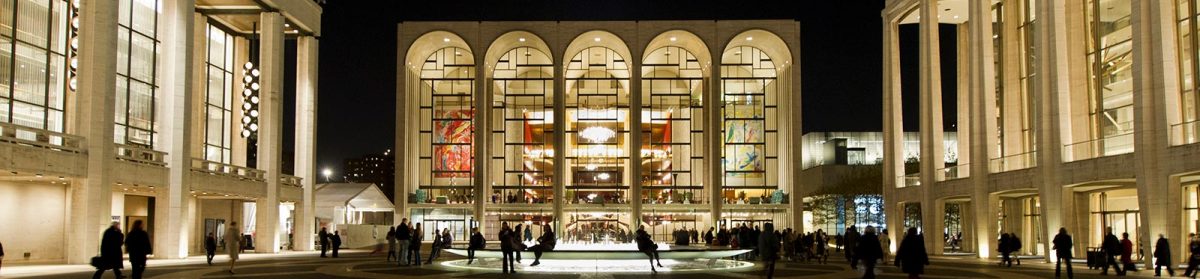
In this 11th year, over ten nights performances from the Met’s Live in HD series will be shown starting with a screening of FUNNY FACE in a special co-presentation with Film at Lincoln Center. Screenings run from August 23 through September 2. There will be 3000 seats in the Plaza in front of the Opera House with an additional standing room area. Cancellations due to thunder/lighting or high wind will not be rescheduled.

DAS RHEINGOLD:Wagner
Original Air Date: 03/14/2019
Jordan; Harmer, Barton, Cargill, Ernst, Siegel, Grimsley, Konieczny, Groissböck, Belosselskiy
SID.19380428
Wagner’s visionary initial installment of the Ring Cycle depicts the original sin of the theft of the sacred golden treasure, the vanity of the gods, the greed of the Nibelungen, the fratricide of the giants, and the building of Valhalla. Bass-baritone Greer Grimsley and baritone Michael Volle share the role of Wotan, the conflicted lord of the gods. Mezzo-soprano Jamie Barton sings her first Wagner role at the Met as Wotan’s embattled wife, Fricka. In collaboration with Ex Machina

SIEGFRIED:Wagner
Original Air Date: 04/13/2019
Jordan; Goerke, Morley, Cargill, Vinke, Siegel, Volle, Konieczny, Belosselskiy
SID.19380640
Review: In the Met’s ‘Siegfried,’ Singers Transcend the Staging – By Joshua Barone April 14, 2019
Pity the opera directors who decide to stage Wagner’s “Ring” — for in doing so they have to figure out what to do with “Siegfried.” The third installment of Wagner’s epic, which returned to the Metropolitan Opera in Robert Lepage’s tech-happy production on Saturday, has tripped up even the smartest of “Ring” directors. Blame the source material: a title role both tedious and impractically difficult; a repetitive libretto sitting somewhere between coming-of-age adventure and dark comedy; a singing dragon. Mr. Lepage’s staging doesn’t do much to help the problems baked into “Siegfried,” a weak spot of the “Ring” that lacks the breakneck pace of “Das Rheingold,” the heart-rending humanity of “Die Walküre” or the textbook-perfect tragedy of “Götterdämmerung.” What it does help, however, is the problem of the 45-ton machine so central to his production as its primary set piece. Instead of relying on the unreliable behemoth to be as kinetic as in the earlier “Ring” operas, Mr. Lepage here treats the machine as more of a canvas for Pedro Pires’s impressive projections. Three-dimensional, interactive videos create the illusion of leaves rustling beneath Siegfried’s feet, of a pond’s surface being truly reflective.
***
But good singers can lift a subpar staging. In this “Siegfried,” they transcend it. Stefan Vinke is making his Met debut in the titular heldentenor role, armed with insouciant high notes and a bright smile. His heroism occasionally veers into howling, and the strain in his voice doesn’t always befit a boyish naïf who knows no fear. (He shares the run with Andreas Schager, who is capable of breezing through the role’s most challenging passages with the shocking ease of Siegfried wrangling a bear.) But Mr. Vinke is a pleasure to watch; he leans into the opera’s comedy — and his character’s ignorance, which often comes off as idiocy. As the scheming Mime, who takes in the orphaned Siegfried in the hope of using the boy’s strength to gain the ring, Gerhard Siegel infused his tenor with venom. Mime’s brother, Alberich, who in “Das Rheingold” commits the original sin of the “Ring,” only returns in “Siegfried” for brief moments in Act II. But those scenes were among the most memorable on Saturday. That’s because Alberich is sung by Tomasz Konieczny, who is also making his Met debut and continues to stand out even among extraordinary colleagues. His resonant bass ricochets off the planks of the machine as he imbues Alberich with dignified authority. His confrontation with Wotan — presented in “Siegfried” as the Wanderer, dressed like a Gandalf of the Wild West and performed by Michael Volle — is a high point of the opera. Or, rather, low: They are both booming basses, equally mighty in a way that illustrates, with only music, how alike these antipodal characters may be.
If women seem absent, it’s because there are so few: the whistle-high Erin Morley as the Woodbird; the solemn Karen Cargill as Erda; and, of course, the fiery soprano Christine Goerke as Brünnhilde. It’s remarkable that anyone in this cast was singing so well in a matinee that began at 11:30 a.m. But Ms. Goerke also had to feign sleep onstage for nearly 20 minutes before letting out a resounding “Heil dir, Sonne!” that penetrated through swelling fortes in the orchestra, crisp and controlled under the baton of Philippe Jordan. Ms. Goerke’s vigor only grew in a crescendo toward all-out majesty in the final scene, a courtship with Mr. Vinke that ended with their leaping into love and matching high C’s. For this climax of old-fashioned operatic thrills, they weren’t even standing on the machine — as if they existed outside Mr. Lepage’s production entirely. @NYTimes
 Berg
Berg
Original Air Date: 12/27/2019
Nézet-Séguin; van den Heever, Mumford, Ventris, Siegel, Staples, Mattei, Van Horn
SID.19520000
After wowing audiences with his astounding production of Lulu in 2015, South African artist William Kentridge now focuses his extraordinary visual imagination on Berg’s other operatic masterpiece, set in an apocalyptic pre–World War I environment. Met Music Director Yannick Nézet-Séguin is on the podium for this important event, with baritone Peter Mattei making his highly anticipated role debut as the title character. Soprano Elza van den Heever is Wozzeck’s unfaithful mate, and the commanding cast also includes tenor Christopher Ventris as the Drum-Major, bass-baritone Christian Van Horn as the Doctor, and tenor Gerhard Siegel as the Captain.
 Berg
Berg
Nézet-Séguin; van den Heever, Mumford, Ventris, Siegel, Staples, Mattei, Van Horn
Original Air Date: 01/22/2020
SID.20040321
After wowing audiences with his astounding production of Lulu in 2015, South African artist William Kentridge now focuses his extraordinary visual imagination on Berg’s other operatic masterpiece, set in an apocalyptic pre–World War I environment. Met Music Director Yannick Nézet-Séguin is on the podium for this important event, with baritone Peter Mattei making his highly anticipated role debut as the title character. Soprano Elza van den Heever is Wozzeck’s unfaithful mate, and the commanding cast also includes tenor Christopher Ventris as the Drum-Major, bass-baritone Christian Van Horn as the Doctor, and tenor Gerhard Siegel as the Captain. A co-production of the Metropolitan Opera; Salzburg Festival; the Canadian Opera Company, Toronto; and Opera Australia

SIEGFRIED:Wagner
Luisi; Voigt, Bardon, Erdmann, Hunter Morris, Siegel, Owens, Konig, Terfel
Original Air Date: 11/05/2011 Live in HD
SID.20130432
Production Photos
Read RWWs review
Siegfried……………Jay Hunter Morris
Brünnhilde…………..Deborah Voigt
Wanderer…………….Bryn Terfel
Erda………………..Patricia Bardon
Mime………………..Gerhard Siegel
Alberich…………….Eric Owens
Fafner………………Hans-Peter König
Forest Bird………….Mojca Erdmann
Stage Horn Solo: Erik Ralske
Conductor……………Fabio Luisi
Production…………..Robert Lepage
Associate Director……Neilson Vignola
Set designer…………Carl Fillion
Costume designer……..François St-Aubin
Lighting designer…….Etienne Boucher
Video Image Artist……Pedro Pires
TV Director………….Gary Halvorson