
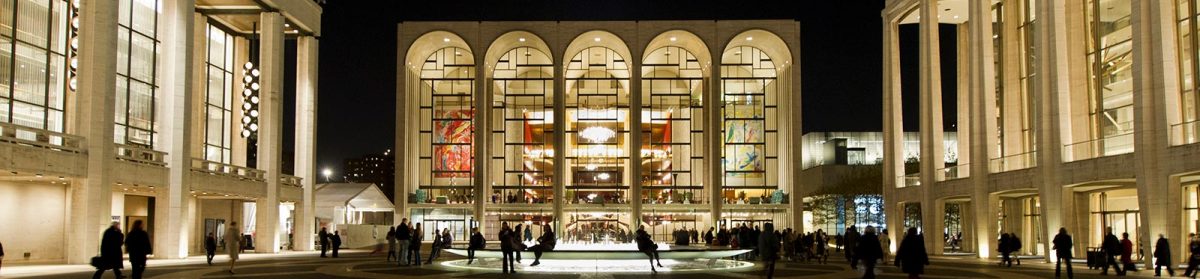
In this 11th year, over ten nights performances from the Met’s Live in HD series will be shown starting with a screening of FUNNY FACE in a special co-presentation with Film at Lincoln Center. Screenings run from August 23 through September 2. There will be 3000 seats in the Plaza in front of the Opera House with an additional standing room area. Cancellations due to thunder/lighting or high wind will not be rescheduled.
Strauss
Original Air Date: 04/18/1992
Levine; Daner, Voigt, Rysanek, Rootering, King
SID.19350107
This broadcast is best as a document of Rysanek’s only Met broadcast Klytemnestra, and Voigt in young, fresh voice. Daner sang all other performances of this new production, when Behrens cancelled after the premiere. I was at the premiere and kept wondering when the performance would be halted. Daner is a competent replacement, but nothing memorable. An annual cycling seems a bit excessive to me.
Strauss
Original Air Date: 04/18/1992
Levine; Daner, Voigt, Rysanek, Rootering, King
SID.19350317
This broadcast is best as a document of Rysanek’s only Met broadcast Klytemnestra, and Voigt in young, fresh voice. Daner sang all other performances of this new production, when Behrens cancelled after the premiere. I was at the premiere and kept wondering when the performance would be halted. Daner is a competent replacement, but nothing memorable. An annual cycling seems a bit excessive to me.
Strauss
Original Air Date: 04/18/1992
Levine; Daner, Voigt, Rysanek, Rootering, King
SID.19350533
This broadcast is best as a document of Rysanek’s only Met broadcast Klytemnestra, and Voigt in young, fresh voice. Daner sang all other performances of this new production, when Behrens cancelled after the premiere. I was at the premiere and kept wondering when the performance would be halted. Daner is a competent replacement, but nothing memorable. An annual cycling seems a bit excessive to me.

SALOME:Strauss
Original Air Date: 12/15/1990
Conlon; Behrens, Clark, Dernesch, Wlaschiha, Baker
SID.19360107
Hildegard Behrens burst on the scene when she appeared with Karajan in his EMI recording of Salome, and subsequent Salzburg production in 1977-1978. Twelve years between her historic recording and her live broadcast from the Met wouldn’t be so long if one were say 35, but Behrens was 41, so this Met broadcast comes at the age of 53. For 53, it is OK, but what was perfection 13 years earlier in the studio is now careful and studied. At a much younger age, Welitsch had the same occurrence. In 1949 she had New York on its heel with her Salome under Reiner at the Met; three years later, it’s a different world; the 1952 Salome is a pale shadow of 1949. Welitsch is 36 in 1949 and 39 in 1952. Three Salomes live were Birgit Nilsson March 1965 (broadcast a few days later) when she was 47. What is remarkable is that she was capable of a concert Salome with Chicago Symphony nine years later in 1974 when she was 56. Tales are told in both Chicago and New York about these concert Salomes. Eva Marton (also heard on a Met broadcast. Not as ideal as Nilsson vocally, she still made quite an impact, and she was 46 for her Met Salome. Last but definitely not least was Karita Mattila who does rank as the most sizzling Salome who could also sing. In 2004, when she was 44, it was filmed by the Met but has never been shown. Four years later she did the work for the HD cameras and she is OK, but now not at the pinnacle (and the HD and the production concept do not reward a Salome that is a bit too ripe.) But prime Nilsson, prime Marton, and prime Mattila, all three captured on Met Saturday matinee microphones are the touchstones. Elektra, in addition to be a more interesting work, allows its heroine more latitude, and Nilsson and Marton as well as Varnay, Jones, and Behrens are all distinguished Elektras. The Met missed Marton as Elektra which is a huge omission. Salome does not yield such pleasure on immediate repetition. Just a little too late for almost everyone. Wlaschiha who is not quite smooth enough for Jokanaan, but a fine Alberich. Cassilly did the first thre Herods (and the last was his Met farewell); Graham Clark did the remaining five.
SALOME:Strauss
Original Air Date: 12/15/1990
Conlon; Behrens, Clark, Dernesch, Wlaschiha, Baker
SID.19360317
Hildegard Behrens burst on the scene when she appeared with Karajan in his EMI recording of Salome, and subsequent Salzburg production in 1977-1978. Twelve years between her historic recording and her live broadcast from the Met wouldn’t be so long if one were say 35, but Behrens was 41, so this Met broadcast comes at the age of 53. For 53, it is OK, but what was perfection 13 years earlier in the studio is now careful and studied. At a much younger age, Welitsch had the same occurrence. In 1949 she had New York on its heel with her Salome under Reiner at the Met; three years later, it’s a different world; the 1952 Salome is a pale shadow of 1949. Welitsch is 36 in 1949 and 39 in 1952. Three Salomes live were Birgit Nilsson March 1965 (broadcast a few days later) when she was 47. What is remarkable is that she was capable of a concert Salome with Chicago Symphony nine years later in 1974 when she was 56. Tales are told in both Chicago and New York about these concert Salomes. Eva Marton (also heard on a Met broadcast. Not as ideal as Nilsson vocally, she still made quite an impact, and she was 46 for her Met Salome. Last but definitely not least was Karita Mattila who does rank as the most sizzling Salome who could also sing. In 2004, when she was 44, it was filmed by the Met but has never been shown. Four years later she did the work for the HD cameras and she is OK, but now not at the pinnacle (and the HD and the production concept do not reward a Salome that is a bit too ripe.) But prime Nilsson, prime Marton, and prime Mattila, all three captured on Met Saturday matinee microphones are the touchstones. Elektra, in addition to be a more interesting work, allows its heroine more latitude, and Nilsson and Marton as well as Varnay, Jones, and Behrens are all distinguished Elektras. The Met missed Marton as Elektra which is a huge omission. Salome does not yield such pleasure on immediate repetition. Just a little too late for almost everyone. Wlaschiha who is not quite smooth enough for Jokanaan, but a fine Alberich. Cassilly did the first thre Herods (and the last was his Met farewell); Graham Clark did the remaining five.
SALOME:Strauss
Original Air Date: 12/15/1990
Conlon; Behrens, Clark, Dernesch, Wlaschiha, Baker
SID.19360533
Hildegard Behrens burst on the scene when she appeared with Karajan in his EMI recording of Salome, and subsequent Salzburg production in 1977-1978. Twelve years between her historic recording and her live broadcast from the Met wouldn’t be so long if one were say 35, but Behrens was 41, so this Met broadcast comes at the age of 53. For 53, it is OK, but what was perfection 13 years earlier in the studio is now careful and studied. At a much younger age, Welitsch had the same occurrence. In 1949 she had New York on its heel with her Salome under Reiner at the Met; three years later, it’s a different world; the 1952 Salome is a pale shadow of 1949. Welitsch is 36 in 1949 and 39 in 1952. Three Salomes live were Birgit Nilsson March 1965 (broadcast a few days later) when she was 47. What is remarkable is that she was capable of a concert Salome with Chicago Symphony nine years later in 1974 when she was 56. Tales are told in both Chicago and New York about these concert Salomes. Eva Marton (also heard on a Met broadcast. Not as ideal as Nilsson vocally, she still made quite an impact, and she was 46 for her Met Salome. Last but definitely not least was Karita Mattila who does rank as the most sizzling Salome who could also sing. In 2004, when she was 44, it was filmed by the Met but has never been shown. Four years later she did the work for the HD cameras and she is OK, but now not at the pinnacle (and the HD and the production concept do not reward a Salome that is a bit too ripe.) But prime Nilsson, prime Marton, and prime Mattila, all three captured on Met Saturday matinee microphones are the touchstones. Elektra, in addition to be a more interesting work, allows its heroine more latitude, and Nilsson and Marton as well as Varnay, Jones, and Behrens are all distinguished Elektras. The Met missed Marton as Elektra which is a huge omission. Salome does not yield such pleasure on immediate repetition. Just a little too late for almost everyone. Wlaschiha who is not quite smooth enough for Jokanaan, but a fine Alberich. Cassilly did the first thre Herods (and the last was his Met farewell); Graham Clark did the remaining five.

DER ROSENKAVALIER:Strauss
Original Air Date: 02/18/1956
Kempe; Stevens, Della Casa; Edelmann, Güden, Herbert
MOD Audio SID.19370103
Della Casa, no more beautiful woman ever trod the operatic stage. With Kempe in the pit for his final Met broadcast, this is a wonderful all-around performance. This performance has been on, but not frequently. An absolute rave. If maybe a little late for Stevens, Della Casa and Guden are in absolute prime. Kempe appeared too little and we certainly need his Arabella (in English) with Steber, Guden and London to appear on Sirius. Don’t miss.
DER ROSENKAVALIER:Strauss
Original Air Date: 02/18/1956
Kempe; Stevens, Della Casa; Edelmann, Güden, Herbert
MOD Audio SID.19370319
Della Casa, no more beautiful woman ever trod the operatic stage. With Kempe in the pit for his final Met broadcast, this is a wonderful all-around performance. This performance has been on, but not frequently. An absolute rave. If maybe a little late for Stevens, Della Casa and Guden are in absolute prime. Kempe appeared too little and we certainly need his Arabella (in English) with Steber, Guden and London to appear on Sirius. Don’t miss.
DER ROSENKAVALIER:Strauss
Original Air Date: 02/18/1956
Kempe; Stevens, Della Casa; Edelmann, Güden, Herbert
MOD Audio SID.19370743
Della Casa, no more beautiful woman ever trod the operatic stage. With Kempe in the pit for his final Met broadcast, this is a wonderful all-around performance. This performance has been on, but not frequently. An absolute rave. If maybe a little late for Stevens, Della Casa and Guden are in absolute prime. Kempe appeared too little and we certainly need his Arabella (in English) with Steber, Guden and London to appear on Sirius. Don’t miss.

ARABELLA:Strauss
Original Air Date: 03/17/1984
Janowski; Andrade, Nentwig, Battle, Rendall, Dunn, Mazura
SID.19380102
I like Janowski very much as a conductor, but the substitution of Andrade for Te Kanawa who did the rest of the run lowers the voltage considerably, and Nentwig is not a high profile Mandryka for my taste; here was a role George London was absolutely perfect for, and it’s a shame the translation challenges of Sirius seem to keep the Kempe led Met premiere season off the air with Steber and London truly inspired. The problems with translations fall on deaf ears here since the translation was by John Gutman, longtime Met asst. Manager. For real value rebroadcast this less often and get London and Steber on the air– it’s the Met at its best.
ARABELLA:Strauss
Original Air Date: 03/17/1984
Janowski; Andrade, Nentwig, Battle, Rendall, Dunn, Mazura
SID.19380318
I like Janowski very much as a conductor, but the substitution of Andrade for Te Kanawa who did the rest of the run lowers the voltage considerably, and Nentwig is not a high profile Mandryka for my taste; here was a role George London was absolutely perfect for, and it’s a shame the translation challenges of Sirius seem to keep the Kempe led Met premiere season off the air with Steber and London truly inspired. The problems with translations fall on deaf ears here since the translation was by John Gutman, longtime Met asst. Manager. For real value rebroadcast this less often and get London and Steber on the air– it’s the Met at its best.
ARABELLA:Strauss
Original Air Date: 03/17/1984
Janowski; Andrade, Nentwig, Battle, Rendall, Dunn, Mazura
SID.19380535
I like Janowski very much as a conductor, but the substitution of Andrade for Te Kanawa who did the rest of the run lowers the voltage considerably, and Nentwig is not a high profile Mandryka for my taste; here was a role George London was absolutely perfect for, and it’s a shame the translation challenges of Sirius seem to keep the Kempe led Met premiere season off the air with Steber and London truly inspired. The problems with translations fall on deaf ears here since the translation was by John Gutman, longtime Met asst. Manager. For real value rebroadcast this less often and get London and Steber on the air– it’s the Met at its best.

ELEKTRA:Strauss
Nezet-Seguin; Goerke, van den heever, Schuster, Morris, Petrenlo
Original Air Date: 03/18/2018
SID.19400106
Christine Goerke sings her first Elektra at the Met in Patrice Chéreau’s landmark production, a sensation at its Met premiere last spring, which the Wall Street Journal called “revolutionary … a triumph on all fronts.” Yannick Nézet-Séguin conducts Strauss’s shattering score, a tour de force for the singers and the orchestra alike. Opening night (3-1-2018) is dedicated to the memory of Patrice Chéreau.
ELEKTRA:Strauss
Nezet-Seguin; Goerke, van den heever, Schuster, Morris, Petrenlo
Original Air Date: 03/18/2018
SID.19400317
Christine Goerke sings her first Elektra at the Met in Patrice Chéreau’s landmark production, a sensation at its Met premiere last spring, which the Wall Street Journal called “revolutionary … a triumph on all fronts.” Yannick Nézet-Séguin conducts Strauss’s shattering score, a tour de force for the singers and the orchestra alike. Opening night (3-1-2018) is dedicated to the memory of Patrice Chéreau.
ELEKTRA:Strauss
Nezet-Seguin; Goerke, van den heever, Schuster, Morris, Petrenlo
Original Air Date: 03/18/2018
SID.19400535
Christine Goerke sings her first Elektra at the Met in Patrice Chéreau’s landmark production, a sensation at its Met premiere last spring, which the Wall Street Journal called “revolutionary … a triumph on all fronts.” Yannick Nézet-Séguin conducts Strauss’s shattering score, a tour de force for the singers and the orchestra alike. Opening night (3-1-2018) is dedicated to the memory of Patrice Chéreau.

ARIADNE AUF NAXOS:Strauss
Levine; Norman, King, Battle, Troyanos, Nentwig, Dickson
Original Air Date: 03/12/1988
MOD AudioMOD Video
SID.19410211
This is the audio for the performance issued on DVD, NOT available on MOoD, as are many of the R. Strauss offerings. Battle’s performance is enhanced by the visual. Norman, King, and Troyanos are among the major exponents of their parts in late 20th century.

SALOME:Strauss
Böhm; Rysanek, Stolze, Dalis, Stewart, MacWherter
Original Air Date: 03/18/1972
SID.19410214
Rysanek’s first Salomes at the Met came after the groundbreaking new production for Nilsson eight years earlier. Longtime Metgoers were still talking about Welitsch from the late 1940s. The best Met Salomes are Welitsch, Nilsson, Bumbry, Marton, and Mattila (first season). Behrens (who has a great studio performance with Karajan). Rysanek was significantly better five years later when Leinsdorf took the reins with Norman Bailey, Astrid Varnay and Ragnar Ulfung; the 1977 performance is available on Met Opera on Demand (MOoD).
ARIADNE AUF NAXOS:Strauss
Levine; Norman, King, Battle, Troyanos, Nentwig, Dickson
Original Air Date: 03/12/1988
MOD AudioMOD Video
SID.19410424
This is the audio for the performance issued on DVD, NOT available on MOoD, as are many of the R. Strauss offerings. Battle’s performance is enhanced by the visual. Norman, King, and Troyanos are among the major exponents of their parts in late 20th century.
ARIADNE AUF NAXOS:Strauss
Levine; Norman, King, Battle, Troyanos, Nentwig, Dickson
Original Air Date: 03/12/1988
MOD AudioMOD Video
SID.19410427
This is the audio for the performance issued on DVD, NOT available on MOoD, as are many of the R. Strauss offerings. Battle’s performance is enhanced by the visual. Norman, King, and Troyanos are among the major exponents of their parts in late 20th century.
SALOME:Strauss
Böhm; Rysanek, Stolze, Dalis, Stewart, MacWherter
Original Air Date: 03/18/1972
SID.19410531
Rysanek’s first Salomes at the Met came after the groundbreaking new production for Nilsson eight years earlier. Longtime Metgoers were still talking about Welitsch from the late 1940s. The best Met Salomes are Welitsch, Nilsson, Bumbry, Marton, and Mattila (first season). Behrens (who has a great studio performance with Karajan). Rysanek was significantly better five years later when Leinsdorf took the reins with Norman Bailey, Astrid Varnay and Ragnar Ulfung; the 1977 performance is available on Met Opera on Demand (MOoD).
SALOME:Strauss
Böhm; Rysanek, Stolze, Dalis, Stewart, MacWherter
Original Air Date: 03/18/1972
SID.19410533
Rysanek’s first Salomes at the Met came after the groundbreaking new production for Nilsson eight years earlier. Longtime Metgoers were still talking about Welitsch from the late 1940s. The best Met Salomes are Welitsch, Nilsson, Bumbry, Marton, and Mattila (first season). Behrens (who has a great studio performance with Karajan). Rysanek was significantly better five years later when Leinsdorf took the reins with Norman Bailey, Astrid Varnay and Ragnar Ulfung; the 1977 performance is available on Met Opera on Demand (MOoD).
ARIADNE AUF NAXOS:Strauss
Levine; Norman, King, Battle, Troyanos, Nentwig, Dickson
Original Air Date: 03/12/1988
MOD AudioMOD Video
SID.19410640
This is the audio for the performance issued on DVD, NOT available on MOoD, as are many of the R. Strauss offerings. Battle’s performance is enhanced by the visual. Norman, King, and Troyanos are among the major exponents of their parts in late 20th century.

DER ROSENKAVALIER:Strauss
Kout; Ziegler, Gessendorf, Haugland, Kilduff, Meredith
Original Air Date: 03/09/1991
SID.19420106
Part of the draw is certainly Pavarotti, but this mostly low voltage marquee cast is very solid. Gessendorf has a second Marschallin four years later under Levine with von Otter and Hawlata which has also been on Sirius. I saw Gessendorf several times in the house, and though not a dramatic house of fire, I like her very much, and find she fills the “big lyric” German roles very well. She’s definitely worth a listen. 7/2/11 Gessendorf is one of those singers who flew under the radar during her Met career. This is the first of her two broadcast Marschallins, and I highly recommend. I think she is even better served on the second one in 1995 with von Otter and Hawlata under Levine. Her Senta broadcast is on Met Player, and her Walkure Sieglinde was also broadcast (Ludwig’s farewell, and G. Jones as the Brunnhilde). She has a number of other Met performances, but alas only these four broadcasts.
DER ROSENKAVALIER:Strauss
Kout; Ziegler, Gessendorf, Haugland, Kilduff, Meredith
Original Air Date: 03/09/1991
SID.19420317
Part of the draw is certainly Pavarotti, but this mostly low voltage marquee cast is very solid. Gessendorf has a second Marschallin four years later under Levine with von Otter and Hawlata which has also been on Sirius. I saw Gessendorf several times in the house, and though not a dramatic house of fire, I like her very much, and find she fills the “big lyric” German roles very well. She’s definitely worth a listen. 7/2/11 Gessendorf is one of those singers who flew under the radar during her Met career. This is the first of her two broadcast Marschallins, and I highly recommend. I think she is even better served on the second one in 1995 with von Otter and Hawlata under Levine. Her Senta broadcast is on Met Player, and her Walkure Sieglinde was also broadcast (Ludwig’s farewell, and G. Jones as the Brunnhilde). She has a number of other Met performances, but alas only these four broadcasts.
DER ROSENKAVALIER:Strauss
Kout; Ziegler, Gessendorf, Haugland, Kilduff, Meredith
Original Air Date: 03/09/1991
SID.19420535
Part of the draw is certainly Pavarotti, but this mostly low voltage marquee cast is very solid. Gessendorf has a second Marschallin four years later under Levine with von Otter and Hawlata which has also been on Sirius. I saw Gessendorf several times in the house, and though not a dramatic house of fire, I like her very much, and find she fills the “big lyric” German roles very well. She’s definitely worth a listen. 7/2/11 Gessendorf is one of those singers who flew under the radar during her Met career. This is the first of her two broadcast Marschallins, and I highly recommend. I think she is even better served on the second one in 1995 with von Otter and Hawlata under Levine. Her Senta broadcast is on Met Player, and her Walkure Sieglinde was also broadcast (Ludwig’s farewell, and G. Jones as the Brunnhilde). She has a number of other Met performances, but alas only these four broadcasts.

DIE FRAU OHNE SCHATTEN:Strauss
Thielemann; Voigt, Moser, Schnaut, Brendel, Runkel
Original Air Date: 01/05/2002
SID.19430209
This was Thielemann’s high water mark at the Met with a popular production by Herbert Wernicke who died an untimely death not long after this production was premiered in December 2001 (he died in April 2002). Thielemann did the score absolutely uncut for the first time at the Met, and the women on the whole garnered high praise. Schnaut’s voice is not a beautiful one (but Christel Goltz was not exactly Kiri te Kanawa either) but she certainly gets to the heart of the character. I have never been able to tolerate Moser’s voice, and Brendel is caught just a little too late in the day for this. For many of us Barak will always be Walter Berry, but of course those lucky to have seen DFD in Europe it was a fine part for him as well. The main draw here is Thielemann conducting the opera complete, something Bohm never did at the Met, and one of the best outings for Voigt. Still FROSCH has some of the best music Strauss ever wrote, and Thielemann is a master of this score against any competition. Highly recommended.
DIE FRAU OHNE SCHATTEN:Strauss
Thielemann; Voigt, Moser, Schnaut, Brendel, Runkel
Original Air Date: 01/05/2002
SID.19430210
This was Thielemann’s high water mark at the Met with a popular production by Herbert Wernicke who died an untimely death not long after this production was premiered in December 2001 (he died in April 2002). Thielemann did the score absolutely uncut for the first time at the Met, and the women on the whole garnered high praise. Schnaut’s voice is not a beautiful one (but Christel Goltz was not exactly Kiri te Kanawa either) but she certainly gets to the heart of the character. I have never been able to tolerate Moser’s voice, and Brendel is caught just a little too late in the day for this. For many of us Barak will always be Walter Berry, but of course those lucky to have seen DFD in Europe it was a fine part for him as well. The main draw here is Thielemann conducting the opera complete, something Bohm never did at the Met, and one of the best outings for Voigt. Still FROSCH has some of the best music Strauss ever wrote, and Thielemann is a master of this score against any competition. Highly recommended.
DIE FRAU OHNE SCHATTEN:Strauss
Thielemann; Voigt, Moser, Schnaut, Brendel, Runkel
Original Air Date: 01/05/2002
SID.19430425
This was Thielemann’s high water mark at the Met with a popular production by Herbert Wernicke who died an untimely death not long after this production was premiered in December 2001 (he died in April 2002). Thielemann did the score absolutely uncut for the first time at the Met, and the women on the whole garnered high praise. Schnaut’s voice is not a beautiful one (but Christel Goltz was not exactly Kiri te Kanawa either) but she certainly gets to the heart of the character. I have never been able to tolerate Moser’s voice, and Brendel is caught just a little too late in the day for this. For many of us Barak will always be Walter Berry, but of course those lucky to have seen DFD in Europe it was a fine part for him as well. The main draw here is Thielemann conducting the opera complete, something Bohm never did at the Met, and one of the best outings for Voigt. Still FROSCH has some of the best music Strauss ever wrote, and Thielemann is a master of this score against any competition. Highly recommended.
DIE FRAU OHNE SCHATTEN:Strauss
Thielemann; Voigt, Moser, Schnaut, Brendel, Runkel
Original Air Date: 01/05/2002
SID.19430426
This was Thielemann’s high water mark at the Met with a popular production by Herbert Wernicke who died an untimely death not long after this production was premiered in December 2001 (he died in April 2002). Thielemann did the score absolutely uncut for the first time at the Met, and the women on the whole garnered high praise. Schnaut’s voice is not a beautiful one (but Christel Goltz was not exactly Kiri te Kanawa either) but she certainly gets to the heart of the character. I have never been able to tolerate Moser’s voice, and Brendel is caught just a little too late in the day for this. For many of us Barak will always be Walter Berry, but of course those lucky to have seen DFD in Europe it was a fine part for him as well. The main draw here is Thielemann conducting the opera complete, something Bohm never did at the Met, and one of the best outings for Voigt. Still FROSCH has some of the best music Strauss ever wrote, and Thielemann is a master of this score against any competition. Highly recommended.
DIE FRAU OHNE SCHATTEN:Strauss
Thielemann; Voigt, Moser, Schnaut, Brendel, Runkel
Original Air Date: 01/05/2002
SID.19430641
This was Thielemann’s high water mark at the Met with a popular production by Herbert Wernicke who died an untimely death not long after this production was premiered in December 2001 (he died in April 2002). Thielemann did the score absolutely uncut for the first time at the Met, and the women on the whole garnered high praise. Schnaut’s voice is not a beautiful one (but Christel Goltz was not exactly Kiri te Kanawa either) but she certainly gets to the heart of the character. I have never been able to tolerate Moser’s voice, and Brendel is caught just a little too late in the day for this. For many of us Barak will always be Walter Berry, but of course those lucky to have seen DFD in Europe it was a fine part for him as well. The main draw here is Thielemann conducting the opera complete, something Bohm never did at the Met, and one of the best outings for Voigt. Still FROSCH has some of the best music Strauss ever wrote, and Thielemann is a master of this score against any competition. Highly recommended.