
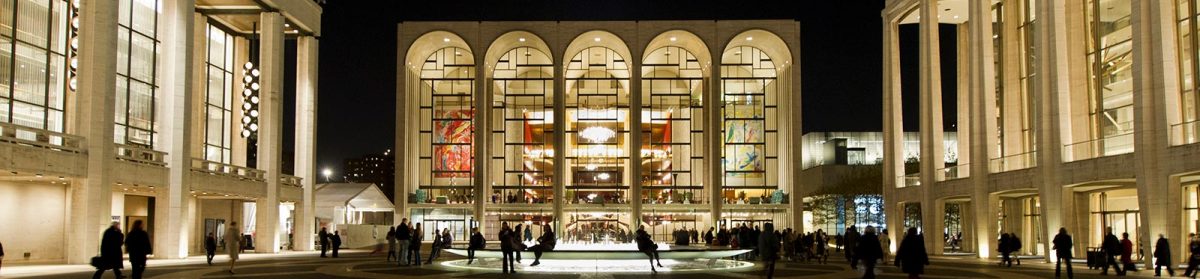
In this 11th year, over ten nights performances from the Met’s Live in HD series will be shown starting with a screening of FUNNY FACE in a special co-presentation with Film at Lincoln Center. Screenings run from August 23 through September 2. There will be 3000 seats in the Plaza in front of the Opera House with an additional standing room area. Cancellations due to thunder/lighting or high wind will not be rescheduled.

GÖTTERDÄMMERUNG:Wagner
Levine; Eaglen, Andersen, Halfvarson, Held, Radvanovsky, Palmer
Original Air Date: 04/22/2000
MOD Audio
SID.19430101
This is one of the two Ring cycles broadcast by Eaglen and Levine. This one finds Eaglen on better form than the 2004 (her Met farewell), but Salminen is a stronger Hagen than Halfvarson. The 2004 has been on Sirius, but even though I previously posted that it was available on MOoD, I do not see it present in current availability. This is Felicity Palmer’s Met debut and really potent Gibich siblings in Held and Radvanovsky.

DEATH IN VENICE:Britten
Atherton; Rolfe Johnson, Allen, Gall, von Aroldingen,
Original Air Date: 02/26/1994
MOD Audio
SID.19430102
The production, shared with Covent Garden in London, where it was presented in 1992, is by the same English team that first staged the opera, in 1973 at the Maltings, near Britten’s home in Suffolk, and later at Covent Garden and the Met: Colin Graham, director; John Piper (who has since died), set designer, and Charles Knode, costume designer. Yet this is no revival. In fact, the old production no longer exists; the original sets were destroyed by fire, and the costumes are in rags. Mr. Graham sets the opera in a black box, like the inside of a camera whose iris opens to reveal images inside Aschenbach’s mind. A hanging gloom of black velour pervades the stage. Images are projected on a central screen and, to stress the theme of fragmentation, deconstructed into abstract parts on side screens framed by reflective pillars. In recreating the costumes from Mr. Knode’s original sketches, Hilary Philpot of Covent Garden eliminated the many stylistic references to the 70’s that had crept in, along with the use of synthetic fabrics. Most of the singers have only one costume, and the Edwardian suits, for men and women, are made with couture perfection of linen, silk or cotton in off-white or pale colors that can be bleached out by the lights. They are transformed by multiple accessories, including more than 80 hats that are pure fantasies of the millinery profession, many in a kind of diaphanous lampshade parchment. The most important costume of all, Aschenbach’s suit, was originally made of a beige linen that is no longer manufactured. Tadzio’s mother is dressed in green rather than the former grays and blues, though her hat retains the famous plumes. (from NYTIMES Feb. 6, 1994) Both Met revivals, the original with Peter Pears from 1974 and this 1994 revival are available in MOoD.

IL BARBIERE DI SIVIGLIA:Rossini
Weikert; Hampson, von Stade, Olsen, Quilico, Ramey
Original Air Date: 02/29/1992
MOD Audio
SID.19430103
Louis Quilico is not my ideal Bartolo. Von Stade’s first Rosina broadcast from 1976 with Stilwell, Corena, and Morris has been on Sirius, but not 1983 which features Pablo Elvira, Sesto Bruscantini (as Bartolo) and Paolo Montarsolo as Basilio. This 1992 performance is her last Met performance as Rosina. Appears almost as much as BOHEME

UN BALLO IN MASCHERA:Verdi
Santi; Tucker, Nilsson, Merrill, Dobbs, Madeira
Original Air Date: 01/12/1963
MOD Audio
SID.19430104
This performance finds the principals in very strong form (Nilsson’s only broadcast from the Met of Amelia) and Tucker is an excellent match for her. Merrill is in his run of eight of the nine Ballo broadcasts between 1955 and 1985!!!! Definitely worth a listen. (Schonberg NYT Review,1/11/63) Birgit Nilsson is by common consent the greatest active Wagenrian soprano, but that does not mean she cannot sing other music. She mader her first appearance of the season at the Metropolitan Opera on Wednesday night, and she sang the role of Amelia in Verdi’s UN BOOLO IN MASCHERA for the first time at the house. And she sang a spectacular performance. It was not the kind of singing, though, that most Italian sopranos bring to the role…Nillsson’s is a Nordic voice with a wider sound than that produced by the Italians, and hence a little cooler. Also, like most Nordic singers, she holds her emotins in check. There is no sobbing, no carrying on, and the general impression is one of complete vocal and emotional control. But what control! …. for more >

DIE WALKÜRE:Wagner
Levine; Behrens, Morris, Norman, Lakes, Ludwig, Moll
Original Air Date: 04/08/1989
MOD AudioMOD Video
SID.19430105
This performance is in the MOoD as a video. Lakes is operating in a league that is at least a half step beyond him. Behrens, who is certainly well schooled, is not the right voice for me. Norman is very much her own stylist. Still this is a strong cast overall, and finds the Met orchestra and Levine in their first cycle together in extremely committed form.
DIE WALKÜRE:Wagner
Levine; Behrens, Morris, Norman, Lakes, Ludwig, Moll
Original Air Date: 04/08/1989
MOD AudioMOD Video
SID.19430106
This performance is in the MOoD as a video. Lakes is operating in a league that is at least a half step beyond him. Behrens, who is certainly well schooled, is not the right voice for me. Norman is very much her own stylist. Still this is a strong cast overall, and finds the Met orchestra and Levine in their first cycle together in extremely committed form.

SAMSON ET DALILA:Saint-Saëns
Abravanel; Maison, Wettergren, Pinza
Original Air Date: 12/26/1936
MOD Audio
SID.19430107
This is the second oldest Met performance to have been rebroadcast on Sirius — the Lawrence/Melchior Gotterdammerung also from 1936 (but previous season) is the oldest. Abravanel is more remembered as longtime conductor of the Utah Symphony, but his three Met seasons beginning with this broadcast showed him as a sure hand in the French and German wings of the repertory. The principals have plenty of profile, and Pinza is an excellent High Priest.

RIGOLETTO:Verdi
Erede; Warren, Güden, Tucker, Pernerstorfer, Madeira
Original Air Date: 12/08/1951
SID.19430208
Though Gueden’s 24 Met Gildas isn’t going to threaten Roberta Peters’ 88 performance record, this was her Met debut a month before this broadcast in a new production designed by Eugene Berman and directed by Herbert Graf (same team as for classic Don Giovanni 6 years later). Warren was the pre-eminent Met Rigoletto during his Met years, and few have sung it so powerfully. Tucker sings the ‘Possente amor’ cabaletta to his ‘Parmi veder’ (only this season if memory serves; the cabaletta does not return until the appearance of Alfredo Kraus 15 years later) None of the 1951 matinee performers are short when it comes to filling out the vocal lines. What is unfortunate is the only broadcast of Warren’s Rigoletto from 1945 to 1959 has not made it to MOoD, and only two of Warren’s SEVEN broadcasts have appeared on Sirius. This 1951 broadcast is very deserving of being promoted to MOoD.

DIE FRAU OHNE SCHATTEN:Strauss
Thielemann; Voigt, Moser, Schnaut, Brendel, Runkel
Original Air Date: 01/05/2002
SID.19430209
This was Thielemann’s high water mark at the Met with a popular production by Herbert Wernicke who died an untimely death not long after this production was premiered in December 2001 (he died in April 2002). Thielemann did the score absolutely uncut for the first time at the Met, and the women on the whole garnered high praise. Schnaut’s voice is not a beautiful one (but Christel Goltz was not exactly Kiri te Kanawa either) but she certainly gets to the heart of the character. I have never been able to tolerate Moser’s voice, and Brendel is caught just a little too late in the day for this. For many of us Barak will always be Walter Berry, but of course those lucky to have seen DFD in Europe it was a fine part for him as well. The main draw here is Thielemann conducting the opera complete, something Bohm never did at the Met, and one of the best outings for Voigt. Still FROSCH has some of the best music Strauss ever wrote, and Thielemann is a master of this score against any competition. Highly recommended.
DIE FRAU OHNE SCHATTEN:Strauss
Thielemann; Voigt, Moser, Schnaut, Brendel, Runkel
Original Air Date: 01/05/2002
SID.19430210
This was Thielemann’s high water mark at the Met with a popular production by Herbert Wernicke who died an untimely death not long after this production was premiered in December 2001 (he died in April 2002). Thielemann did the score absolutely uncut for the first time at the Met, and the women on the whole garnered high praise. Schnaut’s voice is not a beautiful one (but Christel Goltz was not exactly Kiri te Kanawa either) but she certainly gets to the heart of the character. I have never been able to tolerate Moser’s voice, and Brendel is caught just a little too late in the day for this. For many of us Barak will always be Walter Berry, but of course those lucky to have seen DFD in Europe it was a fine part for him as well. The main draw here is Thielemann conducting the opera complete, something Bohm never did at the Met, and one of the best outings for Voigt. Still FROSCH has some of the best music Strauss ever wrote, and Thielemann is a master of this score against any competition. Highly recommended.

LA GIOCONDA:Ponchielli
Cleva; Tebaldi, Bergonzi, MacNeil, Cossotto, Giaiotti
Original Air Date: 03/02/1968
MOD Audio
SID.19430211
This is Tebaldi’s second broadcast of the street singer, and what a sensational cast the Met surrounds her with. Bergonzi did a run with Bumbry eleven years later but that was not broadcast. Tebaldi’s first broadcast a year earlier has also been on Sirius, and is also on MOoD. The earlier broadcast has Morrell (replacing Corelli) and Elias in the Bergonzi and Cossotto parts. Siepi and Giaiotti are both top class Alvises. The Met listing leaves off Dunn, and Cieca is definitely one of the star parts. This is Tebaldi’s second Gioconda broadcast, and despite the wear and tear from 32 Met Giocondas in two years — it is her final Gioconda. Bing serves up A+ colleagues for her, and it is a rousing afternoon. This performance is on Met Player, highly recommend.

COSÌ FAN TUTTE:Mozart
Kord; Carson, Di Giuseppe, Tourangeau, Carlson, Boky, Corena
Original Air Date: 12/20/1975
SID.19430212
This is most notable for Corena’s only Don Alfonso broadcast. The opera was out of the Met repertory from 1928 until 1951, when Steber, Thebom, and Tucker premiered the hugely successful Alfred Lunt production in English (a Columbia studio recording of this production was made, and holds upeven against Italian language originals). The opera remained in English until 1971, when John Pritchard premiered a fall cast which included Corena, but no broadcast.

I PURITANI:Bellini
Müller; Swenson, Neill, Hampson, Miles
Original Air Date: 02/01/1997
MOD Audio
SID.19430213
The Netrebko video and the Gruberova and Sutherland Elviras are all available in MOoD as well as this one. Swenson has an attractive voice, but I don’t find her especially compelling, and the supporting cast is much better on the other performances. Cavalleria/ Pagliacci from 1988 and Idomeneo from 1991 are added into the schedule beginning Wednesday.

OTELLO:Verdi
Stiedry; Vinay, Steber, Warren, Hayward
Original Air Date: 02/09/1952
SID.19430214
This performance has been on a European private label for some years, and the cast (including the conductor) get better and better as the afternoon progresses. Vinay is an acquired taste for some, but he fits well with this role. This is a very good time for Steber, and if you enjoyed her 1949 Violetta , this is very fine singing indeed. This is arguably Tebaldi’s best role, and her first two Met broadcasts first with Stiedry in 1955 and Cleva in 1958, both with Del Monaco still remain missing from the Sirius rebroadcast listings. Del Monaco’s first Met Otello (not broadcast ) is with this 1952 cast 6 days after Steber does her first with Vinay on the broadcast. The other major interest from Steber here is she sang Fiordiligi at night after this broadcast.

LUCIA DI LAMMERMOOR:Donizetti
Molinari-Pradelli; Scotto, Alexander, Sereni, Plishka
Original Air Date: 04/21/1973
SID.19430315
This is Scotto’s only Met broadcast of Lucia, even though she has two 39th street (old house) performances. Alexander is well suited to Edgardo and his Lucias include Sutherland, Moffo, Sills, Robinson, and Negri (his last in a Bronx Parks assignment). Sereni was a regular Enrico and Molinari-Pradelli is a solid maestro. Scotto the previous performance she cancelled after Act 1, and this broadcast is her final New York Lucia. She does do five tour Lucias after this broadcast. The male contingent is fairly standard B+ casting from the Met, not more, not less. This is the first Met broadcast of Lucia since the Moffo, Gedda performance (debut of Franci and Bruson) of 2/1/69 which is a performance not yet on Sirius, but Jackson spends some time on it (and I remember it like yesterday). This was a bad period at the Met for the Bride of Lammermoor.
FEDORA:Giordano
Abbado; Freni, Domingo, Croft, Arteta
Original Air Date: 04/26/1997
MOD Video
SID.19430316
This is the Met’s only broadcast of this verismo work, and is available on DVD also. This is a solid performance even if it catches Freni in the extreme twilight of a very long career. This is Freni’s penultimate opera performance at the Met, with another Fedora 5 days later. She appears 5 years later in an opening night gala doing Act 2 of Fedora, and she returns 3 years later for an end of season concert that marks her last vocal appearance on any stage.
DIE WALKÜRE:Wagner
Levine; Behrens, Morris, Norman, Lakes, Ludwig, Moll
Original Air Date: 04/08/1989
MOD AudioMOD Video
SID.19430317
This performance is in the MOoD as a video. Lakes is operating in a league that is at least a half step beyond him. Behrens, who is certainly well schooled, is not the right voice for me. Norman is very much her own stylist. Still this is a strong cast overall, and finds the Met orchestra and Levine in their first cycle together in extremely committed form.
DIE WALKÜRE:Wagner
Levine; Behrens, Morris, Norman, Lakes, Ludwig, Moll
Original Air Date: 04/08/1989
MOD AudioMOD Video
SID.19430318
This performance is in the MOoD as a video. Lakes is operating in a league that is at least a half step beyond him. Behrens, who is certainly well schooled, is not the right voice for me. Norman is very much her own stylist. Still this is a strong cast overall, and finds the Met orchestra and Levine in their first cycle together in extremely committed form.
SAMSON ET DALILA:Saint-Saëns
Abravanel; Maison, Wettergren, Pinza
Original Air Date: 12/26/1936
MOD Audio
SID.19430319
This is the second oldest Met performance to have been rebroadcast on Sirius — the Lawrence/Melchior Gotterdammerung also from 1936 (but previous season) is the oldest. Abravanel is more remembered as longtime conductor of the Utah Symphony, but his three Met seasons beginning with this broadcast showed him as a sure hand in the French and German wings of the repertory. The principals have plenty of profile, and Pinza is an excellent High Priest.
LUCIA DI LAMMERMOOR:Donizetti
Molinari-Pradelli; Scotto, Alexander, Sereni, Plishka
Original Air Date: 04/21/1973
SID.19430320
This is Scotto’s only Met broadcast of Lucia, even though she has two 39th street (old house) performances. Alexander is well suited to Edgardo and his Lucias include Sutherland, Moffo, Sills, Robinson, and Negri (his last in a Bronx Parks assignment). Sereni was a regular Enrico and Molinari-Pradelli is a solid maestro. Scotto the previous performance she cancelled after Act 1, and this broadcast is her final New York Lucia. She does do five tour Lucias after this broadcast. The male contingent is fairly standard B+ casting from the Met, not more, not less. This is the first Met broadcast of Lucia since the Moffo, Gedda performance (debut of Franci and Bruson) of 2/1/69 which is a performance not yet on Sirius, but Jackson spends some time on it (and I remember it like yesterday). This was a bad period at the Met for the Bride of Lammermoor.
COSÌ FAN TUTTE:Mozart
Kord; Carson, Di Giuseppe, Tourangeau, Carlson, Boky, Corena
Original Air Date: 12/20/1975
SID.19430321
This is most notable for Corena’s only Don Alfonso broadcast. The opera was out of the Met repertory from 1928 until 1951, when Steber, Thebom, and Tucker premiered the hugely successful Alfred Lunt production in English (a Columbia studio recording of this production was made, and holds upeven against Italian language originals). The opera remained in English until 1971, when John Pritchard premiered a fall cast which included Corena, but no broadcast.
IL BARBIERE DI SIVIGLIA:Rossini
Weikert; Hampson, von Stade, Olsen, Quilico, Ramey
Original Air Date: 02/29/1992
MOD Audio
SID.19430422
Louis Quilico is not my ideal Bartolo. Von Stade’s first Rosina broadcast from 1976 with Stilwell, Corena, and Morris has been on Sirius, but not 1983 which features Pablo Elvira, Sesto Bruscantini (as Bartolo) and Paolo Montarsolo as Basilio. This 1992 performance is her last Met performance as Rosina. Appears almost as much as BOHEME
LA GIOCONDA:Ponchielli
Cleva; Tebaldi, Bergonzi, MacNeil, Cossotto, Giaiotti
Original Air Date: 03/02/1968
MOD Audio
SID.19430423
This is Tebaldi’s second broadcast of the street singer, and what a sensational cast the Met surrounds her with. Bergonzi did a run with Bumbry eleven years later but that was not broadcast. Tebaldi’s first broadcast a year earlier has also been on Sirius, and is also on MOoD. The earlier broadcast has Morrell (replacing Corelli) and Elias in the Bergonzi and Cossotto parts. Siepi and Giaiotti are both top class Alvises. The Met listing leaves off Dunn, and Cieca is definitely one of the star parts. This is Tebaldi’s second Gioconda broadcast, and despite the wear and tear from 32 Met Giocondas in two years — it is her final Gioconda. Bing serves up A+ colleagues for her, and it is a rousing afternoon. This performance is on Met Player, highly recommend.
RIGOLETTO:Verdi
Erede; Warren, Güden, Tucker, Pernerstorfer, Madeira
Original Air Date: 12/08/1951
SID.19430424
Though Gueden’s 24 Met Gildas isn’t going to threaten Roberta Peters’ 88 performance record, this was her Met debut a month before this broadcast in a new production designed by Eugene Berman and directed by Herbert Graf (same team as for classic Don Giovanni 6 years later). Warren was the pre-eminent Met Rigoletto during his Met years, and few have sung it so powerfully. Tucker sings the ‘Possente amor’ cabaletta to his ‘Parmi veder’ (only this season if memory serves; the cabaletta does not return until the appearance of Alfredo Kraus 15 years later) None of the 1951 matinee performers are short when it comes to filling out the vocal lines. What is unfortunate is the only broadcast of Warren’s Rigoletto from 1945 to 1959 has not made it to MOoD, and only two of Warren’s SEVEN broadcasts have appeared on Sirius. This 1951 broadcast is very deserving of being promoted to MOoD.
DIE FRAU OHNE SCHATTEN:Strauss
Thielemann; Voigt, Moser, Schnaut, Brendel, Runkel
Original Air Date: 01/05/2002
SID.19430425
This was Thielemann’s high water mark at the Met with a popular production by Herbert Wernicke who died an untimely death not long after this production was premiered in December 2001 (he died in April 2002). Thielemann did the score absolutely uncut for the first time at the Met, and the women on the whole garnered high praise. Schnaut’s voice is not a beautiful one (but Christel Goltz was not exactly Kiri te Kanawa either) but she certainly gets to the heart of the character. I have never been able to tolerate Moser’s voice, and Brendel is caught just a little too late in the day for this. For many of us Barak will always be Walter Berry, but of course those lucky to have seen DFD in Europe it was a fine part for him as well. The main draw here is Thielemann conducting the opera complete, something Bohm never did at the Met, and one of the best outings for Voigt. Still FROSCH has some of the best music Strauss ever wrote, and Thielemann is a master of this score against any competition. Highly recommended.
DIE FRAU OHNE SCHATTEN:Strauss
Thielemann; Voigt, Moser, Schnaut, Brendel, Runkel
Original Air Date: 01/05/2002
SID.19430426
This was Thielemann’s high water mark at the Met with a popular production by Herbert Wernicke who died an untimely death not long after this production was premiered in December 2001 (he died in April 2002). Thielemann did the score absolutely uncut for the first time at the Met, and the women on the whole garnered high praise. Schnaut’s voice is not a beautiful one (but Christel Goltz was not exactly Kiri te Kanawa either) but she certainly gets to the heart of the character. I have never been able to tolerate Moser’s voice, and Brendel is caught just a little too late in the day for this. For many of us Barak will always be Walter Berry, but of course those lucky to have seen DFD in Europe it was a fine part for him as well. The main draw here is Thielemann conducting the opera complete, something Bohm never did at the Met, and one of the best outings for Voigt. Still FROSCH has some of the best music Strauss ever wrote, and Thielemann is a master of this score against any competition. Highly recommended.

Various:Various
Various Artists
Original Air Date: 01/01/9999
SID.19430427
Two of opera’s most thrilling dramatic sopranos, Christine Goerke and Nina Stemme, reprise their fierce portrayals of the title princess. Yannick Nézet-Séguin takes the podium to conduct Franco Zeffirelli’s dazzling production of Puccini’s final masterpiece, which also features tenors Yusif Eyvazov and Riccardo Massi as Calàf, sopranos Eleonora Buratto and Hibla Gerzmava as Liù, and bass-baritone James Morris as Timur.

ORFEO ED EURIDICE:Gluck
Wigglesworth; Hong, Park, Barton
Original Air Date: 10/24/2019
SID.19430428
Mark Morris’s spirited take on the ancient Orpheus myth stars mezzo-soprano Jamie Barton as Orfeo, the grieving lover on a quest through the underworld. Soprano Hei-Kyung Hong sings the plaintive Euridice. Mark Wigglesworth conducts Gluck’s elegant score, a pinnacle of the Baroque repertoire. Production a gift of Mr. and Mrs. Wilmer J. Thomas, Jr.
DEATH IN VENICE:Britten
Atherton; Rolfe Johnson, Allen, Gall, von Aroldingen,
Original Air Date: 02/26/1994
MOD Audio
SID.19430529
The production, shared with Covent Garden in London, where it was presented in 1992, is by the same English team that first staged the opera, in 1973 at the Maltings, near Britten’s home in Suffolk, and later at Covent Garden and the Met: Colin Graham, director; John Piper (who has since died), set designer, and Charles Knode, costume designer. Yet this is no revival. In fact, the old production no longer exists; the original sets were destroyed by fire, and the costumes are in rags. Mr. Graham sets the opera in a black box, like the inside of a camera whose iris opens to reveal images inside Aschenbach’s mind. A hanging gloom of black velour pervades the stage. Images are projected on a central screen and, to stress the theme of fragmentation, deconstructed into abstract parts on side screens framed by reflective pillars. In recreating the costumes from Mr. Knode’s original sketches, Hilary Philpot of Covent Garden eliminated the many stylistic references to the 70’s that had crept in, along with the use of synthetic fabrics. Most of the singers have only one costume, and the Edwardian suits, for men and women, are made with couture perfection of linen, silk or cotton in off-white or pale colors that can be bleached out by the lights. They are transformed by multiple accessories, including more than 80 hats that are pure fantasies of the millinery profession, many in a kind of diaphanous lampshade parchment. The most important costume of all, Aschenbach’s suit, was originally made of a beige linen that is no longer manufactured. Tadzio’s mother is dressed in green rather than the former grays and blues, though her hat retains the famous plumes. (from NYTIMES Feb. 6, 1994) Both Met revivals, the original with Peter Pears from 1974 and this 1994 revival are available in MOoD.
UN BALLO IN MASCHERA:Verdi
Santi; Tucker, Nilsson, Merrill, Dobbs, Madeira
Original Air Date: 01/12/1963
MOD Audio
SID.19430530
This performance finds the principals in very strong form (Nilsson’s only broadcast from the Met of Amelia) and Tucker is an excellent match for her. Merrill is in his run of eight of the nine Ballo broadcasts between 1955 and 1985!!!! Definitely worth a listen. (Schonberg NYT Review,1/11/63) Birgit Nilsson is by common consent the greatest active Wagenrian soprano, but that does not mean she cannot sing other music. She mader her first appearance of the season at the Metropolitan Opera on Wednesday night, and she sang the role of Amelia in Verdi’s UN BOOLO IN MASCHERA for the first time at the house. And she sang a spectacular performance. It was not the kind of singing, though, that most Italian sopranos bring to the role…Nillsson’s is a Nordic voice with a wider sound than that produced by the Italians, and hence a little cooler. Also, like most Nordic singers, she holds her emotins in check. There is no sobbing, no carrying on, and the general impression is one of complete vocal and emotional control. But what control! …. for more