
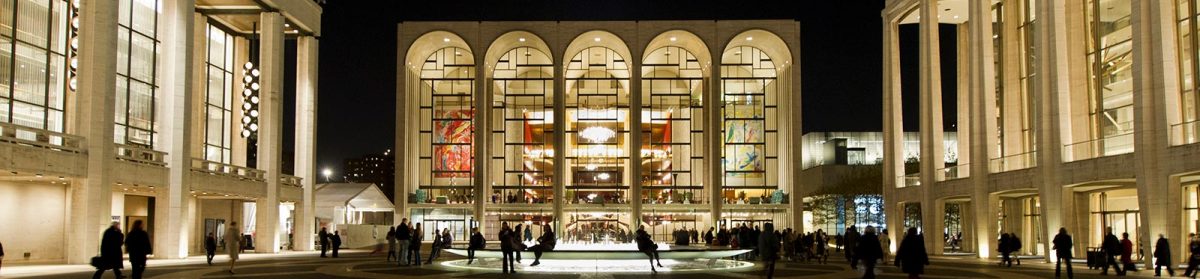
In this 11th year, over ten nights performances from the Met’s Live in HD series will be shown starting with a screening of FUNNY FACE in a special co-presentation with Film at Lincoln Center. Screenings run from August 23 through September 2. There will be 3000 seats in the Plaza in front of the Opera House with an additional standing room area. Cancellations due to thunder/lighting or high wind will not be rescheduled.

DON PASQUALE:Donizetti
Original Air Date: 12/05/1970
Franci; Corena, Grist, Kraus, Krause
MOD Audio SID.19340529
This is a fine performance, but I would love to hear Corena from 1956 with Peters and Valletti in Schippers debut season. I also notice Pinza did a broadcast in 1935 which I think does not survive. Love to hear Pinza and Donizetti, though for the patter duet Corena is absolutely the last word, closely followed by Baccaloni. Corena’s 1965 broadcast with Peters has been on Sirius and is on MOoD, but that’s with Alva, not Valletti.

Donizetti
Original Air Date: 12/04/1982
Bonynge; Sutherland, Kraus, Elvira, Morris
MOD Video SID.19350211
Most people are very familiar with the telecast from November 13, 1982 which is on MOoD. The telecast which is also available on DVD features Plishka instead of Morris, and while Sutherland (age 56) and Kraus (55) are certainly veterans they have a lot to offer. MOD is video from 11-13-82 performance with Plishka for Morris
Donizetti
Original Air Date: 12/04/1982
Bonynge; Sutherland, Kraus, Elvira, Morris
MOD Video SID.19350427
Most people are very familiar with the telecast from November 13, 1982 which is on MOoD. The telecast which is also available on DVD features Plishka instead of Morris, and while Sutherland (age 56) and Kraus (55) are certainly veterans they have a lot to offer. MOD is video from 11-13-82 performance with Plishka for Morris
Donizetti
Original Air Date: 12/04/1982
Bonynge; Sutherland, Kraus, Elvira, Morris
MOD Video SID.19350637
Most people are very familiar with the telecast from November 13, 1982 which is on MOoD. The telecast which is also available on DVD features Plishka instead of Morris, and while Sutherland (age 56) and Kraus (55) are certainly veterans they have a lot to offer. MOD is video from 11-13-82 performance with Plishka for Morris

LA FILLE DU RÉGIMENT:Donizetti
Original Air Date: 03/02/2019
Mazzola; Yende, Blythe, Camarena, Corbelli, Muraro
Live in HD SID.19359996
Tenor Javier Camarena and soprano Pretty Yende team up for a feast of bel canto vocal fireworks—including the show-stopping tenor aria “Ah! Mes amis … Pour mon âme,” with its nine high Cs. Alessandro Corbelli and Maurizio Muraro trade off as the comic Sergeant Sulpice, with mezzo-soprano Stephanie Blythe as the outlandish Marquise of Berkenfield. And in an exciting piece of casting, stage and screen icon Kathleen Turner makes her Met debut in the speaking role of the Duchess of Krakenthorp. Enrique Mazzola conducts. A co-production of the Metropolitan Opera; the Royal Opera House, Covent Garden, London; and the Wiener Staatsoper, Vienna

L’ELISIR D’AMORE:Donizetti
Original Air Date: 12/24/1960
Cleva; Formichini, Söderström, Corena, Guarrera
SID.19360208
This is the premiere year of the new production, where most notably Corena arrived in a balloon, and also ushered in a fine series of productions designed by Robert O’Hearn and directed by Nathaniel Merrill. One might almost call them anti-Regie, but very solid design and production values. Formichini was a replacement for Valletti, but the afternoon is Corena’s, still unsurpassed in this role. Check out the Bergonzi and Kraus afternoons with him as well; both are on Met Player. The key figure in the MET L’Elisirs is the nonpareil Fernando Corena in his first season as Dulcamara. He holds the house record at 53, but I was surprised to see how close Plishka is at 47 Formichini is a substitution for Valletti.
L’ELISIR D’AMORE:Donizetti
Original Air Date: 12/24/1960
Cleva; Formichini, Söderström, Corena, Guarrera
SID.19360424
This is the premiere year of the new production, where most notably Corena arrived in a balloon, and also ushered in a fine series of productions designed by Robert O’Hearn and directed by Nathaniel Merrill. One might almost call them anti-Regie, but very solid design and production values. Formichini was a replacement for Valletti, but the afternoon is Corena’s, still unsurpassed in this role. Check out the Bergonzi and Kraus afternoons with him as well; both are on Met Player. The key figure in the MET L’Elisirs is the nonpareil Fernando Corena in his first season as Dulcamara. He holds the house record at 53, but I was surprised to see how close Plishka is at 47 Formichini is a substitution for Valletti.
L’ELISIR D’AMORE:Donizetti
Original Air Date: 12/24/1960
Cleva; Formichini, Söderström, Corena, Guarrera
SID.19360640
This is the premiere year of the new production, where most notably Corena arrived in a balloon, and also ushered in a fine series of productions designed by Robert O’Hearn and directed by Nathaniel Merrill. One might almost call them anti-Regie, but very solid design and production values. Formichini was a replacement for Valletti, but the afternoon is Corena’s, still unsurpassed in this role. Check out the Bergonzi and Kraus afternoons with him as well; both are on Met Player. The key figure in the MET L’Elisirs is the nonpareil Fernando Corena in his first season as Dulcamara. He holds the house record at 53, but I was surprised to see how close Plishka is at 47 Formichini is a substitution for Valletti.

LA FILLE DU RÉGIMENT:Donizetti
Original Air Date: 01/06/1973
Bonynge; Sutherland, Pavarotti, Resnik, Corena
MOD Audio SID.19370315
Pavarotti may be a bit tight on the high Cs, but his voice is still remarkable, and this is the only broadcast with the Met premiere roster. Resnik and Corena are preferable to their competition. Sutherland is particularly treasurable. This performance is also available on MOoD *** From 1954 until 1976 Fernando Corena was the only Dr. Bartolo to appear on the Met airwaves. Of all Corena’s distinctive characterizations, none rank higher than Bartolo. It would be worthwhile for the Met to unearth its experimental taping (with NHK of Japan)from November 1968 so people could get a taste of his visuals as well. The byplay of Corena with Horne, as well as familiar bass clef tandem, Tozzi are a special delight. Cesare Siepi made his only Met appearances with Levine the following week ending his Met career succeeding Tozzi. *** Pavarotti appears in a broadcast after his initial success with Sutherland. The Cs are already a bit chancy, but this is still a lot of thoroughbreds having a great time. It is also available in MOoD. *** The Met got a little late to Pavarotti (several years after Covent Garden) in Fille and the C’s are more than a little nervous. Still, this is a fun outing if not as well turned out as the studio recording. *** This is from the second season of FIlle, and Pavarotti’s only broadcast of Tonio. Lots of high spirits.
Donizetti
Original Air Date: 01/06/1973
Bonynge; Sutherland, Pavarotti, Resnik, Corena
MOD Audio SID.19370531
Pavarotti may be a bit tight on the high Cs, but his voice is still remarkable, and this is the only broadcast with the Met premiere roster. Resnik and Corena are preferable to their competition. Sutherland is particularly treasurable. This performance is also available on MOoD From 1954 until 1976 Fernando Corena was the only Dr. Bartolo to appear on the Met airwaves. Of all Corena’s distinctive characterizations, none rank higher than Bartolo. It would be worthwhile for the Met to unearth its experimental taping (with NHK of Japan)from November 1968 so people could get a taste of his visuals as well. The byplay of Corena with Horne, as well as familiar bass clef tandem, Tozzi are a special delight. Cesare Siepi made his only Met appearances with Levine the following week ending his Met career succeeding Tozzi. Pavarotti appears in a broadcast after his initial success with Sutherland. The Cs are already a bit chancy, but this is still a lot of thoroughbreds having a great time. It is also available in MOoD. The Met got a little late to Pavarotti (several years after Covent Garden) in Fille and the C’s are more than a little nervous. Still, this is a fun outing if not as well turned out as the studio recording.

LUCIA DI LAMMERMOOR:Donizetti
Original Air Date: 12/11/1999
Müller; Swenson, Vargas, Nucci, Pertusi
SID.19390103
Vargas did some very nice early Edgardos at the Met (I remember one with Futral) and Nucci should also be a strong Enrico. This is the second season for Swenson in a Nicholas Joel production she premiered which replaced the disastrous Zambello production. Solid support from the male contingent for her. If they’re going to put Anderson in MOoD (with Leech and Fu), Swenson should be as well, and this is a stronger male cast.
LUCIA DI LAMMERMOOR:Donizetti
Original Air Date: 12/11/1999
Müller; Swenson, Vargas, Nucci, Pertusi
SID.19390424
Vargas did some very nice early Edgardos at the Met (I remember one with Futral) and Nucci should also be a strong Enrico. This is the second season for Swenson in a Nicholas Joel production she premiered which replaced the disastrous Zambello production. Solid support from the male contingent for her. If they’re going to put Anderson in MOoD (with Leech and Fu), Swenson should be as well, and this is a stronger male cast.
LUCIA DI LAMMERMOOR:Donizetti
Müller; Swenson, Vargas, Nucci, Pertusi
Original Air Date: 12/11/1999
SID.19390640
Vargas did some very nice early Edgardos at the Met (I remember one with Futral) and Nucci should also be a strong Enrico. This is the second season for Swenson in a Nicholas Joel production she premiered which replaced the disastrous Zambello production. Solid support from the male contingent for her. If they’re going to put Anderson in MOoD (with Leech and Fu), Swenson should be as well, and this is a stronger male cast.

L’ELISIR D’AMORE:Donizetti
Benini; Pavarotti, Swenson, Plishka, de Candia
Original Air Date: 03/14/1998
SID.19400212
Swenson is a fruity Adina, but this is the last of Pavarotti’s Nemorino broadcasts. The part spans 24 years at the Met. Generally prefer earlier with him. There are two earlier telecasts and almost all of his Nemorinos (not this one) are on MOoD.
L’ELISIR D’AMORE:Donizetti
Benini; Pavarotti, Swenson, Plishka, de Candia
Original Air Date: 03/14/1998
SID.19400530
Swenson is a fruity Adina, but this is the last of Pavarotti’s Nemorino broadcasts. The part spans 24 years at the Met. Generally prefer earlier with him. There are two earlier telecasts and almost all of his Nemorinos (not this one) are on MOoD.
L’ELISIR D’AMORE:Donizetti
Benini; Pavarotti, Swenson, Plishka, de Candia
Original Air Date: 03/14/1998
SID.19400743
Swenson is a fruity Adina, but this is the last of Pavarotti’s Nemorino broadcasts. The part spans 24 years at the Met. Generally prefer earlier with him. There are two earlier telecasts and almost all of his Nemorinos (not this one) are on MOoD.

Donizetti
Benini; Alaimo, Netrebko, Flórez, Kwiecien
Original Air Date: 04/15/2006
MOD Audio
SID.19420107
This is the first year of the production, and I am sorry this was not the one that was filmed for DVD. This was the end of the Volpe era, and when Levine who was originally attached to this production did not appear because of illness (not the most recent one), any televising disappeared — TV production had practically disappeared under Volpe. Alaimo is a superior Pasquale to Del Carlo, and Florez’ Ernesto should have been captured in this Met production. As much as I enjoy this final video with Levine and gang several years later, for the best in Donizetti audio singing, this is the performance you want. I’m not especially partial to either Sills or Peters as Norina, and my favorite is Grist with Kraus, Corena, and Krause under Franci. Even though Netrebko is several voice sizes bigger than Florez, they are both star performers, and give high profile performances. This is the year of the new production, and the unifying presence of Alaimo is no small contribution. I enjoy Netrebko’s HD (also on DVD and MOoD) at the next revival under Schenk, but I’m grateful this performance is in the MOoD.
DON PASQUALE:Donizetti
Benini; Alaimo, Netrebko, Flórez, Kwiecien
Original Air Date: 04/15/2006
MOD Audio
SID.19420107
This is the first year of the production, and I am sorry this was not the one that was filmed for DVD. This was the end of the Volpe era, and when Levine who was originally attached to this production did not appear because of illness (not the most recent one), any televising disappeared — TV production had practically disappeared under Volpe. Alaimo is a superior Pasquale to Del Carlo, and Florez’ Ernesto should have been captured in this Met production. As much as I enjoy this final video with Levine and gang several years later, for the best in Donizetti audio singing, this is the performance you want. I’m not especially partial to either Sills or Peters as Norina, and my favorite is Grist with Kraus, Corena, and Krause under Franci. Even though Netrebko is several voice sizes bigger than Florez, they are both star performers, and give high profile performances. This is the year of the new production, and the unifying presence of Alaimo is no small contribution. I enjoy Netrebko’s HD (also on DVD and MOoD) at the next revival under Schenk, but I’m grateful this performance is in the MOoD.
DON PASQUALE:Donizetti
Benini; Alaimo, Netrebko, Flórez, Kwiecien
Original Air Date: 04/15/2006
MOD Audio
SID.19420422
This is the first year of the production, and I am sorry this was not the one that was filmed for DVD. This was the end of the Volpe era, and when Levine who was originally attached to this production did not appear because of illness (not the most recent one), any televising disappeared — TV production had practically disappeared under Volpe. Alaimo is a superior Pasquale to Del Carlo, and Florez’ Ernesto should have been captured in this Met production. As much as I enjoy this final video with Levine and gang several years later, for the best in Donizetti audio singing, this is the performance you want. I’m not especially partial to either Sills or Peters as Norina, and my favorite is Grist with Kraus, Corena, and Krause under Franci. Even though Netrebko is several voice sizes bigger than Florez, they are both star performers, and give high profile performances. This is the year of the new production, and the unifying presence of Alaimo is no small contribution. I enjoy Netrebko’s HD (also on DVD and MOoD) at the next revival under Schenk, but I’m grateful this performance is in the MOoD.

LUCIA DI LAMMERMOOR:Donizetti
Molinari-Pradelli; Scotto, Alexander, Sereni, Plishka
Original Air Date: 04/21/1973
SID.19430315
This is Scotto’s only Met broadcast of Lucia, even though she has two 39th street (old house) performances. Alexander is well suited to Edgardo and his Lucias include Sutherland, Moffo, Sills, Robinson, and Negri (his last in a Bronx Parks assignment). Sereni was a regular Enrico and Molinari-Pradelli is a solid maestro. Scotto the previous performance she cancelled after Act 1, and this broadcast is her final New York Lucia. She does do five tour Lucias after this broadcast. The male contingent is fairly standard B+ casting from the Met, not more, not less. This is the first Met broadcast of Lucia since the Moffo, Gedda performance (debut of Franci and Bruson) of 2/1/69 which is a performance not yet on Sirius, but Jackson spends some time on it (and I remember it like yesterday). This was a bad period at the Met for the Bride of Lammermoor.
LUCIA DI LAMMERMOOR:Donizetti
Molinari-Pradelli; Scotto, Alexander, Sereni, Plishka
Original Air Date: 04/21/1973
SID.19430320
This is Scotto’s only Met broadcast of Lucia, even though she has two 39th street (old house) performances. Alexander is well suited to Edgardo and his Lucias include Sutherland, Moffo, Sills, Robinson, and Negri (his last in a Bronx Parks assignment). Sereni was a regular Enrico and Molinari-Pradelli is a solid maestro. Scotto the previous performance she cancelled after Act 1, and this broadcast is her final New York Lucia. She does do five tour Lucias after this broadcast. The male contingent is fairly standard B+ casting from the Met, not more, not less. This is the first Met broadcast of Lucia since the Moffo, Gedda performance (debut of Franci and Bruson) of 2/1/69 which is a performance not yet on Sirius, but Jackson spends some time on it (and I remember it like yesterday). This was a bad period at the Met for the Bride of Lammermoor.
LUCIA DI LAMMERMOOR:Donizetti
Molinari-Pradelli; Scotto, Alexander, Sereni, Plishka
Original Air Date: 04/21/1973
SID.19430747
This is Scotto’s only Met broadcast of Lucia, even though she has two 39th street (old house) performances. Alexander is well suited to Edgardo and his Lucias include Sutherland, Moffo, Sills, Robinson, and Negri (his last in a Bronx Parks assignment). Sereni was a regular Enrico and Molinari-Pradelli is a solid maestro. Scotto the previous performance she cancelled after Act 1, and this broadcast is her final New York Lucia. She does do five tour Lucias after this broadcast. The male contingent is fairly standard B+ casting from the Met, not more, not less. This is the first Met broadcast of Lucia since the Moffo, Gedda performance (debut of Franci and Bruson) of 2/1/69 which is a performance not yet on Sirius, but Jackson spends some time on it. This was a bad period at the Met for the Bride of Lammermoor.

L’ELISIR D’AMORE:Donizetti
Rudolf; Pavarotti, Blegen, Flagello, Reardon
Original Air Date: 04/06/1974
MOD Audio
SID.19440104
“NY Post S Jenkins: In last night’s “”L’Elisir d’Amore”” the Metropolitan Opera pulled off the equivalent of a grand slam home run: a performance that must have delighted the tired businessman, satisfied the opera buff and absolutely satiated the voice lover. And all this wonder came from the musical and dramatic ability of the two leads: Judith Blegen and Luciano Pavarotti.
Gaetano Donizetti’s “”L’Elisir,”” though one of the most popular of Italian comic operas, does not play itself. To be successful, the principals must constantly work to make the audience see that these are real people caught in a comic situation.
Brilliantly crafted by Felice Romani, the librettist of “”Norma,”” “”L’Elisir’s”” book contains the classic tear through a smile: several moments when all the buffoonery is ripped away and the audience sees that Nemorino really loves Adina, and she returns his love.
Miss Blegen and Mr. Pavarotti never ceased to create their characters. Though they sang superlatively, their greatest triumph lay in their complete believability.
Pavarotti, now tipping the scales at around 300, moves on stage with the lightness of a man a quarter of his size, and his marvelously expressive face constantly emotes. Nemorino’s frustrations, his joy and his ultimate victory passed as a motion picture on the. tenor’s countenance.
And what do you say about Miss Blegen except that she is just about the prettiest girl to appear on the Met stage, ever. She also manages to be a coquette without ever once being overcute or too coy. The face, the figure, the attractiveness, how lucky is opera not to have lost her to Broadway!
Vocally, Pavarotti proved himself again the emperor of lyric tenors. Style, finesse, musical taste and a faultless vocal instrument all coalesced in his Nemorino. Some roles fit even a great voice better than others, and from first to last Nemorino is his property. In “”Una furtiva lagrima”” the sheen of his voice seemed to be encircled in a column of air, and his concluding high C in the “”Venti Scudi”” duet sang with ease.
Miss Blegen, whose tone is bright where a more Italianate soprano might be mellow, sang with such authority and finesse that she silenced any possible caviling. Her “”Prendi per me sei libero”” in the last scene, with its descending two-octave run from a high C, glistened as does dew on summer grass.
Mario Sereni contributed his familiar Belcore, one of the baritone’s best roles at the Met, and Ezio Flagello offered up his Dulcamara. Though he sings more of the role than some others who perform it, he has little humor in his voice or presence. It is a solid performance, but lacks the element that makes the old quack really lovable.
The greatest tributes to the brilliance of Miss Blegen, who learned her role in Italian in about 10 days, and Pavarotti were that they overcame the heavyhanded, rather Germanic but solid performance by Max Rudolf. A distinguished maestro with many great performances at the Met in the early Bing years, Rudolf was never known for his Donizetti.
And in almost every way, he seemed to try to knock the bubbles out of the singer’s champagne. With this cast he couldn’t, and there were no unhappy patrons visible.”
L’ELISIR D’AMORE:Donizetti
Rudolf; Pavarotti, Blegen, Flagello, Reardon
Original Air Date: 04/06/1974
MOD Audio
SID.19440320
“NY Post S Jenkins: In last night’s “”L’Elisir d’Amore”” the Metropolitan Opera pulled off the equivalent of a grand slam home run: a performance that must have delighted the tired businessman, satisfied the opera buff and absolutely satiated the voice lover. And all this wonder came from the musical and dramatic ability of the two leads: Judith Blegen and Luciano Pavarotti.
Gaetano Donizetti’s “”L’Elisir,”” though one of the most popular of Italian comic operas, does not play itself. To be successful, the principals must constantly work to make the audience see that these are real people caught in a comic situation.
Brilliantly crafted by Felice Romani, the librettist of “”Norma,”” “”L’Elisir’s”” book contains the classic tear through a smile: several moments when all the buffoonery is ripped away and the audience sees that Nemorino really loves Adina, and she returns his love.
Miss Blegen and Mr. Pavarotti never ceased to create their characters. Though they sang superlatively, their greatest triumph lay in their complete believability.
Pavarotti, now tipping the scales at around 300, moves on stage with the lightness of a man a quarter of his size, and his marvelously expressive face constantly emotes. Nemorino’s frustrations, his joy and his ultimate victory passed as a motion picture on the. tenor’s countenance.
And what do you say about Miss Blegen except that she is just about the prettiest girl to appear on the Met stage, ever. She also manages to be a coquette without ever once being overcute or too coy. The face, the figure, the attractiveness, how lucky is opera not to have lost her to Broadway!
Vocally, Pavarotti proved himself again the emperor of lyric tenors. Style, finesse, musical taste and a faultless vocal instrument all coalesced in his Nemorino. Some roles fit even a great voice better than others, and from first to last Nemorino is his property. In “”Una furtiva lagrima”” the sheen of his voice seemed to be encircled in a column of air, and his concluding high C in the “”Venti Scudi”” duet sang with ease.
Miss Blegen, whose tone is bright where a more Italianate soprano might be mellow, sang with such authority and finesse that she silenced any possible caviling. Her “”Prendi per me sei libero”” in the last scene, with its descending two-octave run from a high C, glistened as does dew on summer grass.
Mario Sereni contributed his familiar Belcore, one of the baritone’s best roles at the Met, and Ezio Flagello offered up his Dulcamara. Though he sings more of the role than some others who perform it, he has little humor in his voice or presence. It is a solid performance, but lacks the element that makes the old quack really lovable.
The greatest tributes to the brilliance of Miss Blegen, who learned her role in Italian in about 10 days, and Pavarotti were that they overcame the heavyhanded, rather Germanic but solid performance by Max Rudolf. A distinguished maestro with many great performances at the Met in the early Bing years, Rudolf was never known for his Donizetti.
And in almost every way, he seemed to try to knock the bubbles out of the singer’s champagne. With this cast he couldn’t, and there were no unhappy patrons visible.”
L’ELISIR D’AMORE:Donizetti
Rudolf; Pavarotti, Blegen, Flagello, Reardon
Original Air Date: 04/06/1974
MOD Audio
SID.19440530
“NY Post S Jenkins: In last night’s “”L’Elisir d’Amore”” the Metropolitan Opera pulled off the equivalent of a grand slam home run: a performance that must have delighted the tired businessman, satisfied the opera buff and absolutely satiated the voice lover. And all this wonder came from the musical and dramatic ability of the two leads: Judith Blegen and Luciano Pavarotti.
Gaetano Donizetti’s “”L’Elisir,”” though one of the most popular of Italian comic operas, does not play itself. To be successful, the principals must constantly work to make the audience see that these are real people caught in a comic situation.
Brilliantly crafted by Felice Romani, the librettist of “”Norma,”” “”L’Elisir’s”” book contains the classic tear through a smile: several moments when all the buffoonery is ripped away and the audience sees that Nemorino really loves Adina, and she returns his love.
Miss Blegen and Mr. Pavarotti never ceased to create their characters. Though they sang superlatively, their greatest triumph lay in their complete believability.
Pavarotti, now tipping the scales at around 300, moves on stage with the lightness of a man a quarter of his size, and his marvelously expressive face constantly emotes. Nemorino’s frustrations, his joy and his ultimate victory passed as a motion picture on the. tenor’s countenance.
And what do you say about Miss Blegen except that she is just about the prettiest girl to appear on the Met stage, ever. She also manages to be a coquette without ever once being overcute or too coy. The face, the figure, the attractiveness, how lucky is opera not to have lost her to Broadway!
Vocally, Pavarotti proved himself again the emperor of lyric tenors. Style, finesse, musical taste and a faultless vocal instrument all coalesced in his Nemorino. Some roles fit even a great voice better than others, and from first to last Nemorino is his property. In “”Una furtiva lagrima”” the sheen of his voice seemed to be encircled in a column of air, and his concluding high C in the “”Venti Scudi”” duet sang with ease.
Miss Blegen, whose tone is bright where a more Italianate soprano might be mellow, sang with such authority and finesse that she silenced any possible caviling. Her “”Prendi per me sei libero”” in the last scene, with its descending two-octave run from a high C, glistened as does dew on summer grass.
Mario Sereni contributed his familiar Belcore, one of the baritone’s best roles at the Met, and Ezio Flagello offered up his Dulcamara. Though he sings more of the role than some others who perform it, he has little humor in his voice or presence. It is a solid performance, but lacks the element that makes the old quack really lovable.
The greatest tributes to the brilliance of Miss Blegen, who learned her role in Italian in about 10 days, and Pavarotti were that they overcame the heavyhanded, rather Germanic but solid performance by Max Rudolf. A distinguished maestro with many great performances at the Met in the early Bing years, Rudolf was never known for his Donizetti.
And in almost every way, he seemed to try to knock the bubbles out of the singer’s champagne. With this cast he couldn’t, and there were no unhappy patrons visible.”
L’ELISIR D’AMORE:Donizetti
Rudolf; Pavarotti, Blegen, Flagello, Reardon
Original Air Date: 04/06/1974
MOD Audio
SID.19440640
“NY Post S Jenkins: In last night’s “”L’Elisir d’Amore”” the Metropolitan Opera pulled off the equivalent of a grand slam home run: a performance that must have delighted the tired businessman, satisfied the opera buff and absolutely satiated the voice lover. And all this wonder came from the musical and dramatic ability of the two leads: Judith Blegen and Luciano Pavarotti.
Gaetano Donizetti’s “”L’Elisir,”” though one of the most popular of Italian comic operas, does not play itself. To be successful, the principals must constantly work to make the audience see that these are real people caught in a comic situation.
Brilliantly crafted by Felice Romani, the librettist of “”Norma,”” “”L’Elisir’s”” book contains the classic tear through a smile: several moments when all the buffoonery is ripped away and the audience sees that Nemorino really loves Adina, and she returns his love.
Miss Blegen and Mr. Pavarotti never ceased to create their characters. Though they sang superlatively, their greatest triumph lay in their complete believability.
Pavarotti, now tipping the scales at around 300, moves on stage with the lightness of a man a quarter of his size, and his marvelously expressive face constantly emotes. Nemorino’s frustrations, his joy and his ultimate victory passed as a motion picture on the. tenor’s countenance.
And what do you say about Miss Blegen except that she is just about the prettiest girl to appear on the Met stage, ever. She also manages to be a coquette without ever once being overcute or too coy. The face, the figure, the attractiveness, how lucky is opera not to have lost her to Broadway!
Vocally, Pavarotti proved himself again the emperor of lyric tenors. Style, finesse, musical taste and a faultless vocal instrument all coalesced in his Nemorino. Some roles fit even a great voice better than others, and from first to last Nemorino is his property. In “”Una furtiva lagrima”” the sheen of his voice seemed to be encircled in a column of air, and his concluding high C in the “”Venti Scudi”” duet sang with ease.
Miss Blegen, whose tone is bright where a more Italianate soprano might be mellow, sang with such authority and finesse that she silenced any possible caviling. Her “”Prendi per me sei libero”” in the last scene, with its descending two-octave run from a high C, glistened as does dew on summer grass.
Mario Sereni contributed his familiar Belcore, one of the baritone’s best roles at the Met, and Ezio Flagello offered up his Dulcamara. Though he sings more of the role than some others who perform it, he has little humor in his voice or presence. It is a solid performance, but lacks the element that makes the old quack really lovable.
The greatest tributes to the brilliance of Miss Blegen, who learned her role in Italian in about 10 days, and Pavarotti were that they overcame the heavyhanded, rather Germanic but solid performance by Max Rudolf. A distinguished maestro with many great performances at the Met in the early Bing years, Rudolf was never known for his Donizetti.
And in almost every way, he seemed to try to knock the bubbles out of the singer’s champagne. With this cast he couldn’t, and there were no unhappy patrons visible.”

LA FAVORITA:Donizetti
López-Cobos; Verrett, Pavarotti, Milnes, Giaiotti
Original Air Date: 03/11/1978
SID.19470208
This is a very fully sung performance. I remember better Leonora de Guzmans from Verrett (Dallas about 1971 and a sizzling concert performance at Carnegie with Kraus some years earlier), but this cast gives all they have. Still, this is a zingy performance and one will not be bored. It’s on Met On Demand as well. This remains the only broadcast of Favorita, and it is a shame that it has now been out of the Met repertory for more than three decades. Zajick for one made a great success with the part in Spain. The opera is more easily cast than Puritani. Milnes is far from my favorite baritone, but this performance has all singers well up to the mark with plenty of energy from all.
LA FAVORITA:Donizetti
López-Cobos; Verrett, Pavarotti, Milnes, Giaiotti
Original Air Date: 03/11/1978
SID.19470425
This is a very fully sung performance. I remember better Leonora de Guzmans from Verrett (Dallas about 1971 and a sizzling concert performance at Carnegie with Kraus some years earlier), but this cast gives all they have. Still, this is a zingy performance and one will not be bored. It’s on Met On Demand as well. This remains the only broadcast of Favorita, and it is a shame that it has now been out of the Met repertory for more than three decades. Zajick for one made a great success with the part in Spain. The opera is more easily cast than Puritani. Milnes is far from my favorite baritone, but this performance has all singers well up to the mark with plenty of energy from all.
LA FAVORITA:Donizetti
López-Cobos; Verrett, Pavarotti, Milnes, Giaiotti
Original Air Date: 03/11/1978
SID.19470637
This is a very fully sung performance. I remember better Leonora de Guzmans from Verrett (Dallas about 1971 and a sizzling concert performance at Carnegie with Kraus some years earlier), but this cast gives all they have. Still, this is a zingy performance and one will not be bored. It’s on Met On Demand as well. This remains the only broadcast of Favorita, and it is a shame that it has now been out of the Met repertory for more than three decades. Zajick for one made a great success with the part in Spain. The opera is more easily cast than Puritani. Milnes is far from my favorite baritone, but this performance has all singers well up to the mark with plenty of energy from all.
Donizetti
Müller; Olsen, Battle, Dara, Oswald
Original Air Date: 12/05/1992
SID.19480103
The opera is not of such depth to deserve what seems like a a weekly rotation. There were a number of evening performances broadcast live of the Florez Damrau cast. They don’t exactly overplay the Bergonzi or Kraus performances, CB has 2, and AK has 1. But better to give the opera a rest, because we’ll have plenty of L’elisir come September. This is Battle’s last Elisir broadcast, and the supporting cast is not especially distinguished.Dara was always a rather colorless Dulcamara for me, and I want a bit more Italian sunshine than Olsen. Battle has 30 (!!!) Met Adinas, the champion. She is not the first Adina I think of. Both Freni and Scotto are more to my taste for very different reasons. Once again this ordinary L’elisir is trotted out. The opera itself (not just this performance) seems overplayed in rotation. It does feature very good orchestra playing and excellent sound. This performance has had some rest, but there are several other Battle Elisirs with Pavarotti that also appear so it seems to repeat her assumption a bit too frequently.