
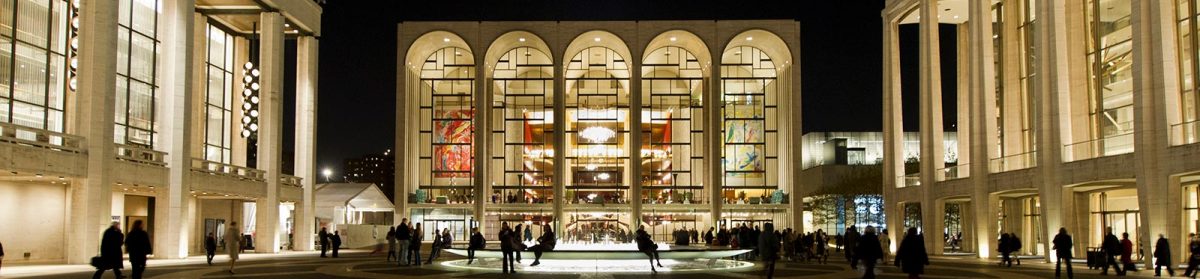
In this 11th year, over ten nights performances from the Met’s Live in HD series will be shown starting with a screening of FUNNY FACE in a special co-presentation with Film at Lincoln Center. Screenings run from August 23 through September 2. There will be 3000 seats in the Plaza in front of the Opera House with an additional standing room area. Cancellations due to thunder/lighting or high wind will not be rescheduled.

LE NOZZE DI FIGARO:Mozart
Original Air Date: 03/05/1977
Bedford; Morris, Blegen, Harper, Carlson, Ewing
SID.19370213
Morris was quite a decent Figaro, and Blegen and Ewing were solid Susanna and Cherubino. Harper is odd casting for a house accustomed to Steber, De Los Angeles, Della Casa, Lorengar Te Kanawa, and Fleming.
LE NOZZE DI FIGARO:Mozart
Original Air Date: 03/05/1977
Bedford; Morris, Blegen, Harper, Carlson, Ewing
SID.19370529
Morris was quite a decent Figaro, and Blegen and Ewing were solid Susanna and Cherubino. Harper is odd casting for a house accustomed to Steber, De Los Angeles, Della Casa, Lorengar Te Kanawa, and Fleming.

L’ELISIR D’AMORE:Donizetti
Rudolf; Pavarotti, Blegen, Flagello, Reardon
Original Air Date: 04/06/1974
MOD Audio
SID.19440104
“NY Post S Jenkins: In last night’s “”L’Elisir d’Amore”” the Metropolitan Opera pulled off the equivalent of a grand slam home run: a performance that must have delighted the tired businessman, satisfied the opera buff and absolutely satiated the voice lover. And all this wonder came from the musical and dramatic ability of the two leads: Judith Blegen and Luciano Pavarotti.
Gaetano Donizetti’s “”L’Elisir,”” though one of the most popular of Italian comic operas, does not play itself. To be successful, the principals must constantly work to make the audience see that these are real people caught in a comic situation.
Brilliantly crafted by Felice Romani, the librettist of “”Norma,”” “”L’Elisir’s”” book contains the classic tear through a smile: several moments when all the buffoonery is ripped away and the audience sees that Nemorino really loves Adina, and she returns his love.
Miss Blegen and Mr. Pavarotti never ceased to create their characters. Though they sang superlatively, their greatest triumph lay in their complete believability.
Pavarotti, now tipping the scales at around 300, moves on stage with the lightness of a man a quarter of his size, and his marvelously expressive face constantly emotes. Nemorino’s frustrations, his joy and his ultimate victory passed as a motion picture on the. tenor’s countenance.
And what do you say about Miss Blegen except that she is just about the prettiest girl to appear on the Met stage, ever. She also manages to be a coquette without ever once being overcute or too coy. The face, the figure, the attractiveness, how lucky is opera not to have lost her to Broadway!
Vocally, Pavarotti proved himself again the emperor of lyric tenors. Style, finesse, musical taste and a faultless vocal instrument all coalesced in his Nemorino. Some roles fit even a great voice better than others, and from first to last Nemorino is his property. In “”Una furtiva lagrima”” the sheen of his voice seemed to be encircled in a column of air, and his concluding high C in the “”Venti Scudi”” duet sang with ease.
Miss Blegen, whose tone is bright where a more Italianate soprano might be mellow, sang with such authority and finesse that she silenced any possible caviling. Her “”Prendi per me sei libero”” in the last scene, with its descending two-octave run from a high C, glistened as does dew on summer grass.
Mario Sereni contributed his familiar Belcore, one of the baritone’s best roles at the Met, and Ezio Flagello offered up his Dulcamara. Though he sings more of the role than some others who perform it, he has little humor in his voice or presence. It is a solid performance, but lacks the element that makes the old quack really lovable.
The greatest tributes to the brilliance of Miss Blegen, who learned her role in Italian in about 10 days, and Pavarotti were that they overcame the heavyhanded, rather Germanic but solid performance by Max Rudolf. A distinguished maestro with many great performances at the Met in the early Bing years, Rudolf was never known for his Donizetti.
And in almost every way, he seemed to try to knock the bubbles out of the singer’s champagne. With this cast he couldn’t, and there were no unhappy patrons visible.”
L’ELISIR D’AMORE:Donizetti
Rudolf; Pavarotti, Blegen, Flagello, Reardon
Original Air Date: 04/06/1974
MOD Audio
SID.19440320
“NY Post S Jenkins: In last night’s “”L’Elisir d’Amore”” the Metropolitan Opera pulled off the equivalent of a grand slam home run: a performance that must have delighted the tired businessman, satisfied the opera buff and absolutely satiated the voice lover. And all this wonder came from the musical and dramatic ability of the two leads: Judith Blegen and Luciano Pavarotti.
Gaetano Donizetti’s “”L’Elisir,”” though one of the most popular of Italian comic operas, does not play itself. To be successful, the principals must constantly work to make the audience see that these are real people caught in a comic situation.
Brilliantly crafted by Felice Romani, the librettist of “”Norma,”” “”L’Elisir’s”” book contains the classic tear through a smile: several moments when all the buffoonery is ripped away and the audience sees that Nemorino really loves Adina, and she returns his love.
Miss Blegen and Mr. Pavarotti never ceased to create their characters. Though they sang superlatively, their greatest triumph lay in their complete believability.
Pavarotti, now tipping the scales at around 300, moves on stage with the lightness of a man a quarter of his size, and his marvelously expressive face constantly emotes. Nemorino’s frustrations, his joy and his ultimate victory passed as a motion picture on the. tenor’s countenance.
And what do you say about Miss Blegen except that she is just about the prettiest girl to appear on the Met stage, ever. She also manages to be a coquette without ever once being overcute or too coy. The face, the figure, the attractiveness, how lucky is opera not to have lost her to Broadway!
Vocally, Pavarotti proved himself again the emperor of lyric tenors. Style, finesse, musical taste and a faultless vocal instrument all coalesced in his Nemorino. Some roles fit even a great voice better than others, and from first to last Nemorino is his property. In “”Una furtiva lagrima”” the sheen of his voice seemed to be encircled in a column of air, and his concluding high C in the “”Venti Scudi”” duet sang with ease.
Miss Blegen, whose tone is bright where a more Italianate soprano might be mellow, sang with such authority and finesse that she silenced any possible caviling. Her “”Prendi per me sei libero”” in the last scene, with its descending two-octave run from a high C, glistened as does dew on summer grass.
Mario Sereni contributed his familiar Belcore, one of the baritone’s best roles at the Met, and Ezio Flagello offered up his Dulcamara. Though he sings more of the role than some others who perform it, he has little humor in his voice or presence. It is a solid performance, but lacks the element that makes the old quack really lovable.
The greatest tributes to the brilliance of Miss Blegen, who learned her role in Italian in about 10 days, and Pavarotti were that they overcame the heavyhanded, rather Germanic but solid performance by Max Rudolf. A distinguished maestro with many great performances at the Met in the early Bing years, Rudolf was never known for his Donizetti.
And in almost every way, he seemed to try to knock the bubbles out of the singer’s champagne. With this cast he couldn’t, and there were no unhappy patrons visible.”
L’ELISIR D’AMORE:Donizetti
Rudolf; Pavarotti, Blegen, Flagello, Reardon
Original Air Date: 04/06/1974
MOD Audio
SID.19440530
“NY Post S Jenkins: In last night’s “”L’Elisir d’Amore”” the Metropolitan Opera pulled off the equivalent of a grand slam home run: a performance that must have delighted the tired businessman, satisfied the opera buff and absolutely satiated the voice lover. And all this wonder came from the musical and dramatic ability of the two leads: Judith Blegen and Luciano Pavarotti.
Gaetano Donizetti’s “”L’Elisir,”” though one of the most popular of Italian comic operas, does not play itself. To be successful, the principals must constantly work to make the audience see that these are real people caught in a comic situation.
Brilliantly crafted by Felice Romani, the librettist of “”Norma,”” “”L’Elisir’s”” book contains the classic tear through a smile: several moments when all the buffoonery is ripped away and the audience sees that Nemorino really loves Adina, and she returns his love.
Miss Blegen and Mr. Pavarotti never ceased to create their characters. Though they sang superlatively, their greatest triumph lay in their complete believability.
Pavarotti, now tipping the scales at around 300, moves on stage with the lightness of a man a quarter of his size, and his marvelously expressive face constantly emotes. Nemorino’s frustrations, his joy and his ultimate victory passed as a motion picture on the. tenor’s countenance.
And what do you say about Miss Blegen except that she is just about the prettiest girl to appear on the Met stage, ever. She also manages to be a coquette without ever once being overcute or too coy. The face, the figure, the attractiveness, how lucky is opera not to have lost her to Broadway!
Vocally, Pavarotti proved himself again the emperor of lyric tenors. Style, finesse, musical taste and a faultless vocal instrument all coalesced in his Nemorino. Some roles fit even a great voice better than others, and from first to last Nemorino is his property. In “”Una furtiva lagrima”” the sheen of his voice seemed to be encircled in a column of air, and his concluding high C in the “”Venti Scudi”” duet sang with ease.
Miss Blegen, whose tone is bright where a more Italianate soprano might be mellow, sang with such authority and finesse that she silenced any possible caviling. Her “”Prendi per me sei libero”” in the last scene, with its descending two-octave run from a high C, glistened as does dew on summer grass.
Mario Sereni contributed his familiar Belcore, one of the baritone’s best roles at the Met, and Ezio Flagello offered up his Dulcamara. Though he sings more of the role than some others who perform it, he has little humor in his voice or presence. It is a solid performance, but lacks the element that makes the old quack really lovable.
The greatest tributes to the brilliance of Miss Blegen, who learned her role in Italian in about 10 days, and Pavarotti were that they overcame the heavyhanded, rather Germanic but solid performance by Max Rudolf. A distinguished maestro with many great performances at the Met in the early Bing years, Rudolf was never known for his Donizetti.
And in almost every way, he seemed to try to knock the bubbles out of the singer’s champagne. With this cast he couldn’t, and there were no unhappy patrons visible.”
L’ELISIR D’AMORE:Donizetti
Rudolf; Pavarotti, Blegen, Flagello, Reardon
Original Air Date: 04/06/1974
MOD Audio
SID.19440640
“NY Post S Jenkins: In last night’s “”L’Elisir d’Amore”” the Metropolitan Opera pulled off the equivalent of a grand slam home run: a performance that must have delighted the tired businessman, satisfied the opera buff and absolutely satiated the voice lover. And all this wonder came from the musical and dramatic ability of the two leads: Judith Blegen and Luciano Pavarotti.
Gaetano Donizetti’s “”L’Elisir,”” though one of the most popular of Italian comic operas, does not play itself. To be successful, the principals must constantly work to make the audience see that these are real people caught in a comic situation.
Brilliantly crafted by Felice Romani, the librettist of “”Norma,”” “”L’Elisir’s”” book contains the classic tear through a smile: several moments when all the buffoonery is ripped away and the audience sees that Nemorino really loves Adina, and she returns his love.
Miss Blegen and Mr. Pavarotti never ceased to create their characters. Though they sang superlatively, their greatest triumph lay in their complete believability.
Pavarotti, now tipping the scales at around 300, moves on stage with the lightness of a man a quarter of his size, and his marvelously expressive face constantly emotes. Nemorino’s frustrations, his joy and his ultimate victory passed as a motion picture on the. tenor’s countenance.
And what do you say about Miss Blegen except that she is just about the prettiest girl to appear on the Met stage, ever. She also manages to be a coquette without ever once being overcute or too coy. The face, the figure, the attractiveness, how lucky is opera not to have lost her to Broadway!
Vocally, Pavarotti proved himself again the emperor of lyric tenors. Style, finesse, musical taste and a faultless vocal instrument all coalesced in his Nemorino. Some roles fit even a great voice better than others, and from first to last Nemorino is his property. In “”Una furtiva lagrima”” the sheen of his voice seemed to be encircled in a column of air, and his concluding high C in the “”Venti Scudi”” duet sang with ease.
Miss Blegen, whose tone is bright where a more Italianate soprano might be mellow, sang with such authority and finesse that she silenced any possible caviling. Her “”Prendi per me sei libero”” in the last scene, with its descending two-octave run from a high C, glistened as does dew on summer grass.
Mario Sereni contributed his familiar Belcore, one of the baritone’s best roles at the Met, and Ezio Flagello offered up his Dulcamara. Though he sings more of the role than some others who perform it, he has little humor in his voice or presence. It is a solid performance, but lacks the element that makes the old quack really lovable.
The greatest tributes to the brilliance of Miss Blegen, who learned her role in Italian in about 10 days, and Pavarotti were that they overcame the heavyhanded, rather Germanic but solid performance by Max Rudolf. A distinguished maestro with many great performances at the Met in the early Bing years, Rudolf was never known for his Donizetti.
And in almost every way, he seemed to try to knock the bubbles out of the singer’s champagne. With this cast he couldn’t, and there were no unhappy patrons visible.”

FALSTAFF:Verdi
Levine; Taddei, Neblett, Monk, Cossotto, Blegen, Ahlstedt
Original Air Date: 03/08/1986
MOD Audio
SID.20050316
Its particularly good to have this performance back on the radio. Taddei and Cossotto make a most interesting pair, and I’m sorry she did not do more of the part. I don’t have strong memories of Neblett and Monk. Taddei who came very late to the Met did this run of Falstaff followed by a run in L’elisir which was broadcast and has been on Sirius. If they run that performance again I will check it out. Taddei’s actual Met farewell is as Dulcamara in Met in the Pennsauken Cooper River Park in New Jersey with Hong as his Adina. Taddei appeared as both Scarpia and Rigoletto in Philadelphia (both with Tucker) and I also saw his Leporello in Dallas (with Sutherland and the EMI gang), Germont (with Callas) and much later Leporello again in San Francisco with Siepi. The Met was not starving for good baritones in those days, so we got too little of him and very late. He has a nice non-Met legacy of studio and live performances. He died at 93 June 2, 2010.
FALSTAFF:Verdi
Levine; Taddei, Neblett, Monk, Cossotto, Blegen, Ahlstedt
Original Air Date: 03/08/1986
MOD Audio
SID.20050636
Its particularly good to have this performance back on the radio. Taddei and Cossotto make a most interesting pair, and I’m sorry she did not do more of the part. I don’t have strong memories of Neblett and Monk. Taddei who came very late to the Met did this run of Falstaff followed by a run in L’elisir which was broadcast and has been on Sirius. If they run that performance again I will check it out. Taddei’s actual Met farewell is as Dulcamara in Met in the Pennsauken Cooper River Park in New Jersey with Hong as his Adina. Taddei appeared as both Scarpia and Rigoletto in Philadelphia (both with Tucker) and I also saw his Leporello in Dallas (with Sutherland and the EMI gang), Germont (with Callas) and much later Leporello again in San Francisco with Siepi. The Met was not starving for good baritones in those days, so we got too little of him and very late. He has a nice non-Met legacy of studio and live performances. He died at 93 June 2, 2010.

DIE ENTFÜHRUNG AUS DEM SERAIL:Mozart
Rudel; Malfitano, Araiza, Korn, Blegen, Creech
Original Air Date: 03/31/1984
SID.20100104
Malfitano sings well if not finally in the commanding manner the music requires and so rarely gets. Korn is pretty weak tea after Moll’s unbeatable Osmin that had premiered the production. Araiza is an interesting figure. Moving on to Walther in Meistersinger was a mistake. Karajan picked him for his Tamino, this was his Met debut season.
DIE ENTFÜHRUNG AUS DEM SERAIL:Mozart
Rudel; Malfitano, Araiza, Korn, Blegen, Creech
Original Air Date: 03/31/1984
SID.20100321
Malfitano sings well if not finally in the commanding manner the music requires and so rarely gets. Korn is pretty weak tea after Moll’s unbeatable Osmin that had premiered the production. Araiza is an interesting figure. Moving on to Walther in Meistersinger was a mistake. Karajan picked him for his Tamino, this was his Met debut season.
DIE ENTFÜHRUNG AUS DEM SERAIL:Mozart
Rudel; Malfitano, Araiza, Korn, Blegen, Creech
Original Air Date: 03/31/1984
SID.20100637
Malfitano sings well if not finally in the commanding manner the music requires and so rarely gets. Korn is pretty weak tea after Moll’s unbeatable Osmin that had premiered the production. Araiza is an interesting figure. Moving on to Walther in Meistersinger was a mistake. Karajan picked him for his Tamino, this was his Met debut season.

RIGOLETTO:Verdi
Stivender; MacNeil, Blegen, Alexander, Hines, Jones
Original Air Date: 03/03/1979
SID.20110106
This is MacNeil’s final Met broadcast of the title role– he has the house record at 102 (5 broadcasts); Sirius should roll out MacNeil’s first Rigoletto broadcast from 1960, when he is really in super-baritone form or even 1964 with Bergonzi’s first Duke broadcast. Blegen is tied for fourth after Peters (88!!!!!! one for every piano key), Pons, and Swenson who are tied for second. Blegen’s earlier broadcast is on Met Opera on Demand (MOoD) and she is one of my favorite Gildas. Alexander is a dependable Duke, but he has some stiff competition . He was a fine musician, marvelous colleague, and sustained among the most-wide ranging Met repertoire (and without need of transpositions). A very favored colleague of Sutherland, Caballe, Sills, and Levine.
RIGOLETTO:Verdi
Stivender; MacNeil, Blegen, Alexander, Hines, Jones
Original Air Date: 03/03/1979
SID.20110317
This is MacNeil’s final Met broadcast of the title role– he has the house record at 102 (5 broadcasts); Sirius should roll out MacNeil’s first Rigoletto broadcast from 1960, when he is really in super-baritone form or even 1964 with Bergonzi’s first Duke broadcast. Blegen is tied for fourth after Peters (88!!!!!! one for every piano key), Pons, and Swenson who are tied for second. Blegen’s earlier broadcast is on Met Opera on Demand (MOoD) and she is one of my favorite Gildas. Alexander is a dependable Duke, but he has some stiff competition . He was a fine musician, marvelous colleague, and sustained among the most-wide ranging Met repertoire (and without need of transpositions). A very favored colleague of Sutherland, Caballe, Sills, and Levine.
RIGOLETTO:Verdi
Stivender; MacNeil, Blegen, Alexander, Hines, Jones
Original Air Date: 03/03/1979
SID.20110533
This is MacNeil’s final Met broadcast of the title role– he has the house record at 102 (5 broadcasts); Sirius should roll out MacNeil’s first Rigoletto broadcast from 1960, when he is really in super-baritone form or even 1964 with Bergonzi’s first Duke broadcast. Blegen is tied for fourth after Peters (88!!!!!! one for every piano key), Pons, and Swenson who are tied for second. Blegen’s earlier broadcast is on Met Opera on Demand (MOoD) and she is one of my favorite Gildas. Alexander is a dependable Duke, but he has some stiff competition . He was a fine musician, marvelous colleague, and sustained among the most-wide ranging Met repertoire (and without need of transpositions). A very favored colleague of Sutherland, Caballe, Sills, and Levine.
RIGOLETTO:Verdi
Stivender; MacNeil, Blegen, Alexander, Hines, Jones
Original Air Date: 03/03/1979
SID.20120101
This is MacNeil’s final Met broadcast of the title role– he has the house record at 102 (5 broadcasts); Sirius should roll out MacNeil’s first Rigoletto broadcast from 1960, when he is really in super-baritone form or even 1964 with Bergonzi’s first Duke broadcast. Blegen is tied for fourth after Peters (88!!!!!! one for every piano key), Pons, and Swenson who are tied for second. Blegen’s earlier broadcast is on Met Opera on Demand (MOoD) and she is one of my favorite Gildas. Alexander is a dependable Duke, but he has some stiff competition . He was a fine musician, marvelous colleague, and sustained among the most-wide ranging Met repertoire (and without need of transpositions). A very favored colleague of Sutherland, Caballe, Sills, and Levine.

FIDELIO:Beethoven
Haitink; Meier, Sooter, Roar, Macurdy, Blegen, Atherton
Original Air Date: 04/10/1982
SID.20150208
This is Haitink’s only Met season, and Meier is pinch-hitting for Verrett who was sick for two other performances (also sung by Johanna Meier) in the run as well. Hard to believe the original casting for Florestan was Sooter, but in any event he gets a fine review from Harriet Johnson of the NY Post. To my knowledge, Verrett’s 3 performances are her only times in the part.
FIDELIO:Beethoven
Haitink; Meier, Sooter, Roar, Macurdy, Blegen, Atherton
Original Air Date: 04/10/1982
SID.20150319
This is Haitink’s only Met season, and Meier is pinch-hitting for Verrett who was sick for two other performances (also sung by Johanna Meier) in the run as well. Hard to believe the original casting for Florestan was Sooter, but in any event he gets a fine review from Harriet Johnson of the NY Post. To my knowledge, Verrett’s 3 performances are her only times in the part.
FIDELIO:Beethoven
Haitink; Meier, Sooter, Roar, Macurdy, Blegen, Atherton
Original Air Date: 04/10/1982
SID.20150537
This is Haitink’s only Met season, and Meier is pinch-hitting for Verrett who was sick for two other performances (also sung by Johanna Meier) in the run as well. Hard to believe the original casting for Florestan was Sooter, but in any event he gets a fine review from Harriet Johnson of the NY Post. To my knowledge, Verrett’s 3 performances are her only times in the part.
FIDELIO:Beethoven
Haitink; Meier, Sooter, Roar, Macurdy, Blegen, Atherton
Original Air Date: 04/10/1982
SID.20150648
This is Haitink’s only Met season, and Meier is pinch-hitting for Verrett who was sick for two other performances (also sung by Johanna Meier) in the run as well. Hard to believe the original casting for Florestan was Sooter, but in any event he gets a fine review from Harriet Johnson of the NY Post. To my knowledge, Verrett’s 3 performances are her only times in the part.

ROMÉO ET JULIETTE:Gounod
Lewis; Corelli, Blegen, Gill, Munzer, Carlson
Original Air Date: 12/07/1974
SID.20170317
This performance does not catch Corelli at his best. This is his final season and he completes his Met broadcast career 2 weeks later with a Turandot (and Bjoner’s final met appearance). For a man with almost 400 Met performances, he is richly represented in the broadcast archives. Better to listen to the Trovatore or Turandot in 1961 (a month apart!!!) or the AIda or Tosca from 1962 (also a month apart) or many others. Blegen is OK, but would be better paired with a different Romeo. This performance is on MOoD as well, and Blegen is very good. This is towards the end of the Corelli era (his next to last broadcast) and a close examination of his work is not always satisfying. This is Corelli’s penultimate Met broadcast, with Turandot occurring three weeks later (also Bjoner’s farewell to the Met in that performance). Corelli is second only to de Rezke in Romeo totals at the Met with his 36 performances. When paired with Freni as they were for the production’s premiere in 1967, one does not worry quite so much about the mostly absent French style. Freni had Gedda as her partner for the first broadcast of this production, then Corelli comes back for the next with Pilou as his partner and Lombard in the pit. Corelli has a second broadcast with Boky that finds neither of them in best voice. Blegen is a fine Juliette with him on the third, but the weak link for me this time is the conductor, Henry Lewis, who is no better than the weaker members of the Met’s Asst. Conductor staff. You can hear for yourself on MOoD.
ROMÉO ET JULIETTE:Gounod
Lewis; Corelli, Blegen, Gill, Munzer, Carlson
Original Air Date: 12/07/1974
SID.20170535
This performance does not catch Corelli at his best. This is his final season and he completes his Met broadcast career 2 weeks later with a Turandot (and Bjoner’s final met appearance). For a man with almost 400 Met performances, he is richly represented in the broadcast archives. Better to listen to the Trovatore or Turandot in 1961 (a month apart!!!) or the AIda or Tosca from 1962 (also a month apart) or many others. Blegen is OK, but would be better paired with a different Romeo. This performance is on MOoD as well, and Blegen is very good. This is towards the end of the Corelli era (his next to last broadcast) and a close examination of his work is not always satisfying. This is Corelli’s penultimate Met broadcast, with Turandot occurring three weeks later (also Bjoner’s farewell to the Met in that performance). Corelli is second only to de Rezke in Romeo totals at the Met with his 36 performances. When paired with Freni as they were for the production’s premiere in 1967, one does not worry quite so much about the mostly absent French style. Freni had Gedda as her partner for the first broadcast of this production, then Corelli comes back for the next with Pilou as his partner and Lombard in the pit. Corelli has a second broadcast with Boky that finds neither of them in best voice. Blegen is a fine Juliette with him on the third, but the weak link for me this time is the conductor, Henry Lewis, who is no better than the weaker members of the Met’s Asst. Conductor staff. You can hear for yourself on MOoD.
ROMÉO ET JULIETTE:Gounod
Lewis; Corelli, Blegen, Gill, Munzer, Carlson
Original Air Date: 12/07/1974
SID.20170753
This performance does not catch Corelli at his best. This is his final season and he completes his Met broadcast career 2 weeks later with a Turandot (and Bjoner’s final met appearance). For a man with almost 400 Met performances, he is richly represented in the broadcast archives. Better to listen to the Trovatore or Turandot in 1961 (a month apart!!!) or the AIda or Tosca from 1962 (also a month apart) or many others. Blegen is OK, but would be better paired with a different Romeo. This performance is on MOoD as well, and Blegen is very good. This is towards the end of the Corelli era (his next to last broadcast) and a close examination of his work is not always satisfying. This is Corelli’s penultimate Met broadcast, with Turandot occurring three weeks later (also Bjoner’s farewell to the Met in that performance). Corelli is second only to de Rezke in Romeo totals at the Met with his 36 performances. When paired with Freni as they were for the production’s premiere in 1967, one does not worry quite so much about the mostly absent French style. Freni had Gedda as her partner for the first broadcast of this production, then Corelli comes back for the next with Pilou as his partner and Lombard in the pit. Corelli has a second broadcast with Boky that finds neither of them in best voice. Blegen is a fine Juliette with him on the third, but the weak link for me this time is the conductor, Henry Lewis, who is no better than the weaker members of the Met’s Asst. Conductor staff. You can hear for yourself on MOoD.