
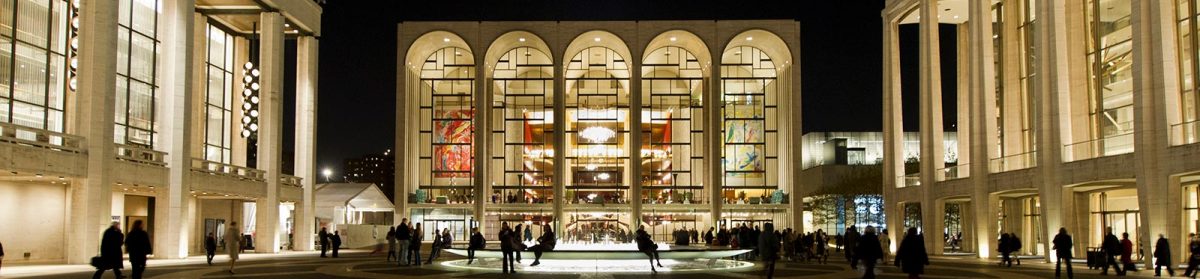
In this 11th year, over ten nights performances from the Met’s Live in HD series will be shown starting with a screening of FUNNY FACE in a special co-presentation with Film at Lincoln Center. Screenings run from August 23 through September 2. There will be 3000 seats in the Plaza in front of the Opera House with an additional standing room area. Cancellations due to thunder/lighting or high wind will not be rescheduled.

DIE MEISTERSINGER VON NÜRNBERG:Wagner
Schippers; Adam, Lorengar, King, Kusche, Flagello, Driscoll
Original Air Date: 01/15/1972
MOD Audio
SID.19400105
This performance is on Sony’s Met historical CD series Lorengar and King, who do not have commercials of their portrayals are fine exponents of their roles, and Kusche is a long respected Beckmesser. Adam split the Sachs with Tozzi, and at this point Adam was probably the better choice.
DIE MEISTERSINGER VON NÜRNBERG:Wagner
Schippers; Adam, Lorengar, King, Kusche, Flagello, Driscoll
Original Air Date: 01/15/1972
MOD Audio
SID.19400316
This performance is on Sony’s Met historical CD series Lorengar and King, who do not have commercials of their portrayals are fine exponents of their roles, and Kusche is a long respected Beckmesser. Adam split the Sachs with Tozzi, and at this point Adam was probably the better choice.
DIE MEISTERSINGER VON NÜRNBERG:Wagner
Schippers; Adam, Lorengar, King, Kusche, Flagello, Driscoll
Original Air Date: 01/15/1972
MOD Audio
SID.SID.19400747
This performance is on Sony’s Met historical CD series Lorengar and King, who do not have commercials of their portrayals are fine exponents of their roles, and Kusche is a long respected Beckmesser. Adam split the Sachs with Tozzi, and at this point Adam was probably the better choice.
DIE MEISTERSINGER VON NÜRNBERG:Wagner
Schippers; Adam, Lorengar, King, Kusche, Flagello, Driscoll
Original Air Date: 01/15/1972
MOD Audio
SID.19410101
This performance is on Sony’s Met historical CD series Lorengar and King, who do not have commercials of their portrayals are fine exponents of their roles, and Kusche is a long respected Beckmesser. Adam split the Sachs with Tozzi, and at this point Adam was probably the better choice.

L’ELISIR D’AMORE:Donizetti
Rudolf; Pavarotti, Blegen, Flagello, Reardon
Original Air Date: 04/06/1974
MOD Audio
SID.19440104
“NY Post S Jenkins: In last night’s “”L’Elisir d’Amore”” the Metropolitan Opera pulled off the equivalent of a grand slam home run: a performance that must have delighted the tired businessman, satisfied the opera buff and absolutely satiated the voice lover. And all this wonder came from the musical and dramatic ability of the two leads: Judith Blegen and Luciano Pavarotti.
Gaetano Donizetti’s “”L’Elisir,”” though one of the most popular of Italian comic operas, does not play itself. To be successful, the principals must constantly work to make the audience see that these are real people caught in a comic situation.
Brilliantly crafted by Felice Romani, the librettist of “”Norma,”” “”L’Elisir’s”” book contains the classic tear through a smile: several moments when all the buffoonery is ripped away and the audience sees that Nemorino really loves Adina, and she returns his love.
Miss Blegen and Mr. Pavarotti never ceased to create their characters. Though they sang superlatively, their greatest triumph lay in their complete believability.
Pavarotti, now tipping the scales at around 300, moves on stage with the lightness of a man a quarter of his size, and his marvelously expressive face constantly emotes. Nemorino’s frustrations, his joy and his ultimate victory passed as a motion picture on the. tenor’s countenance.
And what do you say about Miss Blegen except that she is just about the prettiest girl to appear on the Met stage, ever. She also manages to be a coquette without ever once being overcute or too coy. The face, the figure, the attractiveness, how lucky is opera not to have lost her to Broadway!
Vocally, Pavarotti proved himself again the emperor of lyric tenors. Style, finesse, musical taste and a faultless vocal instrument all coalesced in his Nemorino. Some roles fit even a great voice better than others, and from first to last Nemorino is his property. In “”Una furtiva lagrima”” the sheen of his voice seemed to be encircled in a column of air, and his concluding high C in the “”Venti Scudi”” duet sang with ease.
Miss Blegen, whose tone is bright where a more Italianate soprano might be mellow, sang with such authority and finesse that she silenced any possible caviling. Her “”Prendi per me sei libero”” in the last scene, with its descending two-octave run from a high C, glistened as does dew on summer grass.
Mario Sereni contributed his familiar Belcore, one of the baritone’s best roles at the Met, and Ezio Flagello offered up his Dulcamara. Though he sings more of the role than some others who perform it, he has little humor in his voice or presence. It is a solid performance, but lacks the element that makes the old quack really lovable.
The greatest tributes to the brilliance of Miss Blegen, who learned her role in Italian in about 10 days, and Pavarotti were that they overcame the heavyhanded, rather Germanic but solid performance by Max Rudolf. A distinguished maestro with many great performances at the Met in the early Bing years, Rudolf was never known for his Donizetti.
And in almost every way, he seemed to try to knock the bubbles out of the singer’s champagne. With this cast he couldn’t, and there were no unhappy patrons visible.”

AIDA:Verdi
Cleva; Arroyo, McCracken, Bumbry, Colzani, Flagello
Original Air Date: 12/26/1970
SID.19440107
NYT Ericson [1/18/70]: In the title role, Martina Ar royo poured out her beautiful tones effortlessly. She was able to ride the climaxes of the Triumphal scene as well as to make the soft high arches of sound in “O patria mia.” Rich ard Tucker’s Radames was virile in sound and incisive in phrasing, although the tenor does not have the exceptional breath control he once had. Cornell MacNeil’s baritone, large and resonant, proved forceful in Amonasro’s music. Irene Dalis’s voice, ringing at the top but rather dry in the middle register effectively used in Amneris’s big scene in the last act. The two basses, Ezio Flagello as Ramfis and Paul Plishka as the King, sang handsomely. Even the brief contributions of Rod Mac Wherter as the Messenger and Margaret Kalil as the Priestess sounded fine. Fausto Cleva’s conducting insured a controlled, well coordinated musical perform ance. This was, probably, the the measure of the evening— solid excellence, but nothing to stir the listener’s blood.

DON GIOVANNI:Mozart
Böhm; London, Steber, Flagello, Della Casa, Valletti, Hurley
Original Air Date: 02/14/1959
MOD Audio
SID.19440213
SR: This broadcast is especially notable as it was George London’s only broadcast outing as the Don. His Don was very different from Siepi’s, but just as impressive a portrayal. We also enjoy the two Donna’s..sung by Steber and Della Casa, Ezio Flagello’s Leporello (often overshadowed by Corena’s more broadly comic portrayal) and the sweet tenor of Cesare Valletti. Dr. Karl Böhm leads a to-the-Viennese-manner-born performance. RWW: This is a fine performance; my only cavil is I would have preferred a Siepi broadcast which is available (though not yet on Sirius) from 1957 with the original cast which includes Corena as Leporello. Still, this is one of Steber’s best parts in a treasurable performance and Della Casa is a major Elvira. Flagello is an excellent Leporello. And while I am mentioning lacunae. Bohm’s 1967 broadcast with Sutherland and Lorengar also with Siepi is still missing from the Sirius broadcast stable as well.
AIDA:Verdi
Cleva; Arroyo, McCracken, Bumbry, Colzani, Flagello
Original Air Date: 12/26/1970
SID.19440317
NYT Ericson [1/18/70]: In the title role, Martina Ar royo poured out her beautiful tones effortlessly. She was able to ride the climaxes of the Triumphal scene as well as to make the soft high arches of sound in “O patria mia.” Rich ard Tucker’s Radames was virile in sound and incisive in phrasing, although the tenor does not have the exceptional breath control he once had. Cornell MacNeil’s baritone, large and resonant, proved forceful in Amonasro’s music. Irene Dalis’s voice, ringing at the top but rather dry in the middle register effectively used in Amneris’s big scene in the last act. The two basses, Ezio Flagello as Ramfis and Paul Plishka as the King, sang handsomely. Even the brief contributions of Rod Mac Wherter as the Messenger and Margaret Kalil as the Priestess sounded fine. Fausto Cleva’s conducting insured a controlled, well coordinated musical perform ance. This was, probably, the the measure of the evening— solid excellence, but nothing to stir the listener’s blood.
L’ELISIR D’AMORE:Donizetti
Rudolf; Pavarotti, Blegen, Flagello, Reardon
Original Air Date: 04/06/1974
MOD Audio
SID.19440320
“NY Post S Jenkins: In last night’s “”L’Elisir d’Amore”” the Metropolitan Opera pulled off the equivalent of a grand slam home run: a performance that must have delighted the tired businessman, satisfied the opera buff and absolutely satiated the voice lover. And all this wonder came from the musical and dramatic ability of the two leads: Judith Blegen and Luciano Pavarotti.
Gaetano Donizetti’s “”L’Elisir,”” though one of the most popular of Italian comic operas, does not play itself. To be successful, the principals must constantly work to make the audience see that these are real people caught in a comic situation.
Brilliantly crafted by Felice Romani, the librettist of “”Norma,”” “”L’Elisir’s”” book contains the classic tear through a smile: several moments when all the buffoonery is ripped away and the audience sees that Nemorino really loves Adina, and she returns his love.
Miss Blegen and Mr. Pavarotti never ceased to create their characters. Though they sang superlatively, their greatest triumph lay in their complete believability.
Pavarotti, now tipping the scales at around 300, moves on stage with the lightness of a man a quarter of his size, and his marvelously expressive face constantly emotes. Nemorino’s frustrations, his joy and his ultimate victory passed as a motion picture on the. tenor’s countenance.
And what do you say about Miss Blegen except that she is just about the prettiest girl to appear on the Met stage, ever. She also manages to be a coquette without ever once being overcute or too coy. The face, the figure, the attractiveness, how lucky is opera not to have lost her to Broadway!
Vocally, Pavarotti proved himself again the emperor of lyric tenors. Style, finesse, musical taste and a faultless vocal instrument all coalesced in his Nemorino. Some roles fit even a great voice better than others, and from first to last Nemorino is his property. In “”Una furtiva lagrima”” the sheen of his voice seemed to be encircled in a column of air, and his concluding high C in the “”Venti Scudi”” duet sang with ease.
Miss Blegen, whose tone is bright where a more Italianate soprano might be mellow, sang with such authority and finesse that she silenced any possible caviling. Her “”Prendi per me sei libero”” in the last scene, with its descending two-octave run from a high C, glistened as does dew on summer grass.
Mario Sereni contributed his familiar Belcore, one of the baritone’s best roles at the Met, and Ezio Flagello offered up his Dulcamara. Though he sings more of the role than some others who perform it, he has little humor in his voice or presence. It is a solid performance, but lacks the element that makes the old quack really lovable.
The greatest tributes to the brilliance of Miss Blegen, who learned her role in Italian in about 10 days, and Pavarotti were that they overcame the heavyhanded, rather Germanic but solid performance by Max Rudolf. A distinguished maestro with many great performances at the Met in the early Bing years, Rudolf was never known for his Donizetti.
And in almost every way, he seemed to try to knock the bubbles out of the singer’s champagne. With this cast he couldn’t, and there were no unhappy patrons visible.”
DON GIOVANNI:Mozart
Böhm; London, Steber, Flagello, Della Casa, Valletti, Hurley
Original Air Date: 02/14/1959
MOD Audio
SID.19440529
SR: This broadcast is especially notable as it was George London’s only broadcast outing as the Don. His Don was very different from Siepi’s, but just as impressive a portrayal. We also enjoy the two Donna’s..sung by Steber and Della Casa, Ezio Flagello’s Leporello (often overshadowed by Corena’s more broadly comic portrayal) and the sweet tenor of Cesare Valletti. Dr. Karl Böhm leads a to-the-Viennese-manner-born performance. RWW: This is a fine performance; my only cavil is I would have preferred a Siepi broadcast which is available (though not yet on Sirius) from 1957 with the original cast which includes Corena as Leporello. Still, this is one of Steber’s best parts in a treasurable performance and Della Casa is a major Elvira. Flagello is an excellent Leporello. And while I am mentioning lacunae. Bohm’s 1967 broadcast with Sutherland and Lorengar also with Siepi is still missing from the Sirius broadcast stable as well.
L’ELISIR D’AMORE:Donizetti
Rudolf; Pavarotti, Blegen, Flagello, Reardon
Original Air Date: 04/06/1974
MOD Audio
SID.19440530
“NY Post S Jenkins: In last night’s “”L’Elisir d’Amore”” the Metropolitan Opera pulled off the equivalent of a grand slam home run: a performance that must have delighted the tired businessman, satisfied the opera buff and absolutely satiated the voice lover. And all this wonder came from the musical and dramatic ability of the two leads: Judith Blegen and Luciano Pavarotti.
Gaetano Donizetti’s “”L’Elisir,”” though one of the most popular of Italian comic operas, does not play itself. To be successful, the principals must constantly work to make the audience see that these are real people caught in a comic situation.
Brilliantly crafted by Felice Romani, the librettist of “”Norma,”” “”L’Elisir’s”” book contains the classic tear through a smile: several moments when all the buffoonery is ripped away and the audience sees that Nemorino really loves Adina, and she returns his love.
Miss Blegen and Mr. Pavarotti never ceased to create their characters. Though they sang superlatively, their greatest triumph lay in their complete believability.
Pavarotti, now tipping the scales at around 300, moves on stage with the lightness of a man a quarter of his size, and his marvelously expressive face constantly emotes. Nemorino’s frustrations, his joy and his ultimate victory passed as a motion picture on the. tenor’s countenance.
And what do you say about Miss Blegen except that she is just about the prettiest girl to appear on the Met stage, ever. She also manages to be a coquette without ever once being overcute or too coy. The face, the figure, the attractiveness, how lucky is opera not to have lost her to Broadway!
Vocally, Pavarotti proved himself again the emperor of lyric tenors. Style, finesse, musical taste and a faultless vocal instrument all coalesced in his Nemorino. Some roles fit even a great voice better than others, and from first to last Nemorino is his property. In “”Una furtiva lagrima”” the sheen of his voice seemed to be encircled in a column of air, and his concluding high C in the “”Venti Scudi”” duet sang with ease.
Miss Blegen, whose tone is bright where a more Italianate soprano might be mellow, sang with such authority and finesse that she silenced any possible caviling. Her “”Prendi per me sei libero”” in the last scene, with its descending two-octave run from a high C, glistened as does dew on summer grass.
Mario Sereni contributed his familiar Belcore, one of the baritone’s best roles at the Met, and Ezio Flagello offered up his Dulcamara. Though he sings more of the role than some others who perform it, he has little humor in his voice or presence. It is a solid performance, but lacks the element that makes the old quack really lovable.
The greatest tributes to the brilliance of Miss Blegen, who learned her role in Italian in about 10 days, and Pavarotti were that they overcame the heavyhanded, rather Germanic but solid performance by Max Rudolf. A distinguished maestro with many great performances at the Met in the early Bing years, Rudolf was never known for his Donizetti.
And in almost every way, he seemed to try to knock the bubbles out of the singer’s champagne. With this cast he couldn’t, and there were no unhappy patrons visible.”
AIDA:Verdi
Cleva; Arroyo, McCracken, Bumbry, Colzani, Flagello
Original Air Date: 12/26/1970
SID.19440533
NYT Ericson [1/18/70]: In the title role, Martina Ar royo poured out her beautiful tones effortlessly. She was able to ride the climaxes of the Triumphal scene as well as to make the soft high arches of sound in “O patria mia.” Rich ard Tucker’s Radames was virile in sound and incisive in phrasing, although the tenor does not have the exceptional breath control he once had. Cornell MacNeil’s baritone, large and resonant, proved forceful in Amonasro’s music. Irene Dalis’s voice, ringing at the top but rather dry in the middle register effectively used in Amneris’s big scene in the last act. The two basses, Ezio Flagello as Ramfis and Paul Plishka as the King, sang handsomely. Even the brief contributions of Rod Mac Wherter as the Messenger and Margaret Kalil as the Priestess sounded fine. Fausto Cleva’s conducting insured a controlled, well coordinated musical perform ance. This was, probably, the the measure of the evening— solid excellence, but nothing to stir the listener’s blood.
L’ELISIR D’AMORE:Donizetti
Rudolf; Pavarotti, Blegen, Flagello, Reardon
Original Air Date: 04/06/1974
MOD Audio
SID.19440640
“NY Post S Jenkins: In last night’s “”L’Elisir d’Amore”” the Metropolitan Opera pulled off the equivalent of a grand slam home run: a performance that must have delighted the tired businessman, satisfied the opera buff and absolutely satiated the voice lover. And all this wonder came from the musical and dramatic ability of the two leads: Judith Blegen and Luciano Pavarotti.
Gaetano Donizetti’s “”L’Elisir,”” though one of the most popular of Italian comic operas, does not play itself. To be successful, the principals must constantly work to make the audience see that these are real people caught in a comic situation.
Brilliantly crafted by Felice Romani, the librettist of “”Norma,”” “”L’Elisir’s”” book contains the classic tear through a smile: several moments when all the buffoonery is ripped away and the audience sees that Nemorino really loves Adina, and she returns his love.
Miss Blegen and Mr. Pavarotti never ceased to create their characters. Though they sang superlatively, their greatest triumph lay in their complete believability.
Pavarotti, now tipping the scales at around 300, moves on stage with the lightness of a man a quarter of his size, and his marvelously expressive face constantly emotes. Nemorino’s frustrations, his joy and his ultimate victory passed as a motion picture on the. tenor’s countenance.
And what do you say about Miss Blegen except that she is just about the prettiest girl to appear on the Met stage, ever. She also manages to be a coquette without ever once being overcute or too coy. The face, the figure, the attractiveness, how lucky is opera not to have lost her to Broadway!
Vocally, Pavarotti proved himself again the emperor of lyric tenors. Style, finesse, musical taste and a faultless vocal instrument all coalesced in his Nemorino. Some roles fit even a great voice better than others, and from first to last Nemorino is his property. In “”Una furtiva lagrima”” the sheen of his voice seemed to be encircled in a column of air, and his concluding high C in the “”Venti Scudi”” duet sang with ease.
Miss Blegen, whose tone is bright where a more Italianate soprano might be mellow, sang with such authority and finesse that she silenced any possible caviling. Her “”Prendi per me sei libero”” in the last scene, with its descending two-octave run from a high C, glistened as does dew on summer grass.
Mario Sereni contributed his familiar Belcore, one of the baritone’s best roles at the Met, and Ezio Flagello offered up his Dulcamara. Though he sings more of the role than some others who perform it, he has little humor in his voice or presence. It is a solid performance, but lacks the element that makes the old quack really lovable.
The greatest tributes to the brilliance of Miss Blegen, who learned her role in Italian in about 10 days, and Pavarotti were that they overcame the heavyhanded, rather Germanic but solid performance by Max Rudolf. A distinguished maestro with many great performances at the Met in the early Bing years, Rudolf was never known for his Donizetti.
And in almost every way, he seemed to try to knock the bubbles out of the singer’s champagne. With this cast he couldn’t, and there were no unhappy patrons visible.”
DON GIOVANNI:Mozart
Böhm; London, Steber, Flagello, Della Casa, Valletti, Hurley
Original Air Date: 02/14/1959
MOD Audio
SID.19440743
SR: This broadcast is especially notable as it was George London’s only broadcast outing as the Don. His Don was very different from Siepi’s, but just as impressive a portrayal. We also enjoy the two Donna’s..sung by Steber and Della Casa, Ezio Flagello’s Leporello (often overshadowed by Corena’s more broadly comic portrayal) and the sweet tenor of Cesare Valletti. Dr. Karl Böhm leads a to-the-Viennese-manner-born performance. RWW: This is a fine performance; my only cavil is I would have preferred a Siepi broadcast which is available (though not yet on Sirius) from 1957 with the original cast which includes Corena as Leporello. Still, this is one of Steber’s best parts in a treasurable performance and Della Casa is a major Elvira. Flagello is an excellent Leporello. And while I am mentioning lacunae. Bohm’s 1967 broadcast with Sutherland and Lorengar also with Siepi is still missing from the Sirius broadcast stable as well.

ANTONY AND CLEOPATRA:Barber
Schippers; Díaz, Price, Thomas, Flagello, Elias
Original Air Date: 09/16/1966
MOD Audio
SID.20080107
This is the opening of the new Met at Lincoln Center and the world premiere of the opera. Leontyne never sang better than this night, and luckily it is well preserved for all to hear. Lady Bird Johnson and Imelda Marcos were among the dignitaries that night. From MOD: Expectations were high when the Metropolitan Opera announced that the world premiere of Samuel Barber’s Antony and Cleopatra would christen its new house at Lincoln Center in the fall of 1966—a suitably grand work based on Shakespeare’s tragedy and written specifically for Leontyne Price as Cleopatra. A singer himself, the composer knew Price’s voice and what it could do, shaping his conception of the opera’s heroine around this iconic American diva. The 26-year-old Puerto Rican–born bass Justino Díaz starred alongside Price as Antony while Ezio Flagello portrayed Antony’s friend Enobarbus. Tenor Jess Thomas brought his heroic presence to the role of Octavius Caesar, and the beloved mezzo-soprano Rosalind Elias, already a Met veteran in her 30s, sang the role of Cleopatra’s attendant Charmian. Thanks to a Texaco–Metropolitan Opera Radio Network broadcast from the opera’s world premiere, this indelible piece of Met history has been preserved for generations.
ANTONY AND CLEOPATRA:Barber
Schippers; Díaz, Price, Thomas, Flagello, Elias
Original Air Date: 09/16/1966
MOD Audio
SID.20080531
This is the opening of the new Met at Lincoln Center and the world premiere of the opera. Leontyne never sang better than this night, and luckily it is well preserved for all to hear. Lady Bird Johnson and Imelda Marcos were among the dignitaries that night. From MOD: Expectations were high when the Metropolitan Opera announced that the world premiere of Samuel Barber’s Antony and Cleopatra would christen its new house at Lincoln Center in the fall of 1966—a suitably grand work based on Shakespeare’s tragedy and written specifically for Leontyne Price as Cleopatra. A singer himself, the composer knew Price’s voice and what it could do, shaping his conception of the opera’s heroine around this iconic American diva. The 26-year-old Puerto Rican–born bass Justino Díaz starred alongside Price as Antony while Ezio Flagello portrayed Antony’s friend Enobarbus. Tenor Jess Thomas brought his heroic presence to the role of Octavius Caesar, and the beloved mezzo-soprano Rosalind Elias, already a Met veteran in her 30s, sang the role of Cleopatra’s attendant Charmian. Thanks to a Texaco–Metropolitan Opera Radio Network broadcast from the opera’s world premiere, this indelible piece of Met history has been preserved for generations.
ANTONY AND CLEOPATRA:Barber
Schippers; Díaz, Price, Thomas, Flagello, Elias
Original Air Date: 09/16/1966
MOD Audio
SID.20080746
This is the opening of the new Met at Lincoln Center and the world premiere of the opera. Leontyne never sang better than this night, and luckily it is well preserved for all to hear. Lady Bird Johnson and Imelda Marcos were among the dignitaries that night. From MOD: Expectations were high when the Metropolitan Opera announced that the world premiere of Samuel Barber’s Antony and Cleopatra would christen its new house at Lincoln Center in the fall of 1966—a suitably grand work based on Shakespeare’s tragedy and written specifically for Leontyne Price as Cleopatra. A singer himself, the composer knew Price’s voice and what it could do, shaping his conception of the opera’s heroine around this iconic American diva. The 26-year-old Puerto Rican–born bass Justino Díaz starred alongside Price as Antony while Ezio Flagello portrayed Antony’s friend Enobarbus. Tenor Jess Thomas brought his heroic presence to the role of Octavius Caesar, and the beloved mezzo-soprano Rosalind Elias, already a Met veteran in her 30s, sang the role of Cleopatra’s attendant Charmian. Thanks to a Texaco–Metropolitan Opera Radio Network broadcast from the opera’s world premiere, this indelible piece of Met history has been preserved for generations.

FALSTAFF:Verdi
Amaducci; Flagello, Curtin, Guarrera, Barbieri, Raskin, Alva
Original Air Date: 12/16/1967
MOD Audio
SID.20130106
RWW: Barbieri, Guarrera, and Alva are veterans of many Falstaffs, and Flagello features a lot of voice for a bass Falstaff. Amaducci, by memory, didn’t have much sparkle. High praise for Alva and Barbieri; she is a characterful Quickly, and he a perfect Fenton, but Amaducci is possibly the weakest Falstaff conductor in Met history(certainly on broadcasts). The 1964 Bernstein has never been on Sirius, and though the Met Database records the 1972 as having been on Sirius with Gobbi, Tebaldi, and Paskalis under von Dohnanyi, it has not been on more than once, and should be heard again. Both of these performances belong in MOoD not this performance. Flagello who had one of the great voices in a time when the Met’s bass cabinet was chock full sings the part very well, but for this work, you must have a conductor to work with you, and that he doesn’t have. Alas, Falstaff is about ensemble, not individual efforts.
FALSTAFF:Verdi
Amaducci; Flagello, Curtin, Guarrera, Barbieri, Raskin, Alva
Original Air Date: 12/16/1967
MOD Audio
SID.20130425
RWW: Barbieri, Guarrera, and Alva are veterans of many Falstaffs, and Flagello features a lot of voice for a bass Falstaff. Amaducci, by memory, didn’t have much sparkle. High praise for Alva and Barbieri; she is a characterful Quickly, and he a perfect Fenton, but Amaducci is possibly the weakest Falstaff conductor in Met history(certainly on broadcasts). The 1964 Bernstein has never been on Sirius, and though the Met Database records the 1972 as having been on Sirius with Gobbi, Tebaldi, and Paskalis under von Dohnanyi, it has not been on more than once, and should be heard again. Both of these performances belong in MOoD not this performance. Flagello who had one of the great voices in a time when the Met’s bass cabinet was chock full sings the part very well, but for this work, you must have a conductor to work with you, and that he doesn’t have. Alas, Falstaff is about ensemble, not individual efforts.
FALSTAFF:Verdi
Amaducci; Flagello, Curtin, Guarrera, Barbieri, Raskin, Alva
Original Air Date: 12/16/1967
MOD Audio
SID.20130757
RWW: Barbieri, Guarrera, and Alva are veterans of many Falstaffs, and Flagello features a lot of voice for a bass Falstaff. Amaducci, by memory, didn’t have much sparkle. High praise for Alva and Barbieri; she is a characterful Quickly, and he a perfect Fenton, but Amaducci is possibly the weakest Falstaff conductor in Met history(certainly on broadcasts). The 1964 Bernstein has never been on Sirius, and though the Met Database records the 1972 as having been on Sirius with Gobbi, Tebaldi, and Paskalis under von Dohnanyi, it has not been on more than once, and should be heard again. Both of these performances belong in MOoD not this performance. Flagello who had one of the great voices in a time when the Met’s bass cabinet was chock full sings the part very well, but for this work, you must have a conductor to work with you, and that he doesn’t have. Alas, Falstaff is about ensemble, not individual efforts.
LA SONNAMBULA:Bellini
Varviso; Sutherland, Gedda, Flagello, Scovotti
Original Air Date: 03/30/1963
SID.20140105
This is stellar singing from one and all, and is available along with her second Met Sonnambula broadcast from 1968 in MOoD. I was lucky to see Sutherland from her very first USA appearance in Alcina (Dallas,1960) and lucky was I to enjoy such stellar performing for more than a quarter century. Other singers may have a more introspective approach to Sonnambula, but La Stupenda offers something different, and nowhere to be found in opera houses today.

Varviso; Sutherland, Gedda, Flagello, Scovotti
Original Air Date: 03/30/1963
SID.20140323
This is stellar singing from one and all, and is available along with her second Met Sonnambula broadcast from 1968 in MOoD. I was lucky to see Sutherland from her very first USA appearance in Alcina (Dallas,1960) and lucky was I to enjoy such stellar performing for more than a quarter century. Other singers may have a more introspective approach to Sonnambula, but La Stupenda offers something different, and nowhere to be found in opera houses today.
LA SONNAMBULA:Bellini
Varviso; Sutherland, Gedda, Flagello, Scovotti
Original Air Date: 03/30/1963
SID.20140642
This is stellar singing from one and all, and is available along with her second Met Sonnambula broadcast from 1968 in MOoD. I was lucky to see Sutherland from her very first USA appearance in Alcina (Dallas,1960) and lucky was I to enjoy such stellar performing for more than a quarter century. Other singers may have a more introspective approach to Sonnambula, but La Stupenda offers something different, and nowhere to be found in opera houses today.