
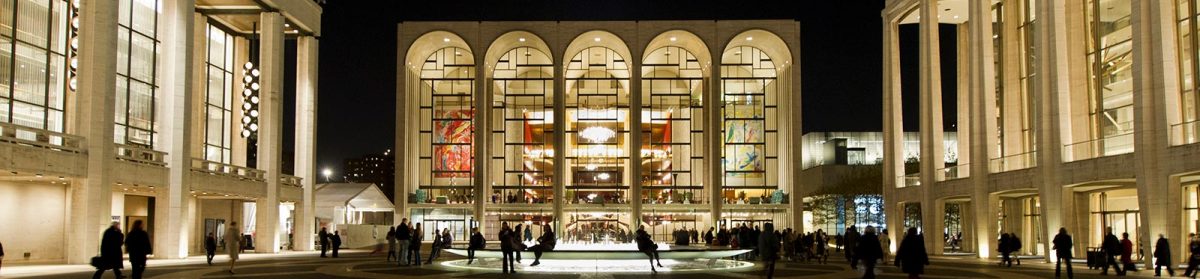
In this 11th year, over ten nights performances from the Met’s Live in HD series will be shown starting with a screening of FUNNY FACE in a special co-presentation with Film at Lincoln Center. Screenings run from August 23 through September 2. There will be 3000 seats in the Plaza in front of the Opera House with an additional standing room area. Cancellations due to thunder/lighting or high wind will not be rescheduled.

OTELLO:Verdi
Stiedry; Vinay, Steber, Warren, Hayward
Original Air Date: 02/09/1952
SID.19430214
This performance has been on a European private label for some years, and the cast (including the conductor) get better and better as the afternoon progresses. Vinay is an acquired taste for some, but he fits well with this role. This is a very good time for Steber, and if you enjoyed her 1949 Violetta , this is very fine singing indeed. This is arguably Tebaldi’s best role, and her first two Met broadcasts first with Stiedry in 1955 and Cleva in 1958, both with Del Monaco still remain missing from the Sirius rebroadcast listings. Del Monaco’s first Met Otello (not broadcast ) is with this 1952 cast 6 days after Steber does her first with Vinay on the broadcast. The other major interest from Steber here is she sang Fiordiligi at night after this broadcast.
OTELLO:Verdi
Stiedry; Vinay, Steber, Warren, Hayward
Original Air Date: 02/09/1952
SID.19430533
This performance has been on a European private label for some years, and the cast (including the conductor) get better and better as the afternoon progresses. Vinay is an acquired taste for some, but he fits well with this role. This is a very good time for Steber, and if you enjoyed her 1949 Violetta , this is very fine singing indeed. This is arguably Tebaldi’s best role, and her first two Met broadcasts first with Stiedry in 1955 and Cleva in 1958, both with Del Monaco still remain missing from the Sirius rebroadcast listings. Del Monaco’s first Met Otello (not broadcast ) is with this 1952 cast 6 days after Steber does her first with Vinay on the broadcast. The other major interest from Steber here is she sang Fiordiligi at night after this broadcast.
OTELLO:Verdi
Stiedry; Vinay, Steber, Warren, Hayward
Original Air Date: 02/09/1952
SID.19430745
This performance has been on a European private label for some years, and the cast (including the conductor) get better and better as the afternoon progresses. Vinay is an acquired taste for some, but he fits well with this role. This is a very good time for Steber, and if you enjoyed her 1949 Violetta , this is very fine singing indeed. This is arguably Tebaldi’s best role, and her first two Met broadcasts first with Stiedry in 1955 and Cleva in 1958, both with Del Monaco still remain missing from the Sirius rebroadcast listings. Del Monaco’s first Met Otello (not broadcast ) is with this 1952 cast 6 days after Steber does her first with Vinay on the broadcast. The other major interest from Steber here is she sang Fiordiligi at night after this broadcast.

DON GIOVANNI:Mozart
Böhm; London, Steber, Flagello, Della Casa, Valletti, Hurley
Original Air Date: 02/14/1959
MOD Audio
SID.19440213
SR: This broadcast is especially notable as it was George London’s only broadcast outing as the Don. His Don was very different from Siepi’s, but just as impressive a portrayal. We also enjoy the two Donna’s..sung by Steber and Della Casa, Ezio Flagello’s Leporello (often overshadowed by Corena’s more broadly comic portrayal) and the sweet tenor of Cesare Valletti. Dr. Karl Böhm leads a to-the-Viennese-manner-born performance. RWW: This is a fine performance; my only cavil is I would have preferred a Siepi broadcast which is available (though not yet on Sirius) from 1957 with the original cast which includes Corena as Leporello. Still, this is one of Steber’s best parts in a treasurable performance and Della Casa is a major Elvira. Flagello is an excellent Leporello. And while I am mentioning lacunae. Bohm’s 1967 broadcast with Sutherland and Lorengar also with Siepi is still missing from the Sirius broadcast stable as well.
DON GIOVANNI:Mozart
Böhm; London, Steber, Flagello, Della Casa, Valletti, Hurley
Original Air Date: 02/14/1959
MOD Audio
SID.19440529
SR: This broadcast is especially notable as it was George London’s only broadcast outing as the Don. His Don was very different from Siepi’s, but just as impressive a portrayal. We also enjoy the two Donna’s..sung by Steber and Della Casa, Ezio Flagello’s Leporello (often overshadowed by Corena’s more broadly comic portrayal) and the sweet tenor of Cesare Valletti. Dr. Karl Böhm leads a to-the-Viennese-manner-born performance. RWW: This is a fine performance; my only cavil is I would have preferred a Siepi broadcast which is available (though not yet on Sirius) from 1957 with the original cast which includes Corena as Leporello. Still, this is one of Steber’s best parts in a treasurable performance and Della Casa is a major Elvira. Flagello is an excellent Leporello. And while I am mentioning lacunae. Bohm’s 1967 broadcast with Sutherland and Lorengar also with Siepi is still missing from the Sirius broadcast stable as well.
DON GIOVANNI:Mozart
Böhm; London, Steber, Flagello, Della Casa, Valletti, Hurley
Original Air Date: 02/14/1959
MOD Audio
SID.19440743
SR: This broadcast is especially notable as it was George London’s only broadcast outing as the Don. His Don was very different from Siepi’s, but just as impressive a portrayal. We also enjoy the two Donna’s..sung by Steber and Della Casa, Ezio Flagello’s Leporello (often overshadowed by Corena’s more broadly comic portrayal) and the sweet tenor of Cesare Valletti. Dr. Karl Böhm leads a to-the-Viennese-manner-born performance. RWW: This is a fine performance; my only cavil is I would have preferred a Siepi broadcast which is available (though not yet on Sirius) from 1957 with the original cast which includes Corena as Leporello. Still, this is one of Steber’s best parts in a treasurable performance and Della Casa is a major Elvira. Flagello is an excellent Leporello. And while I am mentioning lacunae. Bohm’s 1967 broadcast with Sutherland and Lorengar also with Siepi is still missing from the Sirius broadcast stable as well.

DIE FLEDERMAUS:Strauss Jr.
Kozma; Steber, Kullman, Munsel, Hayward, Novotná, Brownlee
Original Air Date: 01/23/1954
SID.20010315
Steber lets the end of the Czardas get away from her, and John Brownlee is never a voice I want to hear, but Munsel is quite a trouper in this role; Novotna is a stylish Orlofsky. Why is the Fledermaus translation not a problem for the Met, but their Arabella is? This is Steber’s only broadcast Rosalinde, and she makes a meal of it. This is getting toward the end of Munsel’s reign at the Met with mostly Perichole and some Depinas ahead of her. My problem is with Brownlee, one of the driest voices ever .
DIE FLEDERMAUS:Strauss Jr.
Kozma; Steber, Kullman, Munsel, Hayward, Novotná, Brownlee
Original Air Date: 01/23/1954
SID.20010423
Steber lets the end of the Czardas get away from her, and John Brownlee is never a voice I want to hear, but Munsel is quite a trouper in this role; Novotna is a stylish Orlofsky. Why is the Fledermaus translation not a problem for the Met, but their Arabella is? This is Steber’s only broadcast Rosalinde, and she makes a meal of it. This is getting toward the end of Munsel’s reign at the Met with mostly Perichole and some Depinas ahead of her. My problem is with Brownlee, one of the driest voices ever .
DIE FLEDERMAUS:Strauss Jr.
Kozma; Steber, Kullman, Munsel, Hayward, Novotná, Brownlee
Original Air Date: 01/23/1954
SID.20010747
Steber lets the end of the Czardas get away from her, and John Brownlee is never a voice I want to hear, but Munsel is quite a trouper in this role; Novotna is a stylish Orlofsky. Why is the Fledermaus translation not a problem for the Met, but their Arabella is? This is Steber’s only broadcast Rosalinde, and she makes a meal of it. This is getting toward the end of Munsel’s reign at the Met with mostly Perichole and some Depinas ahead of her. My problem is with Brownlee, one of the driest voices ever .

DON GIOVANNI:Mozart
Rudolf; London, Harshaw, Corena, Steber, Conley, Conner
Original Air Date: 03/13/1954
SID.20130105
RWW: The unusual casting is for the two leading ladies with Harshaw in her first Anna broadcast (the second comes a year later with Siepi for London, Amara for Steber, Valletti for Conley, and Peters for Conner. Rudolf, Harshaw, and Corena are the constants. Steber finishes her 1944-1954 Met connection with Elvira at 3 tour stops with Valletti back for them. With Bing’s full complement of lyric sopranos, he unveils a new production in 1957 with Steber moving up to Anna [Steber did a 2 performance preview of her Anna in the 1954-1955 season], Della Casa becoming the preferred Elvira, and Peters the preferred Zerlina. I’m happy to have this 1954 in the rotation, but once again call on the Met to offer the 1957 broadcast on Sirius and eventually on MOoD. I have a European pressing of this performance, and it is one of the great broadcasts of the 1950s.
DON GIOVANNI:Mozart
Rudolf; London, Harshaw, Corena, Steber, Conley, Conner
Original Air Date: 03/13/1954
SID.20130324
RWW: The unusual casting is for the two leading ladies with Harshaw in her first Anna broadcast (the second comes a year later with Siepi for London, Amara for Steber, Valletti for Conley, and Peters for Conner. Rudolf, Harshaw, and Corena are the constants. Steber finishes her 1944-1954 Met connection with Elvira at 3 tour stops with Valletti back for them. With Bing’s full complement of lyric sopranos, he unveils a new production in 1957 with Steber moving up to Anna [Steber did a 2 performance preview of her Anna in the 1954-1955 season], Della Casa becoming the preferred Elvira, and Peters the preferred Zerlina. I’m happy to have this 1954 in the rotation, but once again call on the Met to offer the 1957 broadcast on Sirius and eventually on MOoD. I have a European pressing of this performance, and it is one of the great broadcasts of the 1950s.
DON GIOVANNI:Mozart
Rudolf; London, Harshaw, Corena, Steber, Conley, Conner
Original Air Date: 03/13/1954
SID.20130643
RWW: The unusual casting is for the two leading ladies with Harshaw in her first Anna broadcast (the second comes a year later with Siepi for London, Amara for Steber, Valletti for Conley, and Peters for Conner. Rudolf, Harshaw, and Corena are the constants. Steber finishes her 1944-1954 Met connection with Elvira at 3 tour stops with Valletti back for them. With Bing’s full complement of lyric sopranos, he unveils a new production in 1957 with Steber moving up to Anna [Steber did a 2 performance preview of her Anna in the 1954-1955 season], Della Casa becoming the preferred Elvira, and Peters the preferred Zerlina. I’m happy to have this 1954 in the rotation, but once again call on the Met to offer the 1957 broadcast on Sirius and eventually on MOoD. I have a European pressing of this performance, and it is one of the great broadcasts of the 1950s.

VANESSA:Barber
Mitropoulos; Steber, Gedda, Elias, Resnik, Tozzi
Original Air Date: 02/01/1958
MOD Audio
SID.20170214
Vanessa received its world premiere with this cast two weeks before this broadcast. Though Steber was not the first choice for the title role, she does some of her best broadcast singing on this. The Skating aria (later removed by Barber from the published score) has as many technical hurdles as any of Steber’s Mozart heroines, and she is up to them. The libretto gets its deserved criticisms, but Barber’s music has allowed the work to continue performances if none yet in the Met’s Lincoln Center theatre.
VANESSA:Barber
Mitropoulos; Steber, Gedda, Elias, Resnik, Tozzi
Original Air Date: 02/01/1958
MOD Audio
SID.20170533
Vanessa received its world premiere with this cast two weeks before this broadcast. Though Steber was not the first choice for the title role, she does some of her best broadcast singing on this. The Skating aria (later removed by Barber from the published score) has as many technical hurdles as any of Steber’s Mozart heroines, and she is up to them. The libretto gets its deserved criticisms, but Barber’s music has allowed the work to continue performances if none yet in the Met’s Lincoln Center theatre.
VANESSA:Barber
Mitropoulos; Steber, Gedda, Elias, Resnik, Tozzi
Original Air Date: 02/01/1958
MOD Audio
SID.20170751
Vanessa received its world premiere with this cast two weeks before this broadcast. Though Steber was not the first choice for the title role, she does some of her best broadcast singing on this. The Skating aria (later removed by Barber from the published score) has as many technical hurdles as any of Steber’s Mozart heroines, and she is up to them. The libretto gets its deserved criticisms, but Barber’s music has allowed the work to continue performances if none yet in the Met’s Lincoln Center theatre.