
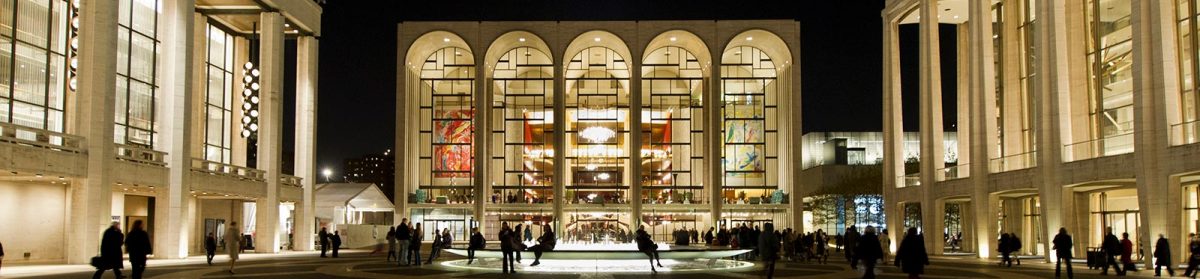
In this 11th year, over ten nights performances from the Met’s Live in HD series will be shown starting with a screening of FUNNY FACE in a special co-presentation with Film at Lincoln Center. Screenings run from August 23 through September 2. There will be 3000 seats in the Plaza in front of the Opera House with an additional standing room area. Cancellations due to thunder/lighting or high wind will not be rescheduled.

MANON LESCAUT:Puccini
Original Air Date: 03/23/1968
Molinari-Pradelli; Tebaldi, Alexander, Guarrera, Michalski
SID.19350104
I am always happy to hear Manon Lescaut, and Alexander is an under-appreciated singer so happy to have him here, BUT Tebaldi’s greatness in the role is in the 1959 broadcast with Tucker (not yet broadcast on Sirius). Also on Met Player . Although this performance is available on Met Player, for some reason the Met keeps avoiding the 1959 performance with Tucker– he is represented with Kabaiwanska in a very decent performance from 1966. Once again I would call on the Met to restore to broadcast availability one of the remarkable unions of two Met legends of Tebaldi and Tucker. This 1968 performance captures Tebaldi after two long runs in Gioconda, and the voice was simply not the same. I yield to no one in my admiration of John Alexander, but it is still inexplicable to me that the 1959 broadcast with Tebaldi and Tucker remains un-rebroadcast, and this performance is in MOoD and regularly on Sirius. For Tebaldi, the 9 year span makes a huge difference. By the time of this broadcast she is well on her way through her Gioconda marathon after a vocal crisis in the early 60s. She has many wonderful moments, but surely Met listeners deserve to hear the Tucker/Tebaldi/Puccini combination one more time (I’ve written on the 1956 Tosca many times).
MANON LESCAUT:Puccini
Original Air Date: 03/23/1968
Molinari-Pradelli; Tebaldi, Alexander, Guarrera, Michalski
SID.19350320
I am always happy to hear Manon Lescaut, and Alexander is an under-appreciated singer so happy to have him here, BUT Tebaldi’s greatness in the role is in the 1959 broadcast with Tucker (not yet broadcast on Sirius). Also on Met Player . Although this performance is available on Met Player, for some reason the Met keeps avoiding the 1959 performance with Tucker– he is represented with Kabaiwanska in a very decent performance from 1966. Once again I would call on the Met to restore to broadcast availability one of the remarkable unions of two Met legends of Tebaldi and Tucker. This 1968 performance captures Tebaldi after two long runs in Gioconda, and the voice was simply not the same. I yield to no one in my admiration of John Alexander, but it is still inexplicable to me that the 1959 broadcast with Tebaldi and Tucker remains un-rebroadcast, and this performance is in MOoD and regularly on Sirius. For Tebaldi, the 9 year span makes a huge difference. By the time of this broadcast she is well on her way through her Gioconda marathon after a vocal crisis in the early 60s. She has many wonderful moments, but surely Met listeners deserve to hear the Tucker/Tebaldi/Puccini combination one more time (I’ve written on the 1956 Tosca many times).
MANON LESCAUT:Puccini
Original Air Date: 03/23/1968
Molinari-Pradelli; Tebaldi, Alexander, Guarrera, Michalski
SID.19350530
I am always happy to hear Manon Lescaut, and Alexander is an under-appreciated singer so happy to have him here, BUT Tebaldi’s greatness in the role is in the 1959 broadcast with Tucker (not yet broadcast on Sirius). Also on Met Player . Although this performance is available on Met Player, for some reason the Met keeps avoiding the 1959 performance with Tucker– he is represented with Kabaiwanska in a very decent performance from 1966. Once again I would call on the Met to restore to broadcast availability one of the remarkable unions of two Met legends of Tebaldi and Tucker. This 1968 performance captures Tebaldi after two long runs in Gioconda, and the voice was simply not the same. I yield to no one in my admiration of John Alexander, but it is still inexplicable to me that the 1959 broadcast with Tebaldi and Tucker remains un-rebroadcast, and this performance is in MOoD and regularly on Sirius. For Tebaldi, the 9 year span makes a huge difference. By the time of this broadcast she is well on her way through her Gioconda marathon after a vocal crisis in the early 60s. She has many wonderful moments, but surely Met listeners deserve to hear the Tucker/Tebaldi/Puccini combination one more time (I’ve written on the 1956 Tosca many times).
MANON LESCAUT:Puccini
Original Air Date: 03/23/1968
Molinari-Pradelli; Tebaldi, Alexander, Guarrera, Michalski
SID.19350749
I am always happy to hear Manon Lescaut, and Alexander is an under-appreciated singer so happy to have him here, BUT Tebaldi’s greatness in the role is in the 1959 broadcast with Tucker (not yet broadcast on Sirius). Also on Met Player . Although this performance is available on Met Player, for some reason the Met keeps avoiding the 1959 performance with Tucker– he is represented with Kabaiwanska in a very decent performance from 1966. Once again I would call on the Met to restore to broadcast availability one of the remarkable unions of two Met legends of Tebaldi and Tucker. This 1968 performance captures Tebaldi after two long runs in Gioconda, and the voice was simply not the same. I yield to no one in my admiration of John Alexander, but it is still inexplicable to me that the 1959 broadcast with Tebaldi and Tucker remains un-rebroadcast, and this performance is in MOoD and regularly on Sirius. For Tebaldi, the 9 year span makes a huge difference. By the time of this broadcast she is well on her way through her Gioconda marathon after a vocal crisis in the early 60s. She has many wonderful moments, but surely Met listeners deserve to hear the Tucker/Tebaldi/Puccini combination one more time (I’ve written on the 1956 Tosca many times).

LA GIOCONDA:Ponchielli
Cleva; Tebaldi, Bergonzi, MacNeil, Cossotto, Giaiotti
Original Air Date: 03/02/1968
MOD Audio
SID.19430211
This is Tebaldi’s second broadcast of the street singer, and what a sensational cast the Met surrounds her with. Bergonzi did a run with Bumbry eleven years later but that was not broadcast. Tebaldi’s first broadcast a year earlier has also been on Sirius, and is also on MOoD. The earlier broadcast has Morrell (replacing Corelli) and Elias in the Bergonzi and Cossotto parts. Siepi and Giaiotti are both top class Alvises. The Met listing leaves off Dunn, and Cieca is definitely one of the star parts. This is Tebaldi’s second Gioconda broadcast, and despite the wear and tear from 32 Met Giocondas in two years — it is her final Gioconda. Bing serves up A+ colleagues for her, and it is a rousing afternoon. This performance is on Met Player, highly recommend.
LA GIOCONDA:Ponchielli
Cleva; Tebaldi, Bergonzi, MacNeil, Cossotto, Giaiotti
Original Air Date: 03/02/1968
MOD Audio
SID.19430423
This is Tebaldi’s second broadcast of the street singer, and what a sensational cast the Met surrounds her with. Bergonzi did a run with Bumbry eleven years later but that was not broadcast. Tebaldi’s first broadcast a year earlier has also been on Sirius, and is also on MOoD. The earlier broadcast has Morrell (replacing Corelli) and Elias in the Bergonzi and Cossotto parts. Siepi and Giaiotti are both top class Alvises. The Met listing leaves off Dunn, and Cieca is definitely one of the star parts. This is Tebaldi’s second Gioconda broadcast, and despite the wear and tear from 32 Met Giocondas in two years — it is her final Gioconda. Bing serves up A+ colleagues for her, and it is a rousing afternoon. This performance is on Met Player, highly recommend.
LA GIOCONDA:Ponchielli
Cleva; Tebaldi, Bergonzi, MacNeil, Cossotto, Giaiotti
Original Air Date: 03/02/1968
MOD Audio
SID.19430744
This is Tebaldi’s second broadcast of the street singer, and what a sensational cast the Met surrounds her with. Bergonzi did a run with Bumbry eleven years later but that was not broadcast. Tebaldi’s first broadcast a year earlier has also been on Sirius, and is also on MOoD. The earlier broadcast has Morrell (replacing Corelli) and Elias in the Bergonzi and Cossotto parts. Siepi and Giaiotti are both top class Alvises. The Met listing leaves off Dunn, and Cieca is definitely one of the star parts. This is Tebaldi’s second Gioconda broadcast, and despite the wear and tear from 32 Met Giocondas in two years — it is her final Gioconda. Bing serves up A+ colleagues for her, and it is a rousing afternoon. This performance is on Met Player, highly recommend.

ROMÉO ET JULIETTE:Gounod
Molinari-Pradelli; Gedda, Freni, Macurdy, Baldwin, Reardon
Original Air Date: 04/13/1968
SID.19440209
Molinari-Pradelli is an improvement on Domingo in the pit, but others are still much better. Gedda and Freni are not ideal, but it’s a wonderful memory of her youthful singing at the Met, and she is more alive on the broadcast than in the studio (and many performances) with Corelli.
ROMÉO ET JULIETTE:Gounod
Molinari-Pradelli; Gedda, Freni, Macurdy, Baldwin, Reardon
Original Air Date: 04/13/1968
SID.19440425
Molinari-Pradelli is an improvement on Domingo in the pit, but others are still much better. Gedda and Freni are not ideal, but it’s a wonderful memory of her youthful singing at the Met, and she is more alive on the broadcast than in the studio (and many performances) with Corelli.
ROMÉO ET JULIETTE:Gounod
Molinari-Pradelli; Gedda, Freni, Macurdy, Baldwin, Reardon
Original Air Date: 04/13/1968
SID.19440641
Molinari-Pradelli is an improvement on Domingo in the pit, but others are still much better. Gedda and Freni are not ideal, but it’s a wonderful memory of her youthful singing at the Met, and she is more alive on the broadcast than in the studio (and many performances) with Corelli.
ROMÉO ET JULIETTE:Gounod
Molinari-Pradelli; Gedda, Freni, Macurdy, Baldwin, Reardon
Original Air Date: 04/13/1968
MOD Audio
SID.20080102
Molinari-Pradelli is an improvement on Domingo in the pit, but others are still much better. Gedda and Freni are not ideal, but it’s a wonderful memory of her youthful singing at the Met, and she is more alive on the broadcast than in the studio (and many performances) with Corelli.

LOHENGRIN:Wagner
Klobucar; Kónya, Arroyo, Dvoráková, Cassel, Macurdy, Milnes
Original Air Date: 02/10/1968
SID.20080209
Milnes’s one of the solid pluses, as are Konya and Arroyo. The last of this run the following week featured James King in the title role. Dvorakova did Isolde at the Met and Senta in Philadelphia.
ROMÉO ET JULIETTE:Gounod
Molinari-Pradelli; Gedda, Freni, Macurdy, Baldwin, Reardon
Original Air Date: 04/13/1968
MOD Audio
SID.20080318
Molinari-Pradelli is an improvement on Domingo in the pit, but others are still much better. Gedda and Freni are not ideal, but it’s a wonderful memory of her youthful singing at the Met, and she is more alive on the broadcast than in the studio (and many performances) with Corelli.
LOHENGRIN:Wagner
Klobucar; Kónya, Arroyo, Dvoráková, Cassel, Macurdy, Milnes
Original Air Date: 02/10/1968
SID.20080425
Milnes’s one of the solid pluses, as are Konya and Arroyo. The last of this run the following week featured James King in the title role. Dvorakova did Isolde at the Met and Senta in Philadelphia.
ROMÉO ET JULIETTE:Gounod
Molinari-Pradelli; Gedda, Freni, Macurdy, Baldwin, Reardon
Original Air Date: 04/13/1968
MOD Audio
SID.20080534
Molinari-Pradelli is an improvement on Domingo in the pit, but others are still much better. Gedda and Freni are not ideal, but it’s a wonderful memory of her youthful singing at the Met, and she is more alive on the broadcast than in the studio (and many performances) with Corelli.
LOHENGRIN:Wagner
Klobucar; Kónya, Arroyo, Dvoráková, Cassel, Macurdy, Milnes
Original Air Date: 02/10/1968
SID.20080642
Milnes’s one of the solid pluses, as are Konya and Arroyo. The last of this run the following week featured James King in the title role. Dvorakova did Isolde at the Met and Senta in Philadelphia.
ROMÉO ET JULIETTE:Gounod
Molinari-Pradelli; Gedda, Freni, Macurdy, Baldwin, Reardon
Original Air Date: 04/13/1968
MOD Audio
SID.20080749
Molinari-Pradelli is an improvement on Domingo in the pit, but others are still much better. Gedda and Freni are not ideal, but it’s a wonderful memory of her youthful singing at the Met, and she is more alive on the broadcast than in the studio (and many performances) with Corelli.

FALSTAFF:Verdi
Amaducci; Flagello, Curtin, Guarrera, Barbieri, Raskin, Alva
Original Air Date: 12/16/1967
MOD Audio
SID.20130106
RWW: Barbieri, Guarrera, and Alva are veterans of many Falstaffs, and Flagello features a lot of voice for a bass Falstaff. Amaducci, by memory, didn’t have much sparkle. High praise for Alva and Barbieri; she is a characterful Quickly, and he a perfect Fenton, but Amaducci is possibly the weakest Falstaff conductor in Met history(certainly on broadcasts). The 1964 Bernstein has never been on Sirius, and though the Met Database records the 1972 as having been on Sirius with Gobbi, Tebaldi, and Paskalis under von Dohnanyi, it has not been on more than once, and should be heard again. Both of these performances belong in MOoD not this performance. Flagello who had one of the great voices in a time when the Met’s bass cabinet was chock full sings the part very well, but for this work, you must have a conductor to work with you, and that he doesn’t have. Alas, Falstaff is about ensemble, not individual efforts.
FALSTAFF:Verdi
Amaducci; Flagello, Curtin, Guarrera, Barbieri, Raskin, Alva
Original Air Date: 12/16/1967
MOD Audio
SID.20130425
RWW: Barbieri, Guarrera, and Alva are veterans of many Falstaffs, and Flagello features a lot of voice for a bass Falstaff. Amaducci, by memory, didn’t have much sparkle. High praise for Alva and Barbieri; she is a characterful Quickly, and he a perfect Fenton, but Amaducci is possibly the weakest Falstaff conductor in Met history(certainly on broadcasts). The 1964 Bernstein has never been on Sirius, and though the Met Database records the 1972 as having been on Sirius with Gobbi, Tebaldi, and Paskalis under von Dohnanyi, it has not been on more than once, and should be heard again. Both of these performances belong in MOoD not this performance. Flagello who had one of the great voices in a time when the Met’s bass cabinet was chock full sings the part very well, but for this work, you must have a conductor to work with you, and that he doesn’t have. Alas, Falstaff is about ensemble, not individual efforts.
FALSTAFF:Verdi
Amaducci; Flagello, Curtin, Guarrera, Barbieri, Raskin, Alva
Original Air Date: 12/16/1967
MOD Audio
SID.20130757
RWW: Barbieri, Guarrera, and Alva are veterans of many Falstaffs, and Flagello features a lot of voice for a bass Falstaff. Amaducci, by memory, didn’t have much sparkle. High praise for Alva and Barbieri; she is a characterful Quickly, and he a perfect Fenton, but Amaducci is possibly the weakest Falstaff conductor in Met history(certainly on broadcasts). The 1964 Bernstein has never been on Sirius, and though the Met Database records the 1972 as having been on Sirius with Gobbi, Tebaldi, and Paskalis under von Dohnanyi, it has not been on more than once, and should be heard again. Both of these performances belong in MOoD not this performance. Flagello who had one of the great voices in a time when the Met’s bass cabinet was chock full sings the part very well, but for this work, you must have a conductor to work with you, and that he doesn’t have. Alas, Falstaff is about ensemble, not individual efforts.

TOSCA:Puccini
Mehta; Crespin, Raimondi, Bacquier
Original Air Date: 01/13/1968
SID.20170212
Crespin was the first prima donna to repeat Tosca on the airwaves during the Bing era. I generally prefer her supporting cast here, and will be eagerly listening to this. She could be an uneven singer, but you know it is she from the first note. Raimondi (Gianni, not Ruggero– no relation) has a brief Met career, but I prefer him to Konya, and Bacquier is astrong Scarpia.