
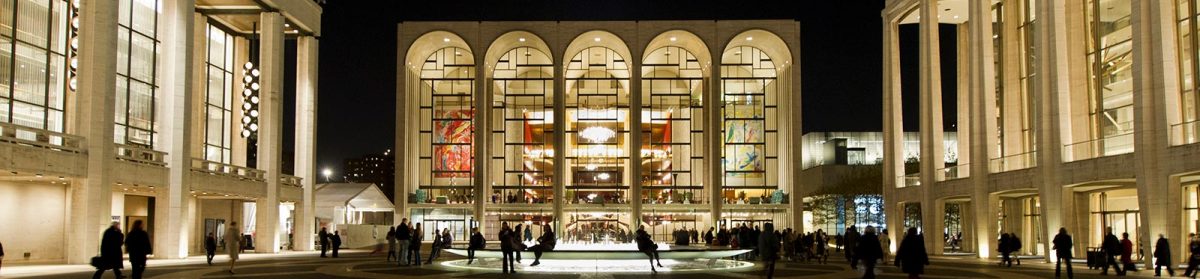
In this 11th year, over ten nights performances from the Met’s Live in HD series will be shown starting with a screening of FUNNY FACE in a special co-presentation with Film at Lincoln Center. Screenings run from August 23 through September 2. There will be 3000 seats in the Plaza in front of the Opera House with an additional standing room area. Cancellations due to thunder/lighting or high wind will not be rescheduled.

DON CARLO:Verdi
Stiedry; Bjorling, Rigal, Merrill, Barbieri, Siepi, Hines
Original Air Date: 11/11/1950
MOD Audio
SID.19420211
This is the production that opened the Bing regime in 1950, and re-introduces Don Carlo to New York audiences. The men are the equal or superior of just about anyone who has ever sung these roles. Barbieri was new, and if Eboli was not quite her meat as much as her Amneris, Azucena, and Quickly, she was still the Eboli of choice when the sainted Covent Garden production of 1958 made the case in London for the opera 8 years later. New York was to see more sensational Ebolis in the 1960s with Bumbry, Cossotto, and Verrett delivering masterful portrayals of the Princess. Rigal would not have seemed quite so short of desirable had she had less outstanding colleagues. Elisabetta remains a challenging role, and though never essayed by Milanov (then the queen of Verdi in New York) or Tebaldi (never did the part onstage), the part didn’t turn out to be a major success for either Steber or Rysanek, though both have their moments in the role. Caballe, Freni, Kabaiwanska and Millo all were notable exponents, but runs were very limited. Scotto is mostly very good (not too late, not too heavy, but still not quite the right voice, if still wonderful stylistically. A propos the discussion on Verdi sopranos, Leontyne Price never did the part, which is unsurprising as it does not play to her considerable Verdian strengths—but that’s another discussion. Siepi’s contribution is particularly important in that he opens and closes the Bing regime as Filippo, and it is a shame that the April 1972 performance has not been rebroadcast. Three veterans of the 1950 broadcast, Merrill, Siepi, and Amara (Celestial Voice) as well as two new Verdian stars in Caballe and Milnes.

FALSTAFF:Verdi
Levine; MacNeil, Lear, Stewart, Barbieri, Valente, Ahlstedt
Original Air Date: 04/05/1975
MOD Audio
SID.19420742
This performance is Levine’s first Falstaff broadcast and Barbieri’s penultimate company broadcast (she returns for Trittico (minus Frugola) 2 years later. MacNeil is a very good Falstaff which I think is his only run in the part– he is a stellar Ford on a Chicago broadcast with Gobbi in 1958. Lear is in better form than her husband — Stewart is not really a Verdian, and the monologue is among the showiest music in the opera.
DON CARLO:Verdi
Stiedry; Bjorling, Rigal, Merrill, Barbieri, Siepi, Hines
Original Air Date: 11/11/1950
MOD Audio
SID.19420426
This is the production that opened the Bing regime in 1950, and re-introduces Don Carlo to New York audiences. The men are the equal or superior of just about anyone who has ever sung these roles. Barbieri was new, and if Eboli was not quite her meat as much as her Amneris, Azucena, and Quickly, she was still the Eboli of choice when the sainted Covent Garden production of 1958 made the case in London for the opera 8 years later. New York was to see more sensational Ebolis in the 1960s with Bumbry, Cossotto, and Verrett delivering masterful portrayals of the Princess. Rigal would not have seemed quite so short of desirable had she had less outstanding colleagues. Elisabetta remains a challenging role, and though never essayed by Milanov (then the queen of Verdi in New York) or Tebaldi (never did the part onstage), the part didn’t turn out to be a major success for either Steber or Rysanek, though both have their moments in the role. Caballe, Freni, Kabaiwanska and Millo all were notable exponents, but runs were very limited. Scotto is mostly very good (not too late, not too heavy, but still not quite the right voice, if still wonderful stylistically. A propos the discussion on Verdi sopranos, Leontyne Price never did the part, which is unsurprising as it does not play to her considerable Verdian strengths—but that’s another discussion. Siepi’s contribution is particularly important in that he opens and closes the Bing regime as Filippo, and it is a shame that the April 1972 performance has not been rebroadcast. Three veterans of the 1950 broadcast, Merrill, Siepi, and Amara (Celestial Voice) as well as two new Verdian stars in Caballe and Milnes.
DON CARLO:Verdi
Stiedry; Bjorling, Rigal, Merrill, Barbieri, Siepi, Hines
Original Air Date: 11/11/1950
MOD Audio
SID.19420529
This is the production that opened the Bing regime in 1950, and re-introduces Don Carlo to New York audiences. The men are the equal or superior of just about anyone who has ever sung these roles. Barbieri was new, and if Eboli was not quite her meat as much as her Amneris, Azucena, and Quickly, she was still the Eboli of choice when the sainted Covent Garden production of 1958 made the case in London for the opera 8 years later. New York was to see more sensational Ebolis in the 1960s with Bumbry, Cossotto, and Verrett delivering masterful portrayals of the Princess. Rigal would not have seemed quite so short of desirable had she had less outstanding colleagues. Elisabetta remains a challenging role, and though never essayed by Milanov (then the queen of Verdi in New York) or Tebaldi (never did the part onstage), the part didn’t turn out to be a major success for either Steber or Rysanek, though both have their moments in the role. Caballe, Freni, Kabaiwanska and Millo all were notable exponents, but runs were very limited. Scotto is mostly very good (not too late, not too heavy, but still not quite the right voice, if still wonderful stylistically. A propos the discussion on Verdi sopranos, Leontyne Price never did the part, which is unsurprising as it does not play to her considerable Verdian strengths—but that’s another discussion. Siepi’s contribution is particularly important in that he opens and closes the Bing regime as Filippo, and it is a shame that the April 1972 performance has not been rebroadcast. Three veterans of the 1950 broadcast, Merrill, Siepi, and Amara (Celestial Voice) as well as two new Verdian stars in Caballe and Milnes.
FALSTAFF:Verdi
Levine; MacNeil, Lear, Stewart, Barbieri, Valente, Ahlstedt
Original Air Date: 04/05/1975
MOD Audio
SID.19420531
This performance is Levine’s first Falstaff broadcast and Barbieri’s penultimate company broadcast (she returns for Trittico (minus Frugola) 2 years later. MacNeil is a very good Falstaff which I think is his only run in the part– he is a stellar Ford on a Chicago broadcast with Gobbi in 1958. Lear is in better form than her husband — Stewart is not really a Verdian, and the monologue is among the showiest music in the opera.
FALSTAFF:Verdi
Levine; MacNeil, Lear, Stewart, Barbieri, Valente, Ahlstedt
Original Air Date: 04/05/1975
MOD Audio
SID.19420742
This performance is Levine’s first Falstaff broadcast and Barbieri’s penultimate company broadcast (she returns for Trittico (minus Frugola) 2 years later. MacNeil is a very good Falstaff which I think is his only run in the part– he is a stellar Ford on a Chicago broadcast with Gobbi in 1958. Lear is in better form than her husband — Stewart is not really a Verdian, and the monologue is among the showiest music in the opera.

DON CARLO:Verdi
Stiedry; Tucker, Rigal, Silveri, Barbieri, Hines, Hotter
Original Air Date: 04/05/1952
MOD Audio
SID.19510214
This is most distinctive for being Tucker’s first Don Carlo broadcast and one of Hotter’s few. This is the first of Tucker’s three Don Carlo broadcasts, and I find his 1955 preferable. What I’ve never heard, but also from 1952 (but next season) is his second which has a better supporting cast with Merrill for Silveri, and Siepi for Hines as Filippo; Erede is in the pit for his only Don Carlo broadcast. Also unusual is that though Tucker went on to sing the opera for 15 more years after his 1955 broadcast with Steber, he never went to the airwaves for it again. At 26 performances, he is by far the Don Carlo champion– I saw him in it three times. most notably at a fall 1968 matinee not broadcast with (Orlandi, Verrett, Merrill, Ghiaurov, and Talvela under Abbado). Bing did not see Hotter in leading roles and in Walkure he was cast as Hunding, not Wotan. What has not been rebroadcast on Sirius is Hotter’s farewell which is a 1954 Parsifal with Svanholm, Varnay, and London, and Hotter as Gurnemanz under Stiedry.
DON CARLO:Verdi
Stiedry; Tucker, Rigal, Silveri, Barbieri, Hines, Hotter
Original Air Date: 04/05/1952
MOD Audio
SID.19510531
This is most distinctive for being Tucker’s first Don Carlo broadcast and one of Hotter’s few. This is the first of Tucker’s three Don Carlo broadcasts, and I find his 1955 preferable. What I’ve never heard, but also from 1952 (but next season) is his second which has a better supporting cast with Merrill for Silveri, and Siepi for Hines as Filippo; Erede is in the pit for his only Don Carlo broadcast. Also unusual is that though Tucker went on to sing the opera for 15 more years after his 1955 broadcast with Steber, he never went to the airwaves for it again. At 26 performances, he is by far the Don Carlo champion– I saw him in it three times. most notably at a fall 1968 matinee not broadcast with (Orlandi, Verrett, Merrill, Ghiaurov, and Talvela under Abbado). Bing did not see Hotter in leading roles and in Walkure he was cast as Hunding, not Wotan. What has not been rebroadcast on Sirius is Hotter’s farewell which is a 1954 Parsifal with Svanholm, Varnay, and London, and Hotter as Gurnemanz under Stiedry.
DON CARLO:Verdi
Stiedry; Tucker, Rigal, Silveri, Barbieri, Hines, Hotter
Original Air Date: 04/05/1952
MOD Audio
SID.19510746
This is most distinctive for being Tucker’s first Don Carlo broadcast and one of Hotter’s few. This is the first of Tucker’s three Don Carlo broadcasts, and I find his 1955 preferable. What I’ve never heard, but also from 1952 (but next season) is his second which has a better supporting cast with Merrill for Silveri, and Siepi for Hines as Filippo; Erede is in the pit for his only Don Carlo broadcast. Also unusual is that though Tucker went on to sing the opera for 15 more years after his 1955 broadcast with Steber, he never went to the airwaves for it again. At 26 performances, he is by far the Don Carlo champion– I saw him in it three times. most notably at a fall 1968 matinee not broadcast with (Orlandi, Verrett, Merrill, Ghiaurov, and Talvela under Abbado). Bing did not see Hotter in leading roles and in Walkure he was cast as Hunding, not Wotan. What has not been rebroadcast on Sirius is Hotter’s farewell which is a 1954 Parsifal with Svanholm, Varnay, and London, and Hotter as Gurnemanz under Stiedry.

FALSTAFF:Verdi
Amaducci; Flagello, Curtin, Guarrera, Barbieri, Raskin, Alva
Original Air Date: 12/16/1967
MOD Audio
SID.20130106
RWW: Barbieri, Guarrera, and Alva are veterans of many Falstaffs, and Flagello features a lot of voice for a bass Falstaff. Amaducci, by memory, didn’t have much sparkle. High praise for Alva and Barbieri; she is a characterful Quickly, and he a perfect Fenton, but Amaducci is possibly the weakest Falstaff conductor in Met history(certainly on broadcasts). The 1964 Bernstein has never been on Sirius, and though the Met Database records the 1972 as having been on Sirius with Gobbi, Tebaldi, and Paskalis under von Dohnanyi, it has not been on more than once, and should be heard again. Both of these performances belong in MOoD not this performance. Flagello who had one of the great voices in a time when the Met’s bass cabinet was chock full sings the part very well, but for this work, you must have a conductor to work with you, and that he doesn’t have. Alas, Falstaff is about ensemble, not individual efforts.
FALSTAFF:Verdi
Amaducci; Flagello, Curtin, Guarrera, Barbieri, Raskin, Alva
Original Air Date: 12/16/1967
MOD Audio
SID.20130425
RWW: Barbieri, Guarrera, and Alva are veterans of many Falstaffs, and Flagello features a lot of voice for a bass Falstaff. Amaducci, by memory, didn’t have much sparkle. High praise for Alva and Barbieri; she is a characterful Quickly, and he a perfect Fenton, but Amaducci is possibly the weakest Falstaff conductor in Met history(certainly on broadcasts). The 1964 Bernstein has never been on Sirius, and though the Met Database records the 1972 as having been on Sirius with Gobbi, Tebaldi, and Paskalis under von Dohnanyi, it has not been on more than once, and should be heard again. Both of these performances belong in MOoD not this performance. Flagello who had one of the great voices in a time when the Met’s bass cabinet was chock full sings the part very well, but for this work, you must have a conductor to work with you, and that he doesn’t have. Alas, Falstaff is about ensemble, not individual efforts.
FALSTAFF:Verdi
Amaducci; Flagello, Curtin, Guarrera, Barbieri, Raskin, Alva
Original Air Date: 12/16/1967
MOD Audio
SID.20130757
RWW: Barbieri, Guarrera, and Alva are veterans of many Falstaffs, and Flagello features a lot of voice for a bass Falstaff. Amaducci, by memory, didn’t have much sparkle. High praise for Alva and Barbieri; she is a characterful Quickly, and he a perfect Fenton, but Amaducci is possibly the weakest Falstaff conductor in Met history(certainly on broadcasts). The 1964 Bernstein has never been on Sirius, and though the Met Database records the 1972 as having been on Sirius with Gobbi, Tebaldi, and Paskalis under von Dohnanyi, it has not been on more than once, and should be heard again. Both of these performances belong in MOoD not this performance. Flagello who had one of the great voices in a time when the Met’s bass cabinet was chock full sings the part very well, but for this work, you must have a conductor to work with you, and that he doesn’t have. Alas, Falstaff is about ensemble, not individual efforts.