
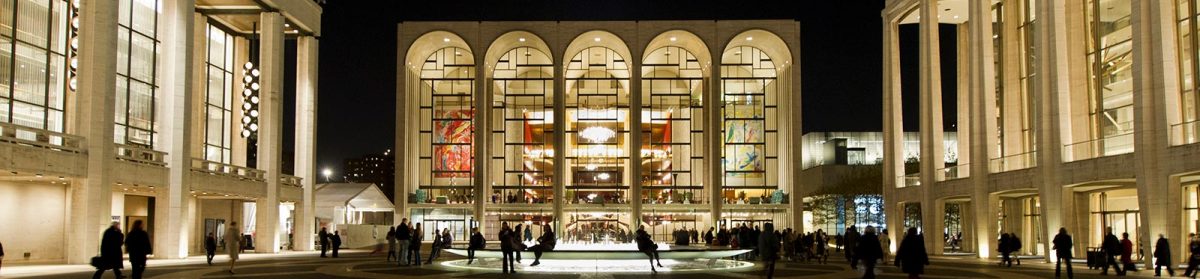
In this 11th year, over ten nights performances from the Met’s Live in HD series will be shown starting with a screening of FUNNY FACE in a special co-presentation with Film at Lincoln Center. Screenings run from August 23 through September 2. There will be 3000 seats in the Plaza in front of the Opera House with an additional standing room area. Cancellations due to thunder/lighting or high wind will not be rescheduled.

TRISTAN UND ISOLDE:Wagner
Original Air Date: 12/09/1950
Reiner; Vinay, Traubel, Thebom, Nilsson, Schöffler
SID.19370107
With leads like these, and Reiner in the pit, this is well worth investigating. Traubel has 40s broadcasts with both Melchior (3) and Svanholm with conductors like Leinsdorf, Beecham, and Busch. Alas none of these have been on Sirius. Enjoy this example of the original “St. Louis woman.”

FIDELIO:Beethoven
Original Air Date: 03/10/1951
Walter; Flagstad, Svanholm, Schöffler, Ernster, Conner, Klein
MOD Audio SID.19370214
This performance marks Flagstad’s return season after an absence of ten years. She also has a Fidelio broadcast under Walter from 1941 which has now also been rebroadcast and finds Flagstad on even finer form on Sirius. Walter and Flagstad are the attraction with the supporting cast variable.
TRISTAN UND ISOLDE:Wagner
Original Air Date: 12/09/1950
Reiner; Vinay, Traubel, Thebom, Nilsson, Schöffler
SID.19370317
With leads like these, and Reiner in the pit, this is well worth investigating. Traubel has 40s broadcasts with both Melchior (3) and Svanholm with conductors like Leinsdorf, Beecham, and Busch. Alas none of these have been on Sirius. Enjoy this example of the original “St. Louis woman.”

FIDELIO:Beethoven
Original Air Date: 03/10/1951
Walter; Flagstad, Svanholm, Schöffler, Ernster, Conner, Klein
MOD Audio SID.19370423
This performance marks Flagstad’s return season after an absence of ten years. She also has a Fidelio broadcast under Walter from 1941 which has now also been rebroadcast and finds Flagstad on even finer form on Sirius. Walter and Flagstad are the attraction with the supporting cast variable.
TRISTAN UND ISOLDE:Wagner
Original Air Date: 12/09/1950
Reiner; Vinay, Traubel, Thebom, Nilsson, Schöffler
SID.19370533
With leads like these, and Reiner in the pit, this is well worth investigating. Traubel has 40s broadcasts with both Melchior (3) and Svanholm with conductors like Leinsdorf, Beecham, and Busch. Alas none of these have been on Sirius. Enjoy this example of the original “St. Louis woman.”

DIE FLEDERMAUS:Strauss Jr.
Ormandy; Piazza, Kullman, Munsel, Tucker, Stevens, Brownlee
Original Air Date: 01/20/1951
MOD Audio
SID.19400214
This is the broadcast of arguably the biggest hit of Bing’s opening season. Welitsch, who had done the premiere gives way to Piazza, for whom this is her sole broadcast and her only role at the Met, though she has a good long run after the broadcast and a Met tour for a total of 14 performances. Piazza would turn up on early 1950s TV show where an attractive (not so much to me) but generic soprano was called for. Tucker is a sonorous Alfred he almost turns the part into a plum. There are some enjoyable moments, and others that leave me cold. Sirius leaves Gilford off the listing, but he has some of the funniest bits.
DIE FLEDERMAUS:Strauss Jr.
Ormandy; Piazza, Kullman, Munsel, Tucker, Stevens, Brownlee
Original Air Date: 01/20/1951
MOD Audio
SID.19400318
This is the broadcast of arguably the biggest hit of Bing’s opening season. Welitsch, who had done the premiere gives way to Piazza, for whom this is her sole broadcast and her only role at the Met, though she has a good long run after the broadcast and a Met tour for a total of 14 performances. Piazza would turn up on early 1950s TV show where an attractive (not so much to me) but generic soprano was called for. Tucker is a sonorous Alfred he almost turns the part into a plum. There are some enjoyable moments, and others that leave me cold. Sirius leaves Gilford off the listing, but he has some of the funniest bits.
DIE FLEDERMAUS:Strauss Jr.
Ormandy; Piazza, Kullman, Munsel, Tucker, Stevens, Brownlee
Original Air Date: 01/20/1951
MOD Audio
SID.19400744
This is the broadcast of arguably the biggest hit of Bing’s opening season. Welitsch, who had done the premiere gives way to Piazza, for whom this is her sole broadcast and her only role at the Met, though she has a good long run after the broadcast and a Met tour for a total of 14 performances. Piazza would turn up on early 1950s TV show where an attractive (not so much to me) but generic soprano was called for. Tucker is a sonorous Alfred he almost turns the part into a plum. There are some enjoyable moments, and others that leave me cold. Sirius leaves Gilford off the listing, but he has some of the funniest bits.

DON CARLO:Verdi
Stiedry; Bjorling, Rigal, Merrill, Barbieri, Siepi, Hines
Original Air Date: 11/11/1950
MOD Audio
SID.19420211
This is the production that opened the Bing regime in 1950, and re-introduces Don Carlo to New York audiences. The men are the equal or superior of just about anyone who has ever sung these roles. Barbieri was new, and if Eboli was not quite her meat as much as her Amneris, Azucena, and Quickly, she was still the Eboli of choice when the sainted Covent Garden production of 1958 made the case in London for the opera 8 years later. New York was to see more sensational Ebolis in the 1960s with Bumbry, Cossotto, and Verrett delivering masterful portrayals of the Princess. Rigal would not have seemed quite so short of desirable had she had less outstanding colleagues. Elisabetta remains a challenging role, and though never essayed by Milanov (then the queen of Verdi in New York) or Tebaldi (never did the part onstage), the part didn’t turn out to be a major success for either Steber or Rysanek, though both have their moments in the role. Caballe, Freni, Kabaiwanska and Millo all were notable exponents, but runs were very limited. Scotto is mostly very good (not too late, not too heavy, but still not quite the right voice, if still wonderful stylistically. A propos the discussion on Verdi sopranos, Leontyne Price never did the part, which is unsurprising as it does not play to her considerable Verdian strengths—but that’s another discussion. Siepi’s contribution is particularly important in that he opens and closes the Bing regime as Filippo, and it is a shame that the April 1972 performance has not been rebroadcast. Three veterans of the 1950 broadcast, Merrill, Siepi, and Amara (Celestial Voice) as well as two new Verdian stars in Caballe and Milnes.
DON CARLO:Verdi
Stiedry; Bjorling, Rigal, Merrill, Barbieri, Siepi, Hines
Original Air Date: 11/11/1950
MOD Audio
SID.19420426
This is the production that opened the Bing regime in 1950, and re-introduces Don Carlo to New York audiences. The men are the equal or superior of just about anyone who has ever sung these roles. Barbieri was new, and if Eboli was not quite her meat as much as her Amneris, Azucena, and Quickly, she was still the Eboli of choice when the sainted Covent Garden production of 1958 made the case in London for the opera 8 years later. New York was to see more sensational Ebolis in the 1960s with Bumbry, Cossotto, and Verrett delivering masterful portrayals of the Princess. Rigal would not have seemed quite so short of desirable had she had less outstanding colleagues. Elisabetta remains a challenging role, and though never essayed by Milanov (then the queen of Verdi in New York) or Tebaldi (never did the part onstage), the part didn’t turn out to be a major success for either Steber or Rysanek, though both have their moments in the role. Caballe, Freni, Kabaiwanska and Millo all were notable exponents, but runs were very limited. Scotto is mostly very good (not too late, not too heavy, but still not quite the right voice, if still wonderful stylistically. A propos the discussion on Verdi sopranos, Leontyne Price never did the part, which is unsurprising as it does not play to her considerable Verdian strengths—but that’s another discussion. Siepi’s contribution is particularly important in that he opens and closes the Bing regime as Filippo, and it is a shame that the April 1972 performance has not been rebroadcast. Three veterans of the 1950 broadcast, Merrill, Siepi, and Amara (Celestial Voice) as well as two new Verdian stars in Caballe and Milnes.
DON CARLO:Verdi
Stiedry; Bjorling, Rigal, Merrill, Barbieri, Siepi, Hines
Original Air Date: 11/11/1950
MOD Audio
SID.19420529
This is the production that opened the Bing regime in 1950, and re-introduces Don Carlo to New York audiences. The men are the equal or superior of just about anyone who has ever sung these roles. Barbieri was new, and if Eboli was not quite her meat as much as her Amneris, Azucena, and Quickly, she was still the Eboli of choice when the sainted Covent Garden production of 1958 made the case in London for the opera 8 years later. New York was to see more sensational Ebolis in the 1960s with Bumbry, Cossotto, and Verrett delivering masterful portrayals of the Princess. Rigal would not have seemed quite so short of desirable had she had less outstanding colleagues. Elisabetta remains a challenging role, and though never essayed by Milanov (then the queen of Verdi in New York) or Tebaldi (never did the part onstage), the part didn’t turn out to be a major success for either Steber or Rysanek, though both have their moments in the role. Caballe, Freni, Kabaiwanska and Millo all were notable exponents, but runs were very limited. Scotto is mostly very good (not too late, not too heavy, but still not quite the right voice, if still wonderful stylistically. A propos the discussion on Verdi sopranos, Leontyne Price never did the part, which is unsurprising as it does not play to her considerable Verdian strengths—but that’s another discussion. Siepi’s contribution is particularly important in that he opens and closes the Bing regime as Filippo, and it is a shame that the April 1972 performance has not been rebroadcast. Three veterans of the 1950 broadcast, Merrill, Siepi, and Amara (Celestial Voice) as well as two new Verdian stars in Caballe and Milnes.

DAS RHEINGOLD:Wagner
Stiedry; Hotter, Harshaw, Svanholm, Davidson, Hines, Ernster
Original Air Date: 01/27/1951
MOD Audio
SID.19440214
Hans Hotter’s MET debut season. This performance is taken from the Wagner at the Met CD box set. The chief vocal interest lies in Hotter’s broadcast of Wotan – one of only two Ring performances he broadcast from the Met; the other was Hunding (not Wotan) in Walkure in 1954. Branzell returns to the Met after a seven year absence and moves down from Fricka to Erda, appearing in two Rheingolds and three Siegfrieds in 1951. Her Met career spans 27 years from 1924 -1951 and 412 performances. Paul Jackson, in his survey of Met broadcasts, is not enamored of Stiedry’s conducting. Hopefully this means we will hear the rest of the 1951 Ring on Sirius – which includes Traubel’s Siegfried & Gotterdammerung Brunnhildes; Jackson is especially fond of her Siegfried even though she omits the few Bs and Cs of the role.
DAS RHEINGOLD:Wagner
Stiedry; Hotter, Harshaw, Svanholm, Davidson, Hines, Ernster
Original Air Date: 01/27/1951
MOD Audio
SID.19440423
Hans Hotter’s MET debut season. This performance is taken from the Wagner at the Met CD box set. The chief vocal interest lies in Hotter’s broadcast of Wotan – one of only two Ring performances he broadcast from the Met; the other was Hunding (not Wotan) in Walkure in 1954. Branzell returns to the Met after a seven year absence and moves down from Fricka to Erda, appearing in two Rheingolds and three Siegfrieds in 1951. Her Met career spans 27 years from 1924 -1951 and 412 performances. Paul Jackson, in his survey of Met broadcasts, is not enamored of Stiedry’s conducting. Hopefully this means we will hear the rest of the 1951 Ring on Sirius – which includes Traubel’s Siegfried & Gotterdammerung Brunnhildes; Jackson is especially fond of her Siegfried even though she omits the few Bs and Cs of the role.
DAS RHEINGOLD:Wagner
Stiedry; Hotter, Harshaw, Svanholm, Davidson, Hines, Ernster
Original Air Date: 01/27/1951
MOD Audio
SID.19440214
Hans Hotter’s MET debut season. This performance is taken from the Wagner at the Met CD box set. The chief vocal interest lies in Hotter’s broadcast of Wotan – one of only two Ring performances he broadcast from the Met; the other was Hunding (not Wotan) in Walkure in 1954. Branzell returns to the Met after a seven year absence and moves down from Fricka to Erda, appearing in two Rheingolds and three Siegfrieds in 1951. Her Met career spans 27 years from 1924 -1951 and 412 performances. Paul Jackson, in his survey of Met broadcasts, is not enamored of Stiedry’s conducting. Hopefully this means we will hear the rest of the 1951 Ring on Sirius – which includes Traubel’s Siegfried & Gotterdammerung Brunnhildes; Jackson is especially fond of her Siegfried even though she omits the few Bs and Cs of the role.

IL BARBIERE DI SIVIGLIA:Rossini
Erede; Valdengo, Pons, Di Stefano, Baccaloni, Hines
Original Air Date: 12/16/1950
MOD Audio
SID.19510321
This performance is also available on Sony Historic CD. I always enjoy Valdengo, and Di Stefano is interesting, but Pons is almost NEVER to my taste. She has a long Met career and was a big star. It is not a faceless Barber, but I prefer Corena and gang from later years.
IL BARBIERE DI SIVIGLIA:Rossini
Erede; Valdengo, Pons, Di Stefano, Baccaloni, Hines
Original Air Date: 12/16/1950
MOD Audio
SID.19510532
This performance is also available on Sony Historic CD. I always enjoy Valdengo, and Di Stefano is interesting, but Pons is almost NEVER to my taste. She has a long Met career and was a big star. It is not a faceless Barber, but I prefer Corena and gang from later years.
IL BARBIERE DI SIVIGLIA:Rossini
Erede; Valdengo, Pons, Di Stefano, Baccaloni, Hines
Original Air Date: 12/16/1950
MOD Audio
SID.19510744
This performance is also available on Sony Historic CD. I always enjoy Valdengo, and Di Stefano is interesting, but Pons is almost NEVER to my taste. She has a long Met career and was a big star. It is not a faceless Barber, but I prefer Corena and gang from later years.

LA BOHÈME:Puccini
Cleva; Sayão, Di Stefano, Hunt, Valdengo, Siepi
Original Air Date: 03/17/1951
MOD Audio
SID.20010211
The oldest BOHEME in the MOD catalog, it’s Siepi’s debut MET season. Although Sayao is Brazilian, she is certainly at one with the idiom and the luxury of Di Stefano, Valdengo, and Siepi among the Bohemians is pleasure indeed. Paul Jackson in his survey of Met broadcasts isn’t thrilled with Cleva, but listening to the MOoD is quite a dose of sunshine, and the sound for a 65 year old broadcast is quite clear.
LA BOHÈME:Puccini
Cleva; Sayão, Di Stefano, Hunt, Valdengo, Siepi
Original Air Date: 03/17/1951
MOD Audio
SID.20010427
The oldest BOHEME in the MOD catalog, it’s Siepi’s debut MET season. Although Sayao is Brazilian, she is certainly at one with the idiom and the luxury of Di Stefano, Valdengo, and Siepi among the Bohemians is pleasure indeed. Paul Jackson in his survey of Met broadcasts isn’t thrilled with Cleva, but listening to the MOoD is quite a dose of sunshine, and the sound for a 65 year old broadcast is quite clear.
LA BOHÈME:Puccini
Cleva; Sayão, Di Stefano, Hunt, Valdengo, Siepi
Original Air Date: 03/17/1951
MOD Audio
SID.20010743
The oldest BOHEME in the MOD catalog, it’s Siepi’s debut MET season. Although Sayao is Brazilian, she is certainly at one with the idiom and the luxury of Di Stefano, Valdengo, and Siepi among the Bohemians is pleasure indeed. Paul Jackson in his survey of Met broadcasts isn’t thrilled with Cleva, but listening to the MOoD is quite a dose of sunshine, and the sound for a 65 year old broadcast is quite clear.
LA BOHÈME:Puccini
Cleva; Sayão, Di Stefano, Hunt, Valdengo, Siepi
Original Air Date: 03/17/1951
MOD Audio
SID.20010748
The oldest BOHEME in the MOD catalog, it’s Siepi’s debut MET season. Although Sayao is Brazilian, she is certainly at one with the idiom and the luxury of Di Stefano, Valdengo, and Siepi among the Bohemians is pleasure indeed. Paul Jackson in his survey of Met broadcasts isn’t thrilled with Cleva, but listening to the MOoD is quite a dose of sunshine, and the sound for a 65 year old broadcast is quite clear.

CAVALLERIA RUSTICANA / PAGLIACCI:Mascagni / Leoncavallo
Erede; Milanov, Tucker, Harvuot / Rigal, Baum, Warren
Original Air Date: 03/03/1951
MOD Audio
SID.20020211
The Cavalleria is strongly cast, and Warren was the major Tonio of the 1950s in Pagliacci. The two highlight vocal performances are Tucker in the Cavalleria and Warren in the Pagliacci. Milanov has a later broadcast on MetPlayer with Baum as Turiddu and Del Monaco as Canio. Representative Met performance, especially in Cavalleria, but Warren’s Prologue is something to hear as well.
CAVALLERIA RUSTICANA / PAGLIACCI:Mascagni / Leoncavallo
Erede; Milanov, Tucker, Harvuot / Rigal, Baum, Warren
Original Air Date: 03/03/1951
MOD Audio
SID.20020422
The Cavalleria is strongly cast, and Warren was the major Tonio of the 1950s in Pagliacci. The two highlight vocal performances are Tucker in the Cavalleria and Warren in the Pagliacci. Milanov has a later broadcast on MetPlayer with Baum as Turiddu and Del Monaco as Canio. Representative Met performance, especially in Cavalleria, but Warren’s Prologue is something to hear as well.
CAVALLERIA RUSTICANA / PAGLIACCI:Mascagni / Leoncavallo
Erede; Milanov, Tucker, Harvuot / Rigal, Baum, Warren
Original Air Date: 03/03/1951
MOD Audio
SID.20020428
The Cavalleria is strongly cast, and Warren was the major Tonio of the 1950s in Pagliacci. The two highlight vocal performances are Tucker in the Cavalleria and Warren in the Pagliacci. Milanov has a later broadcast on MetPlayer with Baum as Turiddu and Del Monaco as Canio. Representative Met performance, especially in Cavalleria, but Warren’s Prologue is something to hear as well.
CAVALLERIA RUSTICANA / PAGLIACCI:Mascagni / Leoncavallo
Erede; Milanov, Tucker, Harvuot / Rigal, Baum, Warren
Original Air Date: 03/03/1951
MOD Audio
SID.20020637
The Cavalleria is strongly cast, and Warren was the major Tonio of the 1950s in Pagliacci. The two highlight vocal performances are Tucker in the Cavalleria and Warren in the Pagliacci. Milanov has a later broadcast on MetPlayer with Baum as Turiddu and Del Monaco as Canio. Representative Met performance, especially in Cavalleria, but Warren’s Prologue is something to hear as well.