
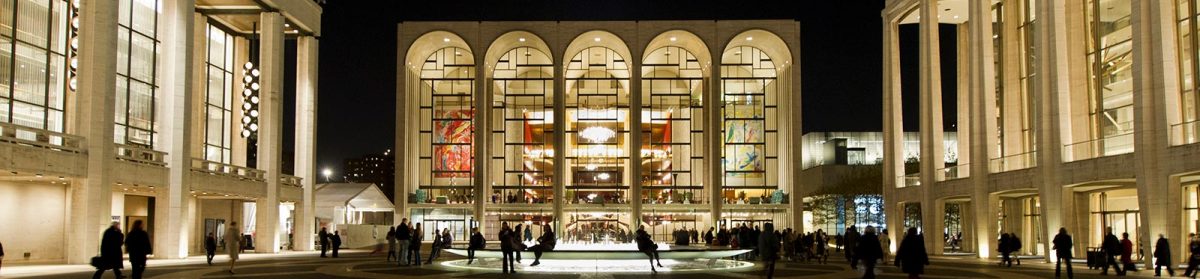
In this 11th year, over ten nights performances from the Met’s Live in HD series will be shown starting with a screening of FUNNY FACE in a special co-presentation with Film at Lincoln Center. Screenings run from August 23 through September 2. There will be 3000 seats in the Plaza in front of the Opera House with an additional standing room area. Cancellations due to thunder/lighting or high wind will not be rescheduled.

RIGOLETTO:Verdi
Original Air Date: 12/07/1968
Cleva; Merrill, Moffo, Bergonzi, Michalski, Love
SID.19350106
A bit of a mini-Robert Merrill festival with his Scarpia and Rigoletto in one week. While RM may be a good shot away from the dramatic demands of Scarpia, Rigoletto worked better for him, not least because of the richness of his voice. I remember this performance well, and while neither Bergonzi nor Merrill are perfect, they brought me much pleasure. Moffo is not in especially good voice (Lucia awaits her before the broadcast microphones 8 weeks later).

UN BALLO IN MASCHERA:Verdi
Original Air Date: 03/17/1962
Santi; Bergonzi, Rysanek, Merrill, Rothenberger, Madeira
SID.19350212
This is the cast that premiered the new production a few weeks earlier, and brought Bergonzi’s matchless Riccardo to Met audiences. He would go on to sing it with the Met 33 times, a house record. Bergonzi has two distinguished studio recordings, and for anyone who saw his performance, it was one of the great assumptions of the postwar Met. He had no better Verdian role, and no other tenor so epitomized the virtues of Verdi’s music. July 13, was Bergonzi’s birthday, and we all truly wish him Cent’anni. Rysanek received good reviews, but the scrutiny of the broadcast microphones show more of a mixed bag. Rysanek does two more Amelias the following season and with a broadcast Don Carlo in 1964, Rysanek is done with Verdi at the Met. She continues at the Met for another 32 years with many distinguished performances, but Italian opera which was her original calling card (as Lady Macbeth) is gone from her repertory. Renato was one of Merrill’s best roles, and recently hearing him in 1963 with Nilsson and Tucker in this Ballo production on Sirius, Merrill makes a strong case for this as the third starring role. He dominated the broadcast airwaves in this role for close to two decades, and especially when he gets to Eri tu and the drawing of the lots, he really leaves competition inside and outside the Met far to the rear (Cappuccilli has a distinguished video from Covent Garden, and his mostly non-Met presence (debut and farewell as Germont on the same night) remains a great loss for the Met. Only Santi and Bergonzi are still with us, and I think Santi is still conducting. This is the cast of the premiere of the new production, and finds Rysanek in uneven form. Bergonzi, Merrill and Rothenberger are just about as good as you can get. Merrill is here in his 3d of 8 broadcasts of Renato from 1955-1975. Milnes breaks the chronology for 1 broadcast in 1973, otherwise if Ballo is on the radio, it’s Bob on board. The conspiracy scene is further strengthened by Giaiotti’s Sam.
RIGOLETTO:Verdi
Original Air Date: 12/07/1968
Cleva; Merrill, Moffo, Bergonzi, Michalski, Love
SID.19350422
A bit of a mini-Robert Merrill festival with his Scarpia and Rigoletto in one week. While RM may be a good shot away from the dramatic demands of Scarpia, Rigoletto worked better for him, not least because of the richness of his voice. I remember this performance well, and while neither Bergonzi nor Merrill are perfect, they brought me much pleasure. Moffo is not in especially good voice (Lucia awaits her before the broadcast microphones 8 weeks later).
UN BALLO IN MASCHERA:Verdi
Original Air Date: 03/17/1962
Santi; Bergonzi, Rysanek, Merrill, Rothenberger, Madeira
SID.19350428
This is the cast that premiered the new production a few weeks earlier, and brought Bergonzi’s matchless Riccardo to Met audiences. He would go on to sing it with the Met 33 times, a house record. Bergonzi has two distinguished studio recordings, and for anyone who saw his performance, it was one of the great assumptions of the postwar Met. He had no better Verdian role, and no other tenor so epitomized the virtues of Verdi’s music. July 13, was Bergonzi’s birthday, and we all truly wish him Cent’anni. Rysanek received good reviews, but the scrutiny of the broadcast microphones show more of a mixed bag. Rysanek does two more Amelias the following season and with a broadcast Don Carlo in 1964, Rysanek is done with Verdi at the Met. She continues at the Met for another 32 years with many distinguished performances, but Italian opera which was her original calling card (as Lady Macbeth) is gone from her repertory. Renato was one of Merrill’s best roles, and recently hearing him in 1963 with Nilsson and Tucker in this Ballo production on Sirius, Merrill makes a strong case for this as the third starring role. He dominated the broadcast airwaves in this role for close to two decades, and especially when he gets to Eri tu and the drawing of the lots, he really leaves competition inside and outside the Met far to the rear (Cappuccilli has a distinguished video from Covent Garden, and his mostly non-Met presence (debut and farewell as Germont on the same night) remains a great loss for the Met. Only Santi and Bergonzi are still with us, and I think Santi is still conducting. This is the cast of the premiere of the new production, and finds Rysanek in uneven form. Bergonzi, Merrill and Rothenberger are just about as good as you can get. Merrill is here in his 3d of 8 broadcasts of Renato from 1955-1975. Milnes breaks the chronology for 1 broadcast in 1973, otherwise if Ballo is on the radio, it’s Bob on board. The conspiracy scene is further strengthened by Giaiotti’s Sam.
RIGOLETTO:Verdi
Original Air Date: 12/07/1968
Cleva; Merrill, Moffo, Bergonzi, Michalski, Love
SID.19350639
A bit of a mini-Robert Merrill festival with his Scarpia and Rigoletto in one week. While RM may be a good shot away from the dramatic demands of Scarpia, Rigoletto worked better for him, not least because of the richness of his voice. I remember this performance well, and while neither Bergonzi nor Merrill are perfect, they brought me much pleasure. Moffo is not in especially good voice (Lucia awaits her before the broadcast microphones 8 weeks later).
UN BALLO IN MASCHERA:Verdi
Original Air Date: 03/17/1962
Santi; Bergonzi, Rysanek, Merrill, Rothenberger, Madeira
SID.19350744
This is the cast that premiered the new production a few weeks earlier, and brought Bergonzi’s matchless Riccardo to Met audiences. He would go on to sing it with the Met 33 times, a house record. Bergonzi has two distinguished studio recordings, and for anyone who saw his performance, it was one of the great assumptions of the postwar Met. He had no better Verdian role, and no other tenor so epitomized the virtues of Verdi’s music. July 13, was Bergonzi’s birthday, and we all truly wish him Cent’anni. Rysanek received good reviews, but the scrutiny of the broadcast microphones show more of a mixed bag. Rysanek does two more Amelias the following season and with a broadcast Don Carlo in 1964, Rysanek is done with Verdi at the Met. She continues at the Met for another 32 years with many distinguished performances, but Italian opera which was her original calling card (as Lady Macbeth) is gone from her repertory. Renato was one of Merrill’s best roles, and recently hearing him in 1963 with Nilsson and Tucker in this Ballo production on Sirius, Merrill makes a strong case for this as the third starring role. He dominated the broadcast airwaves in this role for close to two decades, and especially when he gets to Eri tu and the drawing of the lots, he really leaves competition inside and outside the Met far to the rear (Cappuccilli has a distinguished video from Covent Garden, and his mostly non-Met presence (debut and farewell as Germont on the same night) remains a great loss for the Met. Only Santi and Bergonzi are still with us, and I think Santi is still conducting. This is the cast of the premiere of the new production, and finds Rysanek in uneven form. Bergonzi, Merrill and Rothenberger are just about as good as you can get. Merrill is here in his 3d of 8 broadcasts of Renato from 1955-1975. Milnes breaks the chronology for 1 broadcast in 1973, otherwise if Ballo is on the radio, it’s Bob on board. The conspiracy scene is further strengthened by Giaiotti’s Sam.

FAUST:Gounod
Original Air Date: 01/04/1958
Morel; Gedda, Güden, Hines, Merrill, Roggero
MOD Audio SID.19360211
Gedda (in his first season and his first broadcast) is extremely fine. This performance is also available on MOoD. The other bulwark is Robert Merrill’s Valentin. Guden and Hines are OK, but certainly not the first interpreter you would want to hear. Gedda and Merrill are top drawer, better stlll are several Marguerites to Guden, and Hines while earnest is far from Siepi’s league. Siepi has not one but TWO broadcast Fausts from the Met with Bjorling– 1950 and 1959 and these are long overdue for retransmission and listing in MOoD. Siepi has six broadcast Mephistopheles, only two of which have been on Sirius, the 1955 with Peerce and De Los Angeles and Merrill (also on MOoD) and 1964 with Morell and Moffo. This has been on before and Gedda and Merrill certainly are very fine in their parts, but the continue avoidance of the TWO Bjoerling (1950 and 1959 my preference is for 1959) broadcasts is a big gap in the Met broadcast legacy on Sirius. Where is the 1949 with Kirsten and DiStefano. The Morel is also on Met Player.

LA FORZA DEL DESTINO:Verdi
Original Air Date: 12/30/1961
Schick; Farrell, Tucker, Merrill, Hines, Vanni, Corena
SID.19360212
This production was on tour in Dallas five months later with Amara replacing Farrell who was ill, and Peerce who was doing his first Alvaros with the Met. Schick has the forces very mobilized. Farrell is not ideal, but nice to hear her. The men are all in close to absolute prime even if the fare is more Idaho than pasta, it’s top quality.

AIDA:Verdi
Original Air Date: 03/11/1950
Cooper; Welitsch, Vinay, Harshaw, Merrill, Hines
MOD Audio SID.19360315
Welitsch has some powerful moments, and a pleasure to hear early Merrill in this role. He is the Met champion Amonasro with 72 (MacNeil is 71, and Amato 70)
FAUST:Gounod
Original Air Date: 01/04/1958
Morel; Gedda, Güden, Hines, Merrill, Roggero
MOD Audio SID.19360427
Gedda (in his first season and his first broadcast) is extremely fine. This performance is also available on MOoD. The other bulwark is Robert Merrill’s Valentin. Guden and Hines are OK, but certainly not the first interpreter you would want to hear. Gedda and Merrill are top drawer, better stlll are several Marguerites to Guden, and Hines while earnest is far from Siepi’s league. Siepi has not one but TWO broadcast Fausts from the Met with Bjorling– 1950 and 1959 and these are long overdue for retransmission and listing in MOoD. Siepi has six broadcast Mephistopheles, only two of which have been on Sirius, the 1955 with Peerce and De Los Angeles and Merrill (also on MOoD) and 1964 with Morell and Moffo. This has been on before and Gedda and Merrill certainly are very fine in their parts, but the continue avoidance of the TWO Bjoerling (1950 and 1959 my preference is for 1959) broadcasts is a big gap in the Met broadcast legacy on Sirius. Where is the 1949 with Kirsten and DiStefano. The Morel is also on Met Player.
LA FORZA DEL DESTINO:Verdi
Original Air Date: 12/30/1961
Schick; Farrell, Tucker, Merrill, Hines, Vanni, Corena
SID.19360428
This production was on tour in Dallas five months later with Amara replacing Farrell who was ill, and Peerce who was doing his first Alvaros with the Met. Schick has the forces very mobilized. Farrell is not ideal, but nice to hear her. The men are all in close to absolute prime even if the fare is more Idaho than pasta, it’s top quality.
AIDA:Verdi
Original Air Date: 03/11/1950
Cooper; Welitsch, Vinay, Harshaw, Merrill, Hines
MOD Audio SID.19360531
Welitsch has some powerful moments, and a pleasure to hear early Merrill in this role. He is the Met champion Amonasro with 72 (MacNeil is 71, and Amato 70)
FAUST:Gounod
Original Air Date: 01/04/1958
Morel; Gedda, Güden, Hines, Merrill, Roggero
MOD Audio SID.19360637
Gedda (in his first season and his first broadcast) is extremely fine. This performance is also available on MOoD. The other bulwark is Robert Merrill’s Valentin. Guden and Hines are OK, but certainly not the first interpreter you would want to hear. Gedda and Merrill are top drawer, better stlll are several Marguerites to Guden, and Hines while earnest is far from Siepi’s league. Siepi has not one but TWO broadcast Fausts from the Met with Bjorling– 1950 and 1959 and these are long overdue for retransmission and listing in MOoD. Siepi has six broadcast Mephistopheles, only two of which have been on Sirius, the 1955 with Peerce and De Los Angeles and Merrill (also on MOoD) and 1964 with Morell and Moffo. This has been on before and Gedda and Merrill certainly are very fine in their parts, but the continue avoidance of the TWO Bjoerling (1950 and 1959 my preference is for 1959) broadcasts is a big gap in the Met broadcast legacy on Sirius. Where is the 1949 with Kirsten and DiStefano. The Morel is also on Met Player.
LA FORZA DEL DESTINO:Verdi
Original Air Date: 12/30/1961
Schick; Farrell, Tucker, Merrill, Hines, Vanni, Corena
SID.19360744
This production was on tour in Dallas five months later with Amara replacing Farrell who was ill, and Peerce who was doing his first Alvaros with the Met. Schick has the forces very mobilized. Farrell is not ideal, but nice to hear her. The men are all in close to absolute prime even if the fare is more Idaho than pasta, it’s top quality.
AIDA:Verdi
Original Air Date: 03/11/1950
Cooper; Welitsch, Vinay, Harshaw, Merrill, Hines
MOD Audio SID.19360747
Welitsch has some powerful moments, and a pleasure to hear early Merrill in this role. He is the Met champion Amonasro with 72 (MacNeil is 71, and Amato 70)

TOSCA:Puccini
Original Air Date: 04/17/1965
Cleva; Crespin, Kónya, Merrill
SID.19380211
Crespin the first singer to repeat Tosca in more than a decade before the Met broadcast microphones. if you savor the Gallic tang with a dollop of Roman pepper, she is a fine Tosca. This performance has been on before, but they don’t overuse it. She was the first Tosca to repeat her Floria on the airwaves. Bing had 9 different Toscas from 1952 until 1968 when Crespin repeated with a slightly better cast. Both have been on Sirius. This broadcast finds her in marginally better voice, and is Merrill’s only Scarpia broadcast (he only has 12) and while no match dramatically for Warren or early MacNeil (Gobbi never broadcast the role from the Met), Merrill certainly has some vocal artillery to display. Arguably the most beautiful baritone voice and right up there at the very top in any vocal category.
TOSCA:Puccini
Original Air Date: 04/17/1965
Cleva; Crespin, Kónya, Merrill
SID.19380427
Crespin the first singer to repeat Tosca in more than a decade before the Met broadcast microphones. if you savor the Gallic tang with a dollop of Roman pepper, she is a fine Tosca. This performance has been on before, but they don’t overuse it. She was the first Tosca to repeat her Floria on the airwaves. Bing had 9 different Toscas from 1952 until 1968 when Crespin repeated with a slightly better cast. Both have been on Sirius. This broadcast finds her in marginally better voice, and is Merrill’s only Scarpia broadcast (he only has 12) and while no match dramatically for Warren or early MacNeil (Gobbi never broadcast the role from the Met), Merrill certainly has some vocal artillery to display. Arguably the most beautiful baritone voice and right up there at the very top in any vocal category.
TOSCA:Puccini
Original Air Date: 04/17/1965
Cleva; Crespin, Kónya, Merrill
SID.19380636
Crespin the first singer to repeat Tosca in more than a decade before the Met broadcast microphones. if you savor the Gallic tang with a dollop of Roman pepper, she is a fine Tosca. This performance has been on before, but they don’t overuse it. She was the first Tosca to repeat her Floria on the airwaves. Bing had 9 different Toscas from 1952 until 1968 when Crespin repeated with a slightly better cast. Both have been on Sirius. This broadcast finds her in marginally better voice, and is Merrill’s only Scarpia broadcast (he only has 12) and while no match dramatically for Warren or early MacNeil (Gobbi never broadcast the role from the Met), Merrill certainly has some vocal artillery to display. Arguably the most beautiful baritone voice and right up there at the very top in any vocal category.

RIGOLETTO:Verdi
Original Air Date: 01/05/1957
Cleva; Merrill, Güden, Peerce, Tozzi, Roggero
SID.19390209
This exact same cast broadcast Rigoletto four years earlier– Bing could be very much a creature of habit. Also the exact same trio of leads as the 1953 performance except Erede was in the pit. This is Merrill probably at his vocal peak (the Rigoletto broadcasts would mostly alternate between Warren (often with Tucker) and Merrill, with Tucker’s brother-in law. Luxury indeed. Let me put in a word here for the 1960 Rigoletto which has MacNeil’s first broadcast jester, Giaiotti as Monterone and Tozzi in the third of his three broadcast Sparafuciles. 1957 like so many years was an extraordinary year for Merrill’s instrument. Take a listen. A note on representation in MOoD for Rigoletto. There is no performance represented there between 1945 and 1973. The 1945 shows Warren at close to his vocal best, but no representation of Tucker’s Duke– four broadcasts from 1951-1972, nor Peerce’s, the 1960 for MacNeil, and no Merrill Rigoletto at all, and the same for Peters’ Gilda. Considering some of the mediocre Rigolettos that ARE included, this is one of the worst gaps in terms of match of Sirius/ MOoD to actual Met performance and broadcast history.

UN BALLO IN MASCHERA:Verdi
Original Air Date: 01/30/1971
Cleva; Domingo, Arroyo, Merrill, Peters, Dunn
SID.19390316
This is a solid Ballo with early Domingo (he only arrived in 1968) and late Merrill (well Merrill had one more broadcast and 5 more seasons actually concluding his Met tenure in Detroit in May 1976. On the broadcast airwaves, Merrill totally dominated with 8 of the 9 broadcasts between 1955 and 1975. Arroyo has several impressive moments in the role, but while the top is very secure, the flow in the lower register is not her natural strength. Still, this is an afternoon with little to wince at from anyone.
RIGOLETTO:Verdi
Original Air Date: 01/05/1957
Cleva; Merrill, Güden, Peerce, Tozzi, Roggero
SID.19390532
This exact same cast broadcast Rigoletto four years earlier– Bing could be very much a creature of habit. Also the exact same trio of leads as the 1953 performance except Erede was in the pit. This is Merrill probably at his vocal peak (the Rigoletto broadcasts would mostly alternate between Warren (often with Tucker) and Merrill, with Tucker’s brother-in law. Luxury indeed. Let me put in a word here for the 1960 Rigoletto which has MacNeil’s first broadcast jester, Giaiotti as Monterone and Tozzi in the third of his three broadcast Sparafuciles. 1957 like so many years was an extraordinary year for Merrill’s instrument. Take a listen. A note on representation in MOoD for Rigoletto. There is no performance represented there between 1945 and 1973. The 1945 shows Warren at close to his vocal best, but no representation of Tucker’s Duke– four broadcasts from 1951-1972, nor Peerce’s, the 1960 for MacNeil, and no Merrill Rigoletto at all, and the same for Peters’ Gilda. Considering some of the mediocre Rigolettos that ARE included, this is one of the worst gaps in terms of match of Sirius/ MOoD to actual Met performance and broadcast history.
UN BALLO IN MASCHERA:Verdi
Cleva; Domingo, Arroyo, Merrill, Peters, Dunn
Original Air Date: 01/30/1971
SID.19390535
This is a solid Ballo with early Domingo (he only arrived in 1968) and late Merrill (well Merrill had one more broadcast and 5 more seasons actually concluding his Met tenure in Detroit in May 1976. On the broadcast airwaves, Merrill totally dominated with 8 of the 9 broadcasts between 1955 and 1975. Arroyo has several impressive moments in the role, but while the top is very secure, the flow in the lower register is not her natural strength. Still, this is an afternoon with little to wince at from anyone.
RIGOLETTO:Verdi
Cleva; Merrill, Güden, Peerce, Tozzi, Roggero
Original Air Date: 01/05/1957
SID.19390744
This exact same cast broadcast Rigoletto four years earlier– Bing could be very much a creature of habit. Also the exact same trio of leads as the 1953 performance except Erede was in the pit. This is Merrill probably at his vocal peak (the Rigoletto broadcasts would mostly alternate between Warren (often with Tucker) and Merrill, with Tucker’s brother-in law. Luxury indeed. Let me put in a word here for the 1960 Rigoletto which has MacNeil’s first broadcast jester, Giaiotti as Monterone and Tozzi in the third of his three broadcast Sparafuciles. 1957 like so many years was an extraordinary year for Merrill’s instrument. Take a listen. A note on representation in MOoD for Rigoletto. There is no performance represented there between 1945 and 1973. The 1945 shows Warren at close to his vocal best, but no representation of Tucker’s Duke– four broadcasts from 1951-1972, nor Peerce’s, the 1960 for MacNeil, and no Merrill Rigoletto at all, and the same for Peters’ Gilda. Considering some of the mediocre Rigolettos that ARE included, this is one of the worst gaps in terms of match of Sirius/ MOoD to actual Met performance and broadcast history.

DON CARLO:Verdi
Stiedry; Bjorling, Rigal, Merrill, Barbieri, Siepi, Hines
Original Air Date: 11/11/1950
MOD Audio
SID.19420211
This is the production that opened the Bing regime in 1950, and re-introduces Don Carlo to New York audiences. The men are the equal or superior of just about anyone who has ever sung these roles. Barbieri was new, and if Eboli was not quite her meat as much as her Amneris, Azucena, and Quickly, she was still the Eboli of choice when the sainted Covent Garden production of 1958 made the case in London for the opera 8 years later. New York was to see more sensational Ebolis in the 1960s with Bumbry, Cossotto, and Verrett delivering masterful portrayals of the Princess. Rigal would not have seemed quite so short of desirable had she had less outstanding colleagues. Elisabetta remains a challenging role, and though never essayed by Milanov (then the queen of Verdi in New York) or Tebaldi (never did the part onstage), the part didn’t turn out to be a major success for either Steber or Rysanek, though both have their moments in the role. Caballe, Freni, Kabaiwanska and Millo all were notable exponents, but runs were very limited. Scotto is mostly very good (not too late, not too heavy, but still not quite the right voice, if still wonderful stylistically. A propos the discussion on Verdi sopranos, Leontyne Price never did the part, which is unsurprising as it does not play to her considerable Verdian strengths—but that’s another discussion. Siepi’s contribution is particularly important in that he opens and closes the Bing regime as Filippo, and it is a shame that the April 1972 performance has not been rebroadcast. Three veterans of the 1950 broadcast, Merrill, Siepi, and Amara (Celestial Voice) as well as two new Verdian stars in Caballe and Milnes.
DON CARLO:Verdi
Stiedry; Bjorling, Rigal, Merrill, Barbieri, Siepi, Hines
Original Air Date: 11/11/1950
MOD Audio
SID.19420426
This is the production that opened the Bing regime in 1950, and re-introduces Don Carlo to New York audiences. The men are the equal or superior of just about anyone who has ever sung these roles. Barbieri was new, and if Eboli was not quite her meat as much as her Amneris, Azucena, and Quickly, she was still the Eboli of choice when the sainted Covent Garden production of 1958 made the case in London for the opera 8 years later. New York was to see more sensational Ebolis in the 1960s with Bumbry, Cossotto, and Verrett delivering masterful portrayals of the Princess. Rigal would not have seemed quite so short of desirable had she had less outstanding colleagues. Elisabetta remains a challenging role, and though never essayed by Milanov (then the queen of Verdi in New York) or Tebaldi (never did the part onstage), the part didn’t turn out to be a major success for either Steber or Rysanek, though both have their moments in the role. Caballe, Freni, Kabaiwanska and Millo all were notable exponents, but runs were very limited. Scotto is mostly very good (not too late, not too heavy, but still not quite the right voice, if still wonderful stylistically. A propos the discussion on Verdi sopranos, Leontyne Price never did the part, which is unsurprising as it does not play to her considerable Verdian strengths—but that’s another discussion. Siepi’s contribution is particularly important in that he opens and closes the Bing regime as Filippo, and it is a shame that the April 1972 performance has not been rebroadcast. Three veterans of the 1950 broadcast, Merrill, Siepi, and Amara (Celestial Voice) as well as two new Verdian stars in Caballe and Milnes.
DON CARLO:Verdi
Stiedry; Bjorling, Rigal, Merrill, Barbieri, Siepi, Hines
Original Air Date: 11/11/1950
MOD Audio
SID.19420529
This is the production that opened the Bing regime in 1950, and re-introduces Don Carlo to New York audiences. The men are the equal or superior of just about anyone who has ever sung these roles. Barbieri was new, and if Eboli was not quite her meat as much as her Amneris, Azucena, and Quickly, she was still the Eboli of choice when the sainted Covent Garden production of 1958 made the case in London for the opera 8 years later. New York was to see more sensational Ebolis in the 1960s with Bumbry, Cossotto, and Verrett delivering masterful portrayals of the Princess. Rigal would not have seemed quite so short of desirable had she had less outstanding colleagues. Elisabetta remains a challenging role, and though never essayed by Milanov (then the queen of Verdi in New York) or Tebaldi (never did the part onstage), the part didn’t turn out to be a major success for either Steber or Rysanek, though both have their moments in the role. Caballe, Freni, Kabaiwanska and Millo all were notable exponents, but runs were very limited. Scotto is mostly very good (not too late, not too heavy, but still not quite the right voice, if still wonderful stylistically. A propos the discussion on Verdi sopranos, Leontyne Price never did the part, which is unsurprising as it does not play to her considerable Verdian strengths—but that’s another discussion. Siepi’s contribution is particularly important in that he opens and closes the Bing regime as Filippo, and it is a shame that the April 1972 performance has not been rebroadcast. Three veterans of the 1950 broadcast, Merrill, Siepi, and Amara (Celestial Voice) as well as two new Verdian stars in Caballe and Milnes.

UN BALLO IN MASCHERA:Verdi
Santi; Tucker, Nilsson, Merrill, Dobbs, Madeira
Original Air Date: 01/12/1963
MOD Audio
SID.19430104
This performance finds the principals in very strong form (Nilsson’s only broadcast from the Met of Amelia) and Tucker is an excellent match for her. Merrill is in his run of eight of the nine Ballo broadcasts between 1955 and 1985!!!! Definitely worth a listen. (Schonberg NYT Review,1/11/63) Birgit Nilsson is by common consent the greatest active Wagenrian soprano, but that does not mean she cannot sing other music. She mader her first appearance of the season at the Metropolitan Opera on Wednesday night, and she sang the role of Amelia in Verdi’s UN BOOLO IN MASCHERA for the first time at the house. And she sang a spectacular performance. It was not the kind of singing, though, that most Italian sopranos bring to the role…Nillsson’s is a Nordic voice with a wider sound than that produced by the Italians, and hence a little cooler. Also, like most Nordic singers, she holds her emotins in check. There is no sobbing, no carrying on, and the general impression is one of complete vocal and emotional control. But what control! …. for more >
UN BALLO IN MASCHERA:Verdi
Santi; Tucker, Nilsson, Merrill, Dobbs, Madeira
Original Air Date: 01/12/1963
MOD Audio
SID.19430530
This performance finds the principals in very strong form (Nilsson’s only broadcast from the Met of Amelia) and Tucker is an excellent match for her. Merrill is in his run of eight of the nine Ballo broadcasts between 1955 and 1985!!!! Definitely worth a listen. (Schonberg NYT Review,1/11/63) Birgit Nilsson is by common consent the greatest active Wagenrian soprano, but that does not mean she cannot sing other music. She mader her first appearance of the season at the Metropolitan Opera on Wednesday night, and she sang the role of Amelia in Verdi’s UN BOOLO IN MASCHERA for the first time at the house. And she sang a spectacular performance. It was not the kind of singing, though, that most Italian sopranos bring to the role…Nillsson’s is a Nordic voice with a wider sound than that produced by the Italians, and hence a little cooler. Also, like most Nordic singers, she holds her emotins in check. There is no sobbing, no carrying on, and the general impression is one of complete vocal and emotional control. But what control! …. for more
UN BALLO IN MASCHERA:Verdi
Santi; Tucker, Nilsson, Merrill, Dobbs, Madeira
Original Air Date: 01/12/1963
MOD Audio
SID.19430643
This performance finds the principals in very strong form (Nilsson’s only broadcast from the Met of Amelia) and Tucker is an excellent match for her. Merrill is in his run of eight of the nine Ballo broadcasts between 1955 and 1985!!!! Definitely worth a listen. (Schonberg NYT Review,1/11/63) Birgit Nilsson is by common consent the greatest active Wagenrian soprano, but that does not mean she cannot sing other music. She mader her first appearance of the season at the Metropolitan Opera on Wednesday night, and she sang the role of Amelia in Verdi’s UN BOOLO IN MASCHERA for the first time at the house. And she sang a spectacular performance. It was not the kind of singing, though, that most Italian sopranos bring to the role…Nillsson’s is a Nordic voice with a wider sound than that produced by the Italians, and hence a little cooler. Also, like most Nordic singers, she holds her emotins in check. There is no sobbing, no carrying on, and the general impression is one of complete vocal and emotional control. But what control! …. for more

UN BALLO IN MASCHERA:Verdi
Molinari, Pradelli, Bergonzi, Price, Merrill, Peters, Dunn
Original Air Date: 02/26/1966
SID.20030316
This is the first of Corelli’s four Don Carlo broadcasts and the 1964 performance which was issued in 2011 on Sony only retains Dalis and Uhde in their roles. Since Curtis-Verna is generally underrepresented, I am happy to have this on, but the missing broadcast which is earnestly called for is Bing’s final broadcast as general manager from 1972 with Siepi and Amara returning in their roles from Bing’s inaugural broadcast 22 years earlier. Curtis-Verna only has one other broadcast, that of Aida in 1957 replacing Tebaldi who had withdrawn the day before due to her mother’s death. Curtis-Verna has a very respectable 97 performances over 9 seasons all in leads, but does not make it past 1966 into the new House. She was interviewed in Opera News before her death in 2009 and finished off her career with a distinguished tenure at University of Washington for more than 3 decades in their voice department.