
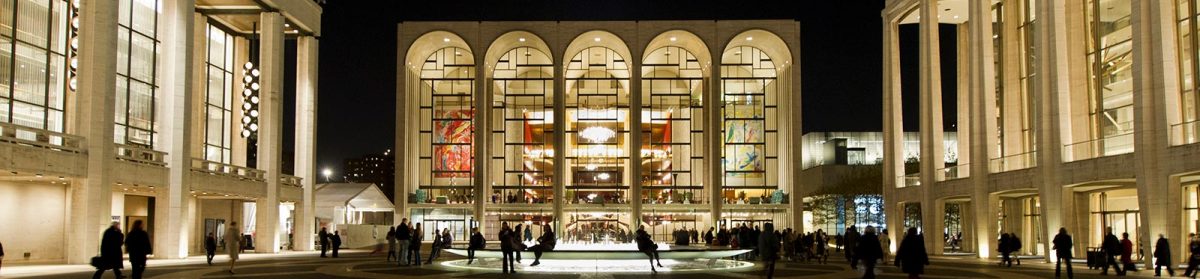
In this 11th year, over ten nights performances from the Met’s Live in HD series will be shown starting with a screening of FUNNY FACE in a special co-presentation with Film at Lincoln Center. Screenings run from August 23 through September 2. There will be 3000 seats in the Plaza in front of the Opera House with an additional standing room area. Cancellations due to thunder/lighting or high wind will not be rescheduled.

UN BALLO IN MASCHERA:Verdi
Original Air Date: 03/17/1962
Santi; Bergonzi, Rysanek, Merrill, Rothenberger, Madeira
SID.19350212
This is the cast that premiered the new production a few weeks earlier, and brought Bergonzi’s matchless Riccardo to Met audiences. He would go on to sing it with the Met 33 times, a house record. Bergonzi has two distinguished studio recordings, and for anyone who saw his performance, it was one of the great assumptions of the postwar Met. He had no better Verdian role, and no other tenor so epitomized the virtues of Verdi’s music. July 13, was Bergonzi’s birthday, and we all truly wish him Cent’anni. Rysanek received good reviews, but the scrutiny of the broadcast microphones show more of a mixed bag. Rysanek does two more Amelias the following season and with a broadcast Don Carlo in 1964, Rysanek is done with Verdi at the Met. She continues at the Met for another 32 years with many distinguished performances, but Italian opera which was her original calling card (as Lady Macbeth) is gone from her repertory. Renato was one of Merrill’s best roles, and recently hearing him in 1963 with Nilsson and Tucker in this Ballo production on Sirius, Merrill makes a strong case for this as the third starring role. He dominated the broadcast airwaves in this role for close to two decades, and especially when he gets to Eri tu and the drawing of the lots, he really leaves competition inside and outside the Met far to the rear (Cappuccilli has a distinguished video from Covent Garden, and his mostly non-Met presence (debut and farewell as Germont on the same night) remains a great loss for the Met. Only Santi and Bergonzi are still with us, and I think Santi is still conducting. This is the cast of the premiere of the new production, and finds Rysanek in uneven form. Bergonzi, Merrill and Rothenberger are just about as good as you can get. Merrill is here in his 3d of 8 broadcasts of Renato from 1955-1975. Milnes breaks the chronology for 1 broadcast in 1973, otherwise if Ballo is on the radio, it’s Bob on board. The conspiracy scene is further strengthened by Giaiotti’s Sam.
UN BALLO IN MASCHERA:Verdi
Original Air Date: 03/17/1962
Santi; Bergonzi, Rysanek, Merrill, Rothenberger, Madeira
SID.19350428
This is the cast that premiered the new production a few weeks earlier, and brought Bergonzi’s matchless Riccardo to Met audiences. He would go on to sing it with the Met 33 times, a house record. Bergonzi has two distinguished studio recordings, and for anyone who saw his performance, it was one of the great assumptions of the postwar Met. He had no better Verdian role, and no other tenor so epitomized the virtues of Verdi’s music. July 13, was Bergonzi’s birthday, and we all truly wish him Cent’anni. Rysanek received good reviews, but the scrutiny of the broadcast microphones show more of a mixed bag. Rysanek does two more Amelias the following season and with a broadcast Don Carlo in 1964, Rysanek is done with Verdi at the Met. She continues at the Met for another 32 years with many distinguished performances, but Italian opera which was her original calling card (as Lady Macbeth) is gone from her repertory. Renato was one of Merrill’s best roles, and recently hearing him in 1963 with Nilsson and Tucker in this Ballo production on Sirius, Merrill makes a strong case for this as the third starring role. He dominated the broadcast airwaves in this role for close to two decades, and especially when he gets to Eri tu and the drawing of the lots, he really leaves competition inside and outside the Met far to the rear (Cappuccilli has a distinguished video from Covent Garden, and his mostly non-Met presence (debut and farewell as Germont on the same night) remains a great loss for the Met. Only Santi and Bergonzi are still with us, and I think Santi is still conducting. This is the cast of the premiere of the new production, and finds Rysanek in uneven form. Bergonzi, Merrill and Rothenberger are just about as good as you can get. Merrill is here in his 3d of 8 broadcasts of Renato from 1955-1975. Milnes breaks the chronology for 1 broadcast in 1973, otherwise if Ballo is on the radio, it’s Bob on board. The conspiracy scene is further strengthened by Giaiotti’s Sam.
UN BALLO IN MASCHERA:Verdi
Original Air Date: 03/17/1962
Santi; Bergonzi, Rysanek, Merrill, Rothenberger, Madeira
SID.19350744
This is the cast that premiered the new production a few weeks earlier, and brought Bergonzi’s matchless Riccardo to Met audiences. He would go on to sing it with the Met 33 times, a house record. Bergonzi has two distinguished studio recordings, and for anyone who saw his performance, it was one of the great assumptions of the postwar Met. He had no better Verdian role, and no other tenor so epitomized the virtues of Verdi’s music. July 13, was Bergonzi’s birthday, and we all truly wish him Cent’anni. Rysanek received good reviews, but the scrutiny of the broadcast microphones show more of a mixed bag. Rysanek does two more Amelias the following season and with a broadcast Don Carlo in 1964, Rysanek is done with Verdi at the Met. She continues at the Met for another 32 years with many distinguished performances, but Italian opera which was her original calling card (as Lady Macbeth) is gone from her repertory. Renato was one of Merrill’s best roles, and recently hearing him in 1963 with Nilsson and Tucker in this Ballo production on Sirius, Merrill makes a strong case for this as the third starring role. He dominated the broadcast airwaves in this role for close to two decades, and especially when he gets to Eri tu and the drawing of the lots, he really leaves competition inside and outside the Met far to the rear (Cappuccilli has a distinguished video from Covent Garden, and his mostly non-Met presence (debut and farewell as Germont on the same night) remains a great loss for the Met. Only Santi and Bergonzi are still with us, and I think Santi is still conducting. This is the cast of the premiere of the new production, and finds Rysanek in uneven form. Bergonzi, Merrill and Rothenberger are just about as good as you can get. Merrill is here in his 3d of 8 broadcasts of Renato from 1955-1975. Milnes breaks the chronology for 1 broadcast in 1973, otherwise if Ballo is on the radio, it’s Bob on board. The conspiracy scene is further strengthened by Giaiotti’s Sam.

LA BOHÈME:Puccini
Original Air Date: 01/20/1962
Rich; Amara, Morell, Hurley, Testi, Giaiotti
SID.19360104
Not much in this cast draws me except for Giaiotti’s only broadcast Colline. He was considered by many in the tier behind Siepi, Tozzi, and Hines. He was an anchor of the Met ensemble for almost 3 decades, and frequently encountered as Timur, Raimondo, and Ramfis. There are definitely more interesting Bohemes out there, and they are broadcast more frequently than this. Still not a plus in this week’s listings.

DIE WALKÜRE:Wagner
Original Air Date: 12/23/1961
Leinsdorf; Nilsson, Edelmann, Kuchta, Vickers, Dalis, Wiemann
MOD Audio SID.19360209
The two real vocal standouts are Nilsson and Vickers, who would put down in London a few months later a marvelous studio version with George London, Rita Gorr, and Gre Brouwenstijn under Leinsdorf; the Valkyries are a particularly strong group, among the best ever. A positive word on Ernst Wiemann, a German Giaiotti : a strong voice with a solid technique and well schooled in the German repertoire. Dalis is an incisive Fricka.
DIE WALKÜRE:Wagner
Original Air Date: 12/23/1961
Leinsdorf; Nilsson, Edelmann, Kuchta, Vickers, Dalis, Wiemann
MOD Audio SID.19360210
The two real vocal standouts are Nilsson and Vickers, who would put down in London a few months later a marvelous studio version with George London, Rita Gorr, and Gre Brouwenstijn under Leinsdorf; the Valkyries are a particularly strong group, among the best ever. A positive word on Ernst Wiemann, a German Giaiotti : a strong voice with a solid technique and well schooled in the German repertoire. Dalis is an incisive Fricka.

LA FORZA DEL DESTINO:Verdi
Original Air Date: 12/30/1961
Schick; Farrell, Tucker, Merrill, Hines, Vanni, Corena
SID.19360212
This production was on tour in Dallas five months later with Amara replacing Farrell who was ill, and Peerce who was doing his first Alvaros with the Met. Schick has the forces very mobilized. Farrell is not ideal, but nice to hear her. The men are all in close to absolute prime even if the fare is more Idaho than pasta, it’s top quality.
LA BOHÈME:Puccini
Original Air Date: 01/20/1962
Rich; Amara, Morell, Hurley, Testi, Giaiotti
SID.19360320
Not much in this cast draws me except for Giaiotti’s only broadcast Colline. He was considered by many in the tier behind Siepi, Tozzi, and Hines. He was an anchor of the Met ensemble for almost 3 decades, and frequently encountered as Timur, Raimondo, and Ramfis. There are definitely more interesting Bohemes out there, and they are broadcast more frequently than this. Still not a plus in this week’s listings.
DIE WALKÜRE:Wagner
Original Air Date: 12/23/1961
Leinsdorf; Nilsson, Edelmann, Kuchta, Vickers, Dalis, Wiemann
MOD Audio SID.19360425
The two real vocal standouts are Nilsson and Vickers, who would put down in London a few months later a marvelous studio version with George London, Rita Gorr, and Gre Brouwenstijn under Leinsdorf; the Valkyries are a particularly strong group, among the best ever. A positive word on Ernst Wiemann, a German Giaiotti : a strong voice with a solid technique and well schooled in the German repertoire. Dalis is an incisive Fricka.
DIE WALKÜRE:Wagner
Original Air Date: 12/23/1961
Leinsdorf; Nilsson, Edelmann, Kuchta, Vickers, Dalis, Wiemann
MOD Audio SID.19360426
The two real vocal standouts are Nilsson and Vickers, who would put down in London a few months later a marvelous studio version with George London, Rita Gorr, and Gre Brouwenstijn under Leinsdorf; the Valkyries are a particularly strong group, among the best ever. A positive word on Ernst Wiemann, a German Giaiotti : a strong voice with a solid technique and well schooled in the German repertoire. Dalis is an incisive Fricka.
LA FORZA DEL DESTINO:Verdi
Original Air Date: 12/30/1961
Schick; Farrell, Tucker, Merrill, Hines, Vanni, Corena
SID.19360428
This production was on tour in Dallas five months later with Amara replacing Farrell who was ill, and Peerce who was doing his first Alvaros with the Met. Schick has the forces very mobilized. Farrell is not ideal, but nice to hear her. The men are all in close to absolute prime even if the fare is more Idaho than pasta, it’s top quality.
LA BOHÈME:Puccini
Original Air Date: 01/20/1962
Rich; Amara, Morell, Hurley, Testi, Giaiotti
SID.19360530
Not much in this cast draws me except for Giaiotti’s only broadcast Colline. He was considered by many in the tier behind Siepi, Tozzi, and Hines. He was an anchor of the Met ensemble for almost 3 decades, and frequently encountered as Timur, Raimondo, and Ramfis. There are definitely more interesting Bohemes out there, and they are broadcast more frequently than this. Still not a plus in this week’s listings.
DIE WALKÜRE:Wagner
Original Air Date: 12/23/1961
Leinsdorf; Nilsson, Edelmann, Kuchta, Vickers, Dalis, Wiemann
MOD Audio SID.19360641
The two real vocal standouts are Nilsson and Vickers, who would put down in London a few months later a marvelous studio version with George London, Rita Gorr, and Gre Brouwenstijn under Leinsdorf; the Valkyries are a particularly strong group, among the best ever. A positive word on Ernst Wiemann, a German Giaiotti : a strong voice with a solid technique and well schooled in the German repertoire. Dalis is an incisive Fricka.
DIE WALKÜRE:Wagner
Original Air Date: 12/23/1961
Leinsdorf; Nilsson, Edelmann, Kuchta, Vickers, Dalis, Wiemann
MOD Audio SID.19360642
The two real vocal standouts are Nilsson and Vickers, who would put down in London a few months later a marvelous studio version with George London, Rita Gorr, and Gre Brouwenstijn under Leinsdorf; the Valkyries are a particularly strong group, among the best ever. A positive word on Ernst Wiemann, a German Giaiotti : a strong voice with a solid technique and well schooled in the German repertoire. Dalis is an incisive Fricka.
LA FORZA DEL DESTINO:Verdi
Original Air Date: 12/30/1961
Schick; Farrell, Tucker, Merrill, Hines, Vanni, Corena
SID.19360744
This production was on tour in Dallas five months later with Amara replacing Farrell who was ill, and Peerce who was doing his first Alvaros with the Met. Schick has the forces very mobilized. Farrell is not ideal, but nice to hear her. The men are all in close to absolute prime even if the fare is more Idaho than pasta, it’s top quality.
Donizetti
Varviso; Sutherland, Tucker, Guarrera, Moscona
Original Air Date: 12/09/1961
SID.19520105
This was played around the time of Sutherland’s death in October 2010, but has not been in the rotation often. Sutherland and Tucker are quite a team in her debut role and season. I saw her in Dallas as Lucia about a month before the first Met appearance ( I think she also did San Francisco and Chicago in a jampacked American fall). The size of her voice in the early years still had the remnants of her dramatic soprano beginnings. Zeffirelli had taught her well in terms of movement, and the coloratura — to steal the Italians’ description for her– stupendous. Don’t miss this. Luckily all four of Sutherland’s broadcast seasons are in MOoD. She has her points in all of them. She has Tucker in two of the broadcasts, and Kraus in the telecast. The quality over a 21 period (1961-1983) from her is really remarkable.
Donizetti
Varviso; Sutherland, Tucker, Guarrera, Moscona
Original Air Date: 12/09/1961
SID.19520315
This was played around the time of Sutherland’s death in October 2010, but has not been in the rotation often. Sutherland and Tucker are quite a team in her debut role and season. I saw her in Dallas as Lucia about a month before the first Met appearance ( I think she also did San Francisco and Chicago in a jampacked American fall). The size of her voice in the early years still had the remnants of her dramatic soprano beginnings. Zeffirelli had taught her well in terms of movement, and the coloratura — to steal the Italians’ description for her– stupendous. Don’t miss this. Luckily all four of Sutherland’s broadcast seasons are in MOoD. She has her points in all of them. She has Tucker in two of the broadcasts, and Kraus in the telecast. The quality over a 21 period (1961-1983) from her is really remarkable.
Donizetti
Varviso; Sutherland, Tucker, Guarrera, Moscona
Original Air Date: 12/09/1961
SID.19520423
This was played around the time of Sutherland’s death in October 2010, but has not been in the rotation often. Sutherland and Tucker are quite a team in her debut role and season. I saw her in Dallas as Lucia about a month before the first Met appearance ( I think she also did San Francisco and Chicago in a jampacked American fall). The size of her voice in the early years still had the remnants of her dramatic soprano beginnings. Zeffirelli had taught her well in terms of movement, and the coloratura — to steal the Italians’ description for her– stupendous. Don’t miss this. Luckily all four of Sutherland’s broadcast seasons are in MOoD. She has her points in all of them. She has Tucker in two of the broadcasts, and Kraus in the telecast. The quality over a 21 period (1961-1983) from her is really remarkable.
Donizetti
Varviso; Sutherland, Tucker, Guarrera, Moscona
Original Air Date: 12/09/1961
SID.19520749
This was played around the time of Sutherland’s death in October 2010, but has not been in the rotation often. Sutherland and Tucker are quite a team in her debut role and season. I saw her in Dallas as Lucia about a month before the first Met appearance ( I think she also did San Francisco and Chicago in a jampacked American fall). The size of her voice in the early years still had the remnants of her dramatic soprano beginnings. Zeffirelli had taught her well in terms of movement, and the coloratura — to steal the Italians’ description for her– stupendous. Don’t miss this. Luckily all four of Sutherland’s broadcast seasons are in MOoD. She has her points in all of them. She has Tucker in two of the broadcasts, and Kraus in the telecast. The quality over a 21 period (1961-1983) from her is really remarkable.

TOSCA:Puccini
Adler; Price, Corelli, MacNeil
Original Air Date: 04/07/1962
SID.20020106
One of the great Saturday afternoons. Adler is at best dutiful, and Price is not an ideal Tosca, but she is returning after a vocal rest in full command of her resources. It is her last New York appearance in the role. Cavaradossi was always one of Corelli’s best parts, and MacNeil is in magnificent form. With such vocal riches, it’s a barnburner of an afternoon. The Met has issued this performance as part of Sony’s Historical CD series.
TOSCA:Puccini
Adler; Price, Corelli, MacNeil
Original Air Date: 04/07/1962
SID.20020317
One of the great Saturday afternoons. Adler is at best dutiful, and Price is not an ideal Tosca, but she is returning after a vocal rest in full command of her resources. It is her last New York appearance in the role. Cavaradossi was always one of Corelli’s best parts, and MacNeil is in magnificent form. With such vocal riches, it’s a barnburner of an afternoon. The Met has issued this performance as part of Sony’s Historical CD series.
TOSCA:Puccini
Adler; Price, Corelli, MacNeil
Original Air Date: 04/07/1962
SID.20020533
One of the great Saturday afternoons. Adler is at best dutiful, and Price is not an ideal Tosca, but she is returning after a vocal rest in full command of her resources. It is her last New York appearance in the role. Cavaradossi was always one of Corelli’s best parts, and MacNeil is in magnificent form. With such vocal riches, it’s a barnburner of an afternoon. The Met has issued this performance as part of Sony’s Historical CD series.

LA GIOCONDA:Ponchielli
Cleva; Farrell, Corelli, Merrill, Rankin, Tozzi
Original Air Date: 03/31/1962
SID.20130213
RWW: Here is why I love the current Sirius service for Met repertory : The fall performances went unbroadcast. This 19700/71 Hoffmann was divided between a fall group with Grist, Elias, and Lorengar in the three ladies and the spring offering was Boky, Crespin, and Amara. The excellent Gedda and Bacquier were in both parts of the revival. I saw one of the fall performances and Grist and Lorengar were excellent. The broadcast does not come until spring, and much as Ilove Crespin as an artist, her Giulietta while visually dazzling was one rocky ride on the Venetian canal. Amara sang a solid Antonia, but her tone never had the luster of a Lorengar. Boky I found similarly lacking compared to Grist. Baudo is no Julius Rudel (among the best conductors I’ve ever heard for Hoffmann) or Chailly, let alone Monteux who originated the production in 1955. What should be mentioned is the strong supporting cast including von Stade as Nicklausse , Velis in the 4 comic tenor parts, and Paul Franke as an inimitable Spalanzani.
LA GIOCONDA:Ponchielli
Cleva; Farrell, Corelli, Merrill, Rankin, Tozzi
Original Air Date: 03/31/1962
SID.20130433
RWW: Here is why I love the current Sirius service for Met repertory : The fall performances went unbroadcast. This 19700/71 Hoffmann was divided between a fall group with Grist, Elias, and Lorengar in the three ladies and the spring offering was Boky, Crespin, and Amara. The excellent Gedda and Bacquier were in both parts of the revival. I saw one of the fall performances and Grist and Lorengar were excellent. The broadcast does not come until spring, and much as Ilove Crespin as an artist, her Giulietta while visually dazzling was one rocky ride on the Venetian canal. Amara sang a solid Antonia, but her tone never had the luster of a Lorengar. Boky I found similarly lacking compared to Grist. Baudo is no Julius Rudel (among the best conductors I’ve ever heard for Hoffmann) or Chailly, let alone Monteux who originated the production in 1955. What should be mentioned is the strong supporting cast including von Stade as Nicklausse , Velis in the 4 comic tenor parts, and Paul Franke as an inimitable Spalanzani.
LA GIOCONDA:Ponchielli
Cleva; Farrell, Corelli, Merrill, Rankin, Tozzi
Original Air Date: 03/31/1962
SID.20130751
RWW: Here is why I love the current Sirius service for Met repertory : The fall performances went unbroadcast. This 19700/71 Hoffmann was divided between a fall group with Grist, Elias, and Lorengar in the three ladies and the spring offering was Boky, Crespin, and Amara. The excellent Gedda and Bacquier were in both parts of the revival. I saw one of the fall performances and Grist and Lorengar were excellent. The broadcast does not come until spring, and much as Ilove Crespin as an artist, her Giulietta while visually dazzling was one rocky ride on the Venetian canal. Amara sang a solid Antonia, but her tone never had the luster of a Lorengar. Boky I found similarly lacking compared to Grist. Baudo is no Julius Rudel (among the best conductors I’ve ever heard for Hoffmann) or Chailly, let alone Monteux who originated the production in 1955. What should be mentioned is the strong supporting cast including von Stade as Nicklausse , Velis in the 4 comic tenor parts, and Paul Franke as an inimitable Spalanzani.

LA TRAVIATA:Verdi
Strasfogel; Moffo, Morell, Sereni
Original Air Date: 04/21/1962
SID.20160213
I’m sure I heard this performance while I was still living in Texas, but despite the visual glamor of Moffo, I find her appeal in this part limited. Along with Albanese (not one of my favorites) with 87, Moffo with her 80 Violettas totally dominate the chronology. Sembrich and Bori are the next two down and by more than two and half dozen. Most Violetta totals at the Met hover between 15 and 25. This is Moffo’s first Violetta broadcast, so probably her best. Her other two (in different seasons) come in 1967, and I know those performances well. Although Moffo had a high selling Traviata for RCA, this is the first of her three broadcasts, and the only one that has been on Sirius. I like her commercial, but as early as 1967, vocally I found her compromised (but always with huge E flat). Morell and Sereni are OK, no more. This is the first of Moffo’s three Violetta broadcasts; the other two are in 1967 (in different seasons). Moffo was a gorgeous Violetta, and very successful. I’m not sure how well it bears up in live performance in an audio only mode, but I’ll give this a try. As for the other Met broadcast Traviatas, I wish the Met would reach back to the 1935 Ponselle/Tibbett Traviata under Panizza. This has been on private labels for years and exists in good enough sound. Ponselle will not be to everyone’s taste, but I find the duet with Tibbett with Panizza’s masterly support to be of the highest quality. Albanese is the dominant Violetta (with several broadcasts from Sayao none on Sirius), but her only appearance on Sirius is her last Violetta broadcast in 1959. It’s a little late, but since I don’t much care for her Violetta (see Paul Jackson’s analysis of Met broadcasts– he worships Albanese), she is partnered by Valletti, and they make a winning pair. Two performances which have been on Sirius and are both on Met Player are the Steber with DiStefano and Merrill from 1949 (she’s replacing Sayao and practically doing a lesson in vocal technique and exquisite vocalism) and Tebaldi from 1957, where first act transpositions are mostly irrelevant to one of the most celebrated performances ever. Tebaldi did 21 performances in a single season, and Bing sent her everywhere. If not quite the perfection of the Tosca, this Violetta is quite memorable. Almost worth a Met Player subscription on its own. Surprisingly, the 1964 Sutherland Violetta has not been on Sirius. This omission should be corrected as part of the Guild’s upcoming memorial to her. I saw her Violetta at least 3 times, and it was one of her most memorable roles. Sutherland is not the only omission that should make its way to Sirius. I remember Cruz-Romo’s fine 1973 broadcast (very much in the Tebaldi tradition), Rita Shane replacing Sills in 1976 (Wixell’s only Germont broadcast), Maria Chiara in 1977, Malfitano in 1982 (I think the first to do two verses of Addio del passato), Maliponte in 1984 (I don’t remember this performance but she’s a favorite of many on this list including me) 1987 with Tomowa Sintow (again I have no memory, but she’s a singer I remember fondly) and the 2000 broadcast with Gallardo-Domas. While I thought Butterfly too heavy for her, her Violetta is one of the very best, and this has not made it to Sirius. Sirius has some heavy lifting to do for Traviata!
LA TRAVIATA:Verdi
Strasfogel; Moffo, Morell, Sereni
Original Air Date: 04/21/1962
SID.20160432
I’m sure I heard this performance while I was still living in Texas, but despite the visual glamor of Moffo, I find her appeal in this part limited. Along with Albanese (not one of my favorites) with 87, Moffo with her 80 Violettas totally dominate the chronology. Sembrich and Bori are the next two down and by more than two and half dozen. Most Violetta totals at the Met hover between 15 and 25. This is Moffo’s first Violetta broadcast, so probably her best. Her other two (in different seasons) come in 1967, and I know those performances well. Although Moffo had a high selling Traviata for RCA, this is the first of her three broadcasts, and the only one that has been on Sirius. I like her commercial, but as early as 1967, vocally I found her compromised (but always with huge E flat). Morell and Sereni are OK, no more. This is the first of Moffo’s three Violetta broadcasts; the other two are in 1967 (in different seasons). Moffo was a gorgeous Violetta, and very successful. I’m not sure how well it bears up in live performance in an audio only mode, but I’ll give this a try. As for the other Met broadcast Traviatas, I wish the Met would reach back to the 1935 Ponselle/Tibbett Traviata under Panizza. This has been on private labels for years and exists in good enough sound. Ponselle will not be to everyone’s taste, but I find the duet with Tibbett with Panizza’s masterly support to be of the highest quality. Albanese is the dominant Violetta (with several broadcasts from Sayao none on Sirius), but her only appearance on Sirius is her last Violetta broadcast in 1959. It’s a little late, but since I don’t much care for her Violetta (see Paul Jackson’s analysis of Met broadcasts– he worships Albanese), she is partnered by Valletti, and they make a winning pair. Two performances which have been on Sirius and are both on Met Player are the Steber with DiStefano and Merrill from 1949 (she’s replacing Sayao and practically doing a lesson in vocal technique and exquisite vocalism) and Tebaldi from 1957, where first act transpositions are mostly irrelevant to one of the most celebrated performances ever. Tebaldi did 21 performances in a single season, and Bing sent her everywhere. If not quite the perfection of the Tosca, this Violetta is quite memorable. Almost worth a Met Player subscription on its own. Surprisingly, the 1964 Sutherland Violetta has not been on Sirius. This omission should be corrected as part of the Guild’s upcoming memorial to her. I saw her Violetta at least 3 times, and it was one of her most memorable roles. Sutherland is not the only omission that should make its way to Sirius. I remember Cruz-Romo’s fine 1973 broadcast (very much in the Tebaldi tradition), Rita Shane replacing Sills in 1976 (Wixell’s only Germont broadcast), Maria Chiara in 1977, Malfitano in 1982 (I think the first to do two verses of Addio del passato), Maliponte in 1984 (I don’t remember this performance but she’s a favorite of many on this list including me) 1987 with Tomowa Sintow (again I have no memory, but she’s a singer I remember fondly) and the 2000 broadcast with Gallardo-Domas. While I thought Butterfly too heavy for her, her Violetta is one of the very best, and this has not made it to Sirius. Sirius has some heavy lifting to do for Traviata!
LA TRAVIATA:Verdi
Strasfogel; Moffo, Morell, Sereni
Original Air Date: 04/21/1962
SID.20160750
I’m sure I heard this performance while I was still living in Texas, but despite the visual glamor of Moffo, I find her appeal in this part limited. Along with Albanese (not one of my favorites) with 87, Moffo with her 80 Violettas totally dominate the chronology. Sembrich and Bori are the next two down and by more than two and half dozen. Most Violetta totals at the Met hover between 15 and 25. This is Moffo’s first Violetta broadcast, so probably her best. Her other two (in different seasons) come in 1967, and I know those performances well. Although Moffo had a high selling Traviata for RCA, this is the first of her three broadcasts, and the only one that has been on Sirius. I like her commercial, but as early as 1967, vocally I found her compromised (but always with huge E flat). Morell and Sereni are OK, no more. This is the first of Moffo’s three Violetta broadcasts; the other two are in 1967 (in different seasons). Moffo was a gorgeous Violetta, and very successful. I’m not sure how well it bears up in live performance in an audio only mode, but I’ll give this a try. As for the other Met broadcast Traviatas, I wish the Met would reach back to the 1935 Ponselle/Tibbett Traviata under Panizza. This has been on private labels for years and exists in good enough sound. Ponselle will not be to everyone’s taste, but I find the duet with Tibbett with Panizza’s masterly support to be of the highest quality. Albanese is the dominant Violetta (with several broadcasts from Sayao none on Sirius), but her only appearance on Sirius is her last Violetta broadcast in 1959. It’s a little late, but since I don’t much care for her Violetta (see Paul Jackson’s analysis of Met broadcasts– he worships Albanese), she is partnered by Valletti, and they make a winning pair. Two performances which have been on Sirius and are both on Met Player are the Steber with DiStefano and Merrill from 1949 (she’s replacing Sayao and practically doing a lesson in vocal technique and exquisite vocalism) and Tebaldi from 1957, where first act transpositions are mostly irrelevant to one of the most celebrated performances ever. Tebaldi did 21 performances in a single season, and Bing sent her everywhere. If not quite the perfection of the Tosca, this Violetta is quite memorable. Almost worth a Met Player subscription on its own. Surprisingly, the 1964 Sutherland Violetta has not been on Sirius. This omission should be corrected as part of the Guild’s upcoming memorial to her. I saw her Violetta at least 3 times, and it was one of her most memorable roles. Sutherland is not the only omission that should make its way to Sirius. I remember Cruz-Romo’s fine 1973 broadcast (very much in the Tebaldi tradition), Rita Shane replacing Sills in 1976 (Wixell’s only Germont broadcast), Maria Chiara in 1977, Malfitano in 1982 (I think the first to do two verses of Addio del passato), Maliponte in 1984 (I don’t remember this performance but she’s a favorite of many on this list including me) 1987 with Tomowa Sintow (again I have no memory, but she’s a singer I remember fondly) and the 2000 broadcast with Gallardo-Domas. While I thought Butterfly too heavy for her, her Violetta is one of the very best, and this has not made it to Sirius. Sirius has some heavy lifting to do for Traviata!