
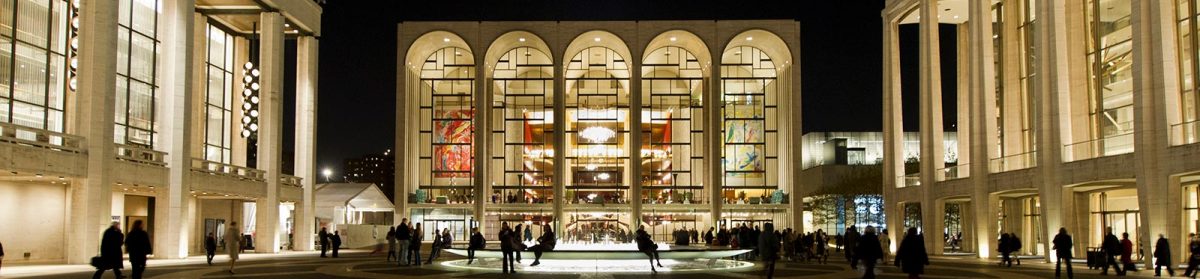
In this 11th year, over ten nights performances from the Met’s Live in HD series will be shown starting with a screening of FUNNY FACE in a special co-presentation with Film at Lincoln Center. Screenings run from August 23 through September 2. There will be 3000 seats in the Plaza in front of the Opera House with an additional standing room area. Cancellations due to thunder/lighting or high wind will not be rescheduled.

RIGOLETTO:Verdi
Original Air Date: 01/05/1957
Cleva; Merrill, Güden, Peerce, Tozzi, Roggero
SID.19390209
This exact same cast broadcast Rigoletto four years earlier– Bing could be very much a creature of habit. Also the exact same trio of leads as the 1953 performance except Erede was in the pit. This is Merrill probably at his vocal peak (the Rigoletto broadcasts would mostly alternate between Warren (often with Tucker) and Merrill, with Tucker’s brother-in law. Luxury indeed. Let me put in a word here for the 1960 Rigoletto which has MacNeil’s first broadcast jester, Giaiotti as Monterone and Tozzi in the third of his three broadcast Sparafuciles. 1957 like so many years was an extraordinary year for Merrill’s instrument. Take a listen. A note on representation in MOoD for Rigoletto. There is no performance represented there between 1945 and 1973. The 1945 shows Warren at close to his vocal best, but no representation of Tucker’s Duke– four broadcasts from 1951-1972, nor Peerce’s, the 1960 for MacNeil, and no Merrill Rigoletto at all, and the same for Peters’ Gilda. Considering some of the mediocre Rigolettos that ARE included, this is one of the worst gaps in terms of match of Sirius/ MOoD to actual Met performance and broadcast history.
RIGOLETTO:Verdi
Original Air Date: 01/05/1957
Cleva; Merrill, Güden, Peerce, Tozzi, Roggero
SID.19390532
This exact same cast broadcast Rigoletto four years earlier– Bing could be very much a creature of habit. Also the exact same trio of leads as the 1953 performance except Erede was in the pit. This is Merrill probably at his vocal peak (the Rigoletto broadcasts would mostly alternate between Warren (often with Tucker) and Merrill, with Tucker’s brother-in law. Luxury indeed. Let me put in a word here for the 1960 Rigoletto which has MacNeil’s first broadcast jester, Giaiotti as Monterone and Tozzi in the third of his three broadcast Sparafuciles. 1957 like so many years was an extraordinary year for Merrill’s instrument. Take a listen. A note on representation in MOoD for Rigoletto. There is no performance represented there between 1945 and 1973. The 1945 shows Warren at close to his vocal best, but no representation of Tucker’s Duke– four broadcasts from 1951-1972, nor Peerce’s, the 1960 for MacNeil, and no Merrill Rigoletto at all, and the same for Peters’ Gilda. Considering some of the mediocre Rigolettos that ARE included, this is one of the worst gaps in terms of match of Sirius/ MOoD to actual Met performance and broadcast history.
RIGOLETTO:Verdi
Cleva; Merrill, Güden, Peerce, Tozzi, Roggero
Original Air Date: 01/05/1957
SID.19390744
This exact same cast broadcast Rigoletto four years earlier– Bing could be very much a creature of habit. Also the exact same trio of leads as the 1953 performance except Erede was in the pit. This is Merrill probably at his vocal peak (the Rigoletto broadcasts would mostly alternate between Warren (often with Tucker) and Merrill, with Tucker’s brother-in law. Luxury indeed. Let me put in a word here for the 1960 Rigoletto which has MacNeil’s first broadcast jester, Giaiotti as Monterone and Tozzi in the third of his three broadcast Sparafuciles. 1957 like so many years was an extraordinary year for Merrill’s instrument. Take a listen. A note on representation in MOoD for Rigoletto. There is no performance represented there between 1945 and 1973. The 1945 shows Warren at close to his vocal best, but no representation of Tucker’s Duke– four broadcasts from 1951-1972, nor Peerce’s, the 1960 for MacNeil, and no Merrill Rigoletto at all, and the same for Peters’ Gilda. Considering some of the mediocre Rigolettos that ARE included, this is one of the worst gaps in terms of match of Sirius/ MOoD to actual Met performance and broadcast history.

ERNANI:Verdi
Mitropoulos; Del Monaco, Milanov, Warren, Siepi
Original Air Date: 12/29/1956
MOD Audio
SID.19440210
Elvira is definitely a bit late for Milanov, but the men are the best in the business for these roles in 1956, and all among the greatest ever in these roles. It is the first Met broadcast of Ernani, and although Del Monaco is slightly better in his Florence broadcast with Cerquetti, he is the Verdian bandit to the life. This is a bit late for Milanov, but Warren and Siepi are certainly top drawer as well. Mitropoulos brings his accustomed fire and a few odd choices in musical text. Mitropoulos and Del Monaco are better represented from Florence, and this part is simply too late for Milanov. This part is HARD– check Freni’s challenge at La Scala. Ernani involvami demands full blown coloratura mastery from the moment you open your mouth, and while the rest of the role is mostly ensembles, it’s challenging. Leona Mitchell is mostly very up to the challenges. Two good stabs at the part were NOT broadcast, Arroyo’s opening night with Bergonzi and Milnes, and Millo, (two in the house, four in the parks very early in her Met career). The good news on Ernani is the complete Met broadcast history is documented on Sirius.
ERNANI:Verdi
Mitropoulos; Del Monaco, Milanov, Warren, Siepi
Original Air Date: 12/29/1956
MOD Audio
SID.19440426
Elvira is definitely a bit late for Milanov, but the men are the best in the business for these roles in 1956, and all among the greatest ever in these roles. It is the first Met broadcast of Ernani, and although Del Monaco is slightly better in his Florence broadcast with Cerquetti, he is the Verdian bandit to the life. This is a bit late for Milanov, but Warren and Siepi are certainly top drawer as well. Mitropoulos brings his accustomed fire and a few odd choices in musical text. Mitropoulos and Del Monaco are better represented from Florence, and this part is simply too late for Milanov. This part is HARD– check Freni’s challenge at La Scala. Ernani involvami demands full blown coloratura mastery from the moment you open your mouth, and while the rest of the role is mostly ensembles, it’s challenging. Leona Mitchell is mostly very up to the challenges. Two good stabs at the part were NOT broadcast, Arroyo’s opening night with Bergonzi and Milnes, and Millo, (two in the house, four in the parks very early in her Met career). The good news on Ernani is the complete Met broadcast history is documented on Sirius.
ERNANI:Verdi
Mitropoulos; Del Monaco, Milanov, Warren, Siepi
Original Air Date: 12/29/1956
MOD Audio
SID.19440642
Elvira is definitely a bit late for Milanov, but the men are the best in the business for these roles in 1956, and all among the greatest ever in these roles. It is the first Met broadcast of Ernani, and although Del Monaco is slightly better in his Florence broadcast with Cerquetti, he is the Verdian bandit to the life. This is a bit late for Milanov, but Warren and Siepi are certainly top drawer as well. Mitropoulos brings his accustomed fire and a few odd choices in musical text. Mitropoulos and Del Monaco are better represented from Florence, and this part is simply too late for Milanov. This part is HARD– check Freni’s challenge at La Scala. Ernani involvami demands full blown coloratura mastery from the moment you open your mouth, and while the rest of the role is mostly ensembles, it’s challenging. Leona Mitchell is mostly very up to the challenges. Two good stabs at the part were NOT broadcast, Arroyo’s opening night with Bergonzi and Milnes, and Millo, (two in the house, four in the parks very early in her Met career). The good news on Ernani is the complete Met broadcast history is documented on Sirius.

LA GIOCONDA:Ponchielli
Cleva; Milanov, Poggi, Warren, Rankin, Siepi
Original Air Date: 04/20/1957
SID.20020209
Paul Jackson in his history of Met broadcasts only deals with 1953 and 1961 in his volume that covers post 1950 Milanov. Rankin, Warren and Siepi are all among the very best exponents of their roles, but I’ve never gotten Poggi’s message. So it’s all about Milanov, and generally always want her earlier (like 1939) rather than later. Milanov was definitely variable in the 50s for her Giocondas. She has 2 more going as last as 1961. Rankin, Warren and Siepi are fine support, and it all depends what kind of a day ZM is having. Her first (not yet broadcast by Sirius) is her best, though the 1946 is also very good (Tucker’s debut year, and he is leagues ahead of Poggi).
LA GIOCONDA:Ponchielli
Cleva; Milanov, Poggi, Warren, Rankin, Siepi
Original Air Date: 04/20/1957
SID.20020425
Paul Jackson in his history of Met broadcasts only deals with 1953 and 1961 in his volume that covers post 1950 Milanov. Rankin, Warren and Siepi are all among the very best exponents of their roles, but I’ve never gotten Poggi’s message. So it’s all about Milanov, and generally always want her earlier (like 1939) rather than later. Milanov was definitely variable in the 50s for her Giocondas. She has 2 more going as last as 1961. Rankin, Warren and Siepi are fine support, and it all depends what kind of a day ZM is having. Her first (not yet broadcast by Sirius) is her best, though the 1946 is also very good (Tucker’s debut year, and he is leagues ahead of Poggi).
LA GIOCONDA:Ponchielli
Cleva; Milanov, Poggi, Warren, Rankin, Siepi
Original Air Date: 04/20/1957
SID.20020642
Paul Jackson in his history of Met broadcasts only deals with 1953 and 1961 in his volume that covers post 1950 Milanov. Rankin, Warren and Siepi are all among the very best exponents of their roles, but I’ve never gotten Poggi’s message. So it’s all about Milanov, and generally always want her earlier (like 1939) rather than later. Milanov was definitely variable in the 50s for her Giocondas. She has 2 more going as last as 1961. Rankin, Warren and Siepi are fine support, and it all depends what kind of a day ZM is having. Her first (not yet broadcast by Sirius) is her best, though the 1946 is also very good (Tucker’s debut year, and he is leagues ahead of Poggi).
LA GIOCONDA:Ponchielli
Cleva; Milanov, Poggi, Warren, Rankin, Siepi
Original Air Date: 04/20/1957
SID.20020745
Paul Jackson in his history of Met broadcasts only deals with 1953 and 1961 in his volume that covers post 1950 Milanov. Rankin, Warren and Siepi are all among the very best exponents of their roles, but I’ve never gotten Poggi’s message. So it’s all about Milanov, and generally always want her earlier (like 1939) rather than later. Milanov was definitely variable in the 50s for her Giocondas. She has 2 more going as last as 1961. Rankin, Warren and Siepi are fine support, and it all depends what kind of a day ZM is having. Her first (not yet broadcast by Sirius) is her best, though the 1946 is also very good (Tucker’s debut year, and he is leagues ahead of Poggi).

SIEGFRIED:Wagner
Stiedry; Windgassen, Mödl, Edelmann, Madeira, Kelley, Pechner
Original Air Date: 02/16/1957
SID.20030213
This is one of Windgassen’s two Met broadcasts (Gotterdammerung two weeks later is the other). The winter of 1957 is his only time at the Met (scheduled for Tannhauser in 1966 but did not appear) and did 7 Ring appearances over a two month period. He is arguably the best postwar Siegfried after Melchior. This is a brisk performance. Modl does the best she can, but New York wanted Flagstad, Traubel, or Nilsson. I’ve listened to large chunks of this performance several times on Sirius, and I enjoy it. It’s not one for the pantheon. This is on regularly, but not excessively. Edelmann is not ideal as the Wanderer, but this is Modl’s only appearance on the Met airwaves. In addition to the three Brunnhildes, she also did Isolde and Kundry in her three Met seasons. Almost everyone whoever saw her never forgot her. Audio only encounters are sometimes more of a mixed bag.
SIEGFRIED:Wagner
Stiedry; Windgassen, Mödl, Edelmann, Madeira, Kelley, Pechner
Original Air Date: 02/16/1957
SID.20030214
This is one of Windgassen’s two Met broadcasts (Gotterdammerung two weeks later is the other). The winter of 1957 is his only time at the Met (scheduled for Tannhauser in 1966 but did not appear) and did 7 Ring appearances over a two month period. He is arguably the best postwar Siegfried after Melchior. This is a brisk performance. Modl does the best she can, but New York wanted Flagstad, Traubel, or Nilsson. I’ve listened to large chunks of this performance several times on Sirius, and I enjoy it. It’s not one for the pantheon. This is on regularly, but not excessively. Edelmann is not ideal as the Wanderer, but this is Modl’s only appearance on the Met airwaves. In addition to the three Brunnhildes, she also did Isolde and Kundry in her three Met seasons. Almost everyone whoever saw her never forgot her. Audio only encounters are sometimes more of a mixed bag.
SIEGFRIED:Wagner
Stiedry; Windgassen, Mödl, Edelmann, Madeira, Kelley, Pechner
Original Air Date: 02/16/1957
SID.20030532
This is one of Windgassen’s two Met broadcasts (Gotterdammerung two weeks later is the other). The winter of 1957 is his only time at the Met (scheduled for Tannhauser in 1966 but did not appear) and did 7 Ring appearances over a two month period. He is arguably the best postwar Siegfried after Melchior. This is a brisk performance. Modl does the best she can, but New York wanted Flagstad, Traubel, or Nilsson. I’ve listened to large chunks of this performance several times on Sirius, and I enjoy it. It’s not one for the pantheon. This is on regularly, but not excessively. Edelmann is not ideal as the Wanderer, but this is Modl’s only appearance on the Met airwaves. In addition to the three Brunnhildes, she also did Isolde and Kundry in her three Met seasons. Almost everyone whoever saw her never forgot her. Audio only encounters are sometimes more of a mixed bag.
SIEGFRIED:Wagner
Stiedry; Windgassen, Mödl, Edelmann, Madeira, Kelley, Pechner
Original Air Date: 02/16/1957
SID.20030533
This is one of Windgassen’s two Met broadcasts (Gotterdammerung two weeks later is the other). The winter of 1957 is his only time at the Met (scheduled for Tannhauser in 1966 but did not appear) and did 7 Ring appearances over a two month period. He is arguably the best postwar Siegfried after Melchior. This is a brisk performance. Modl does the best she can, but New York wanted Flagstad, Traubel, or Nilsson. I’ve listened to large chunks of this performance several times on Sirius, and I enjoy it. It’s not one for the pantheon. This is on regularly, but not excessively. Edelmann is not ideal as the Wanderer, but this is Modl’s only appearance on the Met airwaves. In addition to the three Brunnhildes, she also did Isolde and Kundry in her three Met seasons. Almost everyone whoever saw her never forgot her. Audio only encounters are sometimes more of a mixed bag.
SIEGFRIED:Wagner
Stiedry; Windgassen, Mödl, Edelmann, Madeira, Kelley, Pechner
Original Air Date: 02/16/1957
SID.20030743
This is one of Windgassen’s two Met broadcasts (Gotterdammerung two weeks later is the other). The winter of 1957 is his only time at the Met (scheduled for Tannhauser in 1966 but did not appear) and did 7 Ring appearances over a two month period. He is arguably the best postwar Siegfried after Melchior. This is a brisk performance. Modl does the best she can, but New York wanted Flagstad, Traubel, or Nilsson. I’ve listened to large chunks of this performance several times on Sirius, and I enjoy it. It’s not one for the pantheon. This is on regularly, but not excessively. Edelmann is not ideal as the Wanderer, but this is Modl’s only appearance on the Met airwaves. In addition to the three Brunnhildes, she also did Isolde and Kundry in her three Met seasons. Almost everyone whoever saw her never forgot her. Audio only encounters are sometimes more of a mixed bag.
SIEGFRIED:Wagner
Stiedry; Windgassen, Mödl, Edelmann, Madeira, Kelley, Pechner
Original Air Date: 02/16/1957
SID.20030744
This is one of Windgassen’s two Met broadcasts (Gotterdammerung two weeks later is the other). The winter of 1957 is his only time at the Met (scheduled for Tannhauser in 1966 but did not appear) and did 7 Ring appearances over a two month period. He is arguably the best postwar Siegfried after Melchior. This is a brisk performance. Modl does the best she can, but New York wanted Flagstad, Traubel, or Nilsson. I’ve listened to large chunks of this performance several times on Sirius, and I enjoy it. It’s not one for the pantheon. This is on regularly, but not excessively. Edelmann is not ideal as the Wanderer, but this is Modl’s only appearance on the Met airwaves. In addition to the three Brunnhildes, she also did Isolde and Kundry in her three Met seasons. Almost everyone whoever saw her never forgot her. Audio only encounters are sometimes more of a mixed bag.

LUCIA DI LAMMERMOOR:Donizetti
Cleva; Callas, Votipka, McCracken, Sordello, Campora, Franke, Moscona
Original Air Date: 12/08/1956
MOD Audio
SID.20090103
The matinée of Lucia di Lammermoor on December 8, 1956, represents the sole Met broadcast of Maria Callas (1923-77). Callas’s Met career was frustratingly meager: in three seasons, she sang just twenty-one performances. Her company debut, in Norma, on October 29, 1956, was preceded by artistic triumphs in Europe and Chicago and an avalanche of pre-opening publicity; in his memoirs, Met general manager Rudolf Bing called Callas’s debut – undoubtedly the most exciting of all such in my time at the Metropolitan. The soprano’s first two Met seasons were colored by her dissatisfaction with some of the aging stagings in which the company presented her: the Lucia, for example, dated from 1942, although the soprano wore costumes designed by Ebe Colciaghi for a 1954 La Scala production. A disagreement with Bing over proposed repertory for 1958-59 ended with the diva’s well-publicized ‘firing’; Callas did not return to the Met until 1965, when she sang two Toscas, her final opera performances in the U.S. Callas’s Lucia conductor was Fausto Cleva (1902-71), the Trieste-born maestro who led seventeen of her Met appearances. The afternoon’s Edgardo was Italian lyric tenor Giuseppe Campora (1923-2004), who had joined the Met roster in 1955, as Rodolfo. Enzo Sordello (b. 1927), Callas’s Enrico, was the focus of the soprano’s wrath when she claimed that the Italian baritone held the final note of the ‘Se tradirmi’ duet too long; heard today, Sordello’s action seems the result of confusion rather than malice. Nevertheless, in his memoirs, Bing claims that he canceled the balance of the baritone’s contract after the Lucia matinée contretemps. Greek bass Nicola Moscona (1907-75) sang fifty-seven Lucia Raimondos during his twenty-five seasons with the company; the first of his more than 700 Met performances was as Ramfis in 1937. An even more impressive Lucia record-holder was Ohio-born soprano Thelma Votipka (1906-72), whose more than 1,400 Met performances during her twenty-nine seasons with the company included 116 Alisas. Another American, tenor James McCracken (1926-88), shone as the afternoon’s Normanno; then in his fourth season of singing comprimario parts at the Met, McCracken would leave the company to build his resumé in Europe in the late 1950s. McCracken returned to the Met in triumph in 1963 as the Moor in a new production of Otello and remained one of the company’s best-loved stars until his death.
LUCIA DI LAMMERMOOR:Donizetti
Cleva; Callas, Votipka, McCracken, Sordello, Campora, Franke, Moscona
Original Air Date: 12/08/1956
MOD Audio
SID.20090319
The matinée of Lucia di Lammermoor on December 8, 1956, represents the sole Met broadcast of Maria Callas (1923-77). Callas’s Met career was frustratingly meager: in three seasons, she sang just twenty-one performances. Her company debut, in Norma, on October 29, 1956, was preceded by artistic triumphs in Europe and Chicago and an avalanche of pre-opening publicity; in his memoirs, Met general manager Rudolf Bing called Callas’s debut – undoubtedly the most exciting of all such in my time at the Metropolitan. The soprano’s first two Met seasons were colored by her dissatisfaction with some of the aging stagings in which the company presented her: the Lucia, for example, dated from 1942, although the soprano wore costumes designed by Ebe Colciaghi for a 1954 La Scala production. A disagreement with Bing over proposed repertory for 1958-59 ended with the diva’s well-publicized ‘firing’; Callas did not return to the Met until 1965, when she sang two Toscas, her final opera performances in the U.S. Callas’s Lucia conductor was Fausto Cleva (1902-71), the Trieste-born maestro who led seventeen of her Met appearances. The afternoon’s Edgardo was Italian lyric tenor Giuseppe Campora (1923-2004), who had joined the Met roster in 1955, as Rodolfo. Enzo Sordello (b. 1927), Callas’s Enrico, was the focus of the soprano’s wrath when she claimed that the Italian baritone held the final note of the ‘Se tradirmi’ duet too long; heard today, Sordello’s action seems the result of confusion rather than malice. Nevertheless, in his memoirs, Bing claims that he canceled the balance of the baritone’s contract after the Lucia matinée contretemps. Greek bass Nicola Moscona (1907-75) sang fifty-seven Lucia Raimondos during his twenty-five seasons with the company; the first of his more than 700 Met performances was as Ramfis in 1937. An even more impressive Lucia record-holder was Ohio-born soprano Thelma Votipka (1906-72), whose more than 1,400 Met performances during her twenty-nine seasons with the company included 116 Alisas. Another American, tenor James McCracken (1926-88), shone as the afternoon’s Normanno; then in his fourth season of singing comprimario parts at the Met, McCracken would leave the company to build his resumé in Europe in the late 1950s. McCracken returned to the Met in triumph in 1963 as the Moor in a new production of Otello and remained one of the company’s best-loved stars until his death.
LUCIA DI LAMMERMOOR:Donizetti
Cleva; Callas, Votipka, McCracken, Sordello, Campora, Franke, Moscona
Original Air Date: 12/08/1956
MOD Audio
SID.20090535
The matinée of Lucia di Lammermoor on December 8, 1956, represents the sole Met broadcast of Maria Callas (1923-77). Callas’s Met career was frustratingly meager: in three seasons, she sang just twenty-one performances. Her company debut, in Norma, on October 29, 1956, was preceded by artistic triumphs in Europe and Chicago and an avalanche of pre-opening publicity; in his memoirs, Met general manager Rudolf Bing called Callas’s debut – undoubtedly the most exciting of all such in my time at the Metropolitan. The soprano’s first two Met seasons were colored by her dissatisfaction with some of the aging stagings in which the company presented her: the Lucia, for example, dated from 1942, although the soprano wore costumes designed by Ebe Colciaghi for a 1954 La Scala production. A disagreement with Bing over proposed repertory for 1958-59 ended with the diva’s well-publicized ‘firing’; Callas did not return to the Met until 1965, when she sang two Toscas, her final opera performances in the U.S. Callas’s Lucia conductor was Fausto Cleva (1902-71), the Trieste-born maestro who led seventeen of her Met appearances. The afternoon’s Edgardo was Italian lyric tenor Giuseppe Campora (1923-2004), who had joined the Met roster in 1955, as Rodolfo. Enzo Sordello (b. 1927), Callas’s Enrico, was the focus of the soprano’s wrath when she claimed that the Italian baritone held the final note of the ‘Se tradirmi’ duet too long; heard today, Sordello’s action seems the result of confusion rather than malice. Nevertheless, in his memoirs, Bing claims that he canceled the balance of the baritone’s contract after the Lucia matinée contretemps. Greek bass Nicola Moscona (1907-75) sang fifty-seven Lucia Raimondos during his twenty-five seasons with the company; the first of his more than 700 Met performances was as Ramfis in 1937. An even more impressive Lucia record-holder was Ohio-born soprano Thelma Votipka (1906-72), whose more than 1,400 Met performances during her twenty-nine seasons with the company included 116 Alisas. Another American, tenor James McCracken (1926-88), shone as the afternoon’s Normanno; then in his fourth season of singing comprimario parts at the Met, McCracken would leave the company to build his resumé in Europe in the late 1950s. McCracken returned to the Met in triumph in 1963 as the Moor in a new production of Otello and remained one of the company’s best-loved stars until his death.

CAVALLERIA RUSTICANA / PAGLIACCI:Mascagni / Leoncavallo
Cleva; Milanov, Tucker, Valentino / Amara, Baum, Merrill
Original Air Date: 04/13/1957
SID.20110212
The main feature here is Merrill’s Tonio which he only broadcast twice in his long Met career, this performance and in 1960 with a weaker Cavalleria cast. The Pagliacci is the same cast on both broadcasts. Warren really dominated Tonio during his lifetime, and MacNeil and Milnes in the latter part of Merrill’s career. Merrill is the voice for the prologue, and he also has an excellent commercial with Lorengar and McCracken.
CAVALLERIA RUSTICANA / PAGLIACCI:Mascagni / Leoncavallo
Cleva; Milanov, Tucker, Valentino / Amara, Baum, Merrill
Original Air Date: 04/13/1957
SID.20110529
The main feature here is Merrill’s Tonio which he only broadcast twice in his long Met career, this performance and in 1960 with a weaker Cavalleria cast. The Pagliacci is the same cast on both broadcasts. Warren really dominated Tonio during his lifetime, and MacNeil and Milnes in the latter part of Merrill’s career. Merrill is the voice for the prologue, and he also has an excellent commercial with Lorengar and McCracken.
CAVALLERIA RUSTICANA / PAGLIACCI:Mascagni / Leoncavallo
Cleva; Milanov, Tucker, Valentino / Amara, Baum, Merrill
Original Air Date: 04/13/1957
SID.20110749
The main feature here is Merrill’s Tonio which he only broadcast twice in his long Met career, this performance and in 1960 with a weaker Cavalleria cast. The Pagliacci is the same cast on both broadcasts. Warren really dominated Tonio during his lifetime, and MacNeil and Milnes in the latter part of Merrill’s career. Merrill is the voice for the prologue, and he also has an excellent commercial with Lorengar and McCracken.

IL TROVATORE:Verdi
Rudolf; Baum, Stella, Madeira, Merrill, Moscona
Original Air Date: 03/16/1957
SID.20140104
This is a performance well worth hearing. Stella and Merrill are blessed with two of the richest voices ever to be before the public and both are in their absolute prime. I don’t much care for Baum, but for some he is more listenable. He is the Manrico most frequently encountered in the 40s and 50s. This is his 6th and last broadcast Trovatore (only Martinelli exceeds Baum’s 60 Manricos with 69). Madeira is tied with Mignon Dunn for 4th (Homer, Zajick, and Cossotto are #1-3). Her voice is a real alt, so the end of the opera is a bit beyond her. The conductor Max Rudolf was “head of music staff” in this period and just as his Butterfly recording with Steber and Tucker is quite tidy, so is this Trovatore. Take a listen to this performance and see how you think it ranks with this season’s Trovatore.
IL TROVATORE:Verdi
Rudolf; Baum, Stella, Madeira, Merrill, Moscona
Original Air Date: 03/16/1957
SID.20140321
This is a performance well worth hearing. Stella and Merrill are blessed with two of the richest voices ever to be before the public and both are in their absolute prime. I don’t much care for Baum, but for some he is more listenable. He is the Manrico most frequently encountered in the 40s and 50s. This is his 6th and last broadcast Trovatore (only Martinelli exceeds Baum’s 60 Manricos with 69). Madeira is tied with Mignon Dunn for 4th (Homer, Zajick, and Cossotto are #1-3). Her voice is a real alt, so the end of the opera is a bit beyond her. The conductor Max Rudolf was “head of music staff” in this period and just as his Butterfly recording with Steber and Tucker is quite tidy, so is this Trovatore. Take a listen to this performance and see how you think it ranks with this season’s Trovatore.
IL TROVATORE:Verdi
Rudolf; Baum, Stella, Madeira, Merrill, Moscona
Original Air Date: 03/16/1957
SID.20140533
This is a performance well worth hearing. Stella and Merrill are blessed with two of the richest voices ever to be before the public and both are in their absolute prime. I don’t much care for Baum, but for some he is more listenable. He is the Manrico most frequently encountered in the 40s and 50s. This is his 6th and last broadcast Trovatore (only Martinelli exceeds Baum’s 60 Manricos with 69). Madeira is tied with Mignon Dunn for 4th (Homer, Zajick, and Cossotto are #1-3). Her voice is a real alt, so the end of the opera is a bit beyond her. The conductor Max Rudolf was “head of music staff” in this period and just as his Butterfly recording with Steber and Tucker is quite tidy, so is this Trovatore. Take a listen to this performance and see how you think it ranks with this season’s Trovatore.
IL TROVATORE:Verdi
Rudolf; Baum, Stella, Madeira, Merrill, Moscona
Original Air Date: 03/16/1957
SID.20140648
This is a performance well worth hearing. Stella and Merrill are blessed with two of the richest voices ever to be before the public and both are in their absolute prime. I don’t much care for Baum, but for some he is more listenable. He is the Manrico most frequently encountered in the 40s and 50s. This is his 6th and last broadcast Trovatore (only Martinelli exceeds Baum’s 60 Manricos with 69). Madeira is tied with Mignon Dunn for 4th (Homer, Zajick, and Cossotto are #1-3). Her voice is a real alt, so the end of the opera is a bit beyond her. The conductor Max Rudolf was “head of music staff” in this period and just as his Butterfly recording with Steber and Tucker is quite tidy, so is this Trovatore. Take a listen to this performance and see how you think it ranks with this season’s Trovatore.

DIE WALKÜRE:Wagner
Mitropoulos; Harshaw, Edelmann, Schech, Vinay, Thebom, Böhme
Original Air Date: 02/02/1957
MOD Audio
SID.20160212
Mitropoulos is not often heard in Wagner, but he is alert to the drama at all times. Unfortunately, there are a number of cuts even in parts of the Todesverkundigung (about 4.5 minutes there by my check). Still, this is a performance worth hearing. Harshaw is a stalwart Brunnhilde, and Edelmann was not yet in terminal Ochs voice. I also like Vinay very much, but he is not to everyone’s taste. One of MY highlights for the week.
DIE WALKÜRE:Wagner
Mitropoulos; Harshaw, Edelmann, Schech, Vinay, Thebom, Böhme
Original Air Date: 02/02/1957
MOD Audio
SID.20160430
Mitropoulos is not often heard in Wagner, but he is alert to the drama at all times. Unfortunately, there are a number of cuts even in parts of the Todesverkundigung (about 4.5 minutes there by my check). Still, this is a performance worth hearing. Harshaw is a stalwart Brunnhilde, and Edelmann was not yet in terminal Ochs voice. I also like Vinay very much, but he is not to everyone’s taste. One of MY highlights for the week.
DIE WALKÜRE:Wagner
Mitropoulos; Harshaw, Edelmann, Schech, Vinay, Thebom, Böhme
Original Air Date: 02/02/1957
MOD Audio
SID.20160642
Mitropoulos is not often heard in Wagner, but he is alert to the drama at all times. Unfortunately, there are a number of cuts even in parts of the Todesverkundigung (about 4.5 minutes there by my check). Still, this is a performance worth hearing. Harshaw is a stalwart Brunnhilde, and Edelmann was not yet in terminal Ochs voice. I also like Vinay very much, but he is not to everyone’s taste. One of MY highlights for the week.