
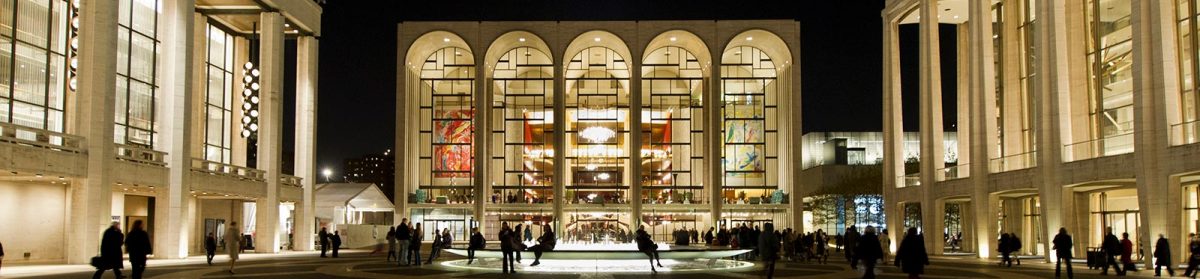
In this 11th year, over ten nights performances from the Met’s Live in HD series will be shown starting with a screening of FUNNY FACE in a special co-presentation with Film at Lincoln Center. Screenings run from August 23 through September 2. There will be 3000 seats in the Plaza in front of the Opera House with an additional standing room area. Cancellations due to thunder/lighting or high wind will not be rescheduled.

LUCIA DI LAMMERMOOR:Donizetti
Cleva; Callas, Votipka, McCracken, Sordello, Campora, Franke, Moscona
Original Air Date: 12/08/1956
MOD Audio
SID.20090103
The matinée of Lucia di Lammermoor on December 8, 1956, represents the sole Met broadcast of Maria Callas (1923-77). Callas’s Met career was frustratingly meager: in three seasons, she sang just twenty-one performances. Her company debut, in Norma, on October 29, 1956, was preceded by artistic triumphs in Europe and Chicago and an avalanche of pre-opening publicity; in his memoirs, Met general manager Rudolf Bing called Callas’s debut – undoubtedly the most exciting of all such in my time at the Metropolitan. The soprano’s first two Met seasons were colored by her dissatisfaction with some of the aging stagings in which the company presented her: the Lucia, for example, dated from 1942, although the soprano wore costumes designed by Ebe Colciaghi for a 1954 La Scala production. A disagreement with Bing over proposed repertory for 1958-59 ended with the diva’s well-publicized ‘firing’; Callas did not return to the Met until 1965, when she sang two Toscas, her final opera performances in the U.S. Callas’s Lucia conductor was Fausto Cleva (1902-71), the Trieste-born maestro who led seventeen of her Met appearances. The afternoon’s Edgardo was Italian lyric tenor Giuseppe Campora (1923-2004), who had joined the Met roster in 1955, as Rodolfo. Enzo Sordello (b. 1927), Callas’s Enrico, was the focus of the soprano’s wrath when she claimed that the Italian baritone held the final note of the ‘Se tradirmi’ duet too long; heard today, Sordello’s action seems the result of confusion rather than malice. Nevertheless, in his memoirs, Bing claims that he canceled the balance of the baritone’s contract after the Lucia matinée contretemps. Greek bass Nicola Moscona (1907-75) sang fifty-seven Lucia Raimondos during his twenty-five seasons with the company; the first of his more than 700 Met performances was as Ramfis in 1937. An even more impressive Lucia record-holder was Ohio-born soprano Thelma Votipka (1906-72), whose more than 1,400 Met performances during her twenty-nine seasons with the company included 116 Alisas. Another American, tenor James McCracken (1926-88), shone as the afternoon’s Normanno; then in his fourth season of singing comprimario parts at the Met, McCracken would leave the company to build his resumé in Europe in the late 1950s. McCracken returned to the Met in triumph in 1963 as the Moor in a new production of Otello and remained one of the company’s best-loved stars until his death.
LUCIA DI LAMMERMOOR:Donizetti
Cleva; Callas, Votipka, McCracken, Sordello, Campora, Franke, Moscona
Original Air Date: 12/08/1956
MOD Audio
SID.20090319
The matinée of Lucia di Lammermoor on December 8, 1956, represents the sole Met broadcast of Maria Callas (1923-77). Callas’s Met career was frustratingly meager: in three seasons, she sang just twenty-one performances. Her company debut, in Norma, on October 29, 1956, was preceded by artistic triumphs in Europe and Chicago and an avalanche of pre-opening publicity; in his memoirs, Met general manager Rudolf Bing called Callas’s debut – undoubtedly the most exciting of all such in my time at the Metropolitan. The soprano’s first two Met seasons were colored by her dissatisfaction with some of the aging stagings in which the company presented her: the Lucia, for example, dated from 1942, although the soprano wore costumes designed by Ebe Colciaghi for a 1954 La Scala production. A disagreement with Bing over proposed repertory for 1958-59 ended with the diva’s well-publicized ‘firing’; Callas did not return to the Met until 1965, when she sang two Toscas, her final opera performances in the U.S. Callas’s Lucia conductor was Fausto Cleva (1902-71), the Trieste-born maestro who led seventeen of her Met appearances. The afternoon’s Edgardo was Italian lyric tenor Giuseppe Campora (1923-2004), who had joined the Met roster in 1955, as Rodolfo. Enzo Sordello (b. 1927), Callas’s Enrico, was the focus of the soprano’s wrath when she claimed that the Italian baritone held the final note of the ‘Se tradirmi’ duet too long; heard today, Sordello’s action seems the result of confusion rather than malice. Nevertheless, in his memoirs, Bing claims that he canceled the balance of the baritone’s contract after the Lucia matinée contretemps. Greek bass Nicola Moscona (1907-75) sang fifty-seven Lucia Raimondos during his twenty-five seasons with the company; the first of his more than 700 Met performances was as Ramfis in 1937. An even more impressive Lucia record-holder was Ohio-born soprano Thelma Votipka (1906-72), whose more than 1,400 Met performances during her twenty-nine seasons with the company included 116 Alisas. Another American, tenor James McCracken (1926-88), shone as the afternoon’s Normanno; then in his fourth season of singing comprimario parts at the Met, McCracken would leave the company to build his resumé in Europe in the late 1950s. McCracken returned to the Met in triumph in 1963 as the Moor in a new production of Otello and remained one of the company’s best-loved stars until his death.
LUCIA DI LAMMERMOOR:Donizetti
Cleva; Callas, Votipka, McCracken, Sordello, Campora, Franke, Moscona
Original Air Date: 12/08/1956
MOD Audio
SID.20090535
The matinée of Lucia di Lammermoor on December 8, 1956, represents the sole Met broadcast of Maria Callas (1923-77). Callas’s Met career was frustratingly meager: in three seasons, she sang just twenty-one performances. Her company debut, in Norma, on October 29, 1956, was preceded by artistic triumphs in Europe and Chicago and an avalanche of pre-opening publicity; in his memoirs, Met general manager Rudolf Bing called Callas’s debut – undoubtedly the most exciting of all such in my time at the Metropolitan. The soprano’s first two Met seasons were colored by her dissatisfaction with some of the aging stagings in which the company presented her: the Lucia, for example, dated from 1942, although the soprano wore costumes designed by Ebe Colciaghi for a 1954 La Scala production. A disagreement with Bing over proposed repertory for 1958-59 ended with the diva’s well-publicized ‘firing’; Callas did not return to the Met until 1965, when she sang two Toscas, her final opera performances in the U.S. Callas’s Lucia conductor was Fausto Cleva (1902-71), the Trieste-born maestro who led seventeen of her Met appearances. The afternoon’s Edgardo was Italian lyric tenor Giuseppe Campora (1923-2004), who had joined the Met roster in 1955, as Rodolfo. Enzo Sordello (b. 1927), Callas’s Enrico, was the focus of the soprano’s wrath when she claimed that the Italian baritone held the final note of the ‘Se tradirmi’ duet too long; heard today, Sordello’s action seems the result of confusion rather than malice. Nevertheless, in his memoirs, Bing claims that he canceled the balance of the baritone’s contract after the Lucia matinée contretemps. Greek bass Nicola Moscona (1907-75) sang fifty-seven Lucia Raimondos during his twenty-five seasons with the company; the first of his more than 700 Met performances was as Ramfis in 1937. An even more impressive Lucia record-holder was Ohio-born soprano Thelma Votipka (1906-72), whose more than 1,400 Met performances during her twenty-nine seasons with the company included 116 Alisas. Another American, tenor James McCracken (1926-88), shone as the afternoon’s Normanno; then in his fourth season of singing comprimario parts at the Met, McCracken would leave the company to build his resumé in Europe in the late 1950s. McCracken returned to the Met in triumph in 1963 as the Moor in a new production of Otello and remained one of the company’s best-loved stars until his death.