
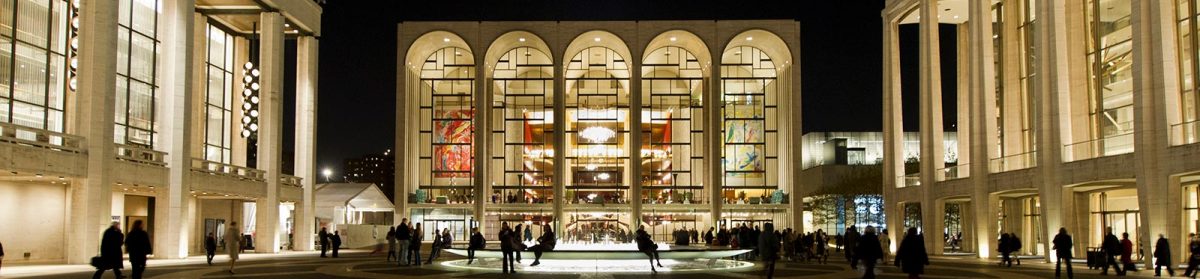
In this 11th year, over ten nights performances from the Met’s Live in HD series will be shown starting with a screening of FUNNY FACE in a special co-presentation with Film at Lincoln Center. Screenings run from August 23 through September 2. There will be 3000 seats in the Plaza in front of the Opera House with an additional standing room area. Cancellations due to thunder/lighting or high wind will not be rescheduled.

L’ASSEDIO DI CORINTO:Rossini
Schippers; Sills, Verrett, Theyard, Díaz
Original Air Date: 04/19/1975
MOD Audio
SID.19410106
The following season also with Sills and Verrett under Woitach) are the Met broadcast history of this problematic Rossini work, and both are on MOoD. Verrett is in top form, but I find Sills too late for these assumptions. I find the work as edited for these performances a jumble and they don’t make this reluctant Rossinian any less so. Barbiere remains a miracle and though done to death, still sparkles.
L’ASSEDIO DI CORINTO:Rossini
Schippers; Sills, Verrett, Theyard, Díaz
Original Air Date: 04/19/1975
MOD Audio
SID.19410316
The following season also with Sills and Verrett under Woitach) are the Met broadcast history of this problematic Rossini work, and both are on MOoD. Verrett is in top form, but I find Sills too late for these assumptions. I find the work as edited for these performances a jumble and they don’t make this reluctant Rossinian any less so. Barbiere remains a miracle and though done to death, still sparkles.
L’ASSEDIO DI CORINTO:Rossini
Schippers; Sills, Verrett, Theyard, Díaz
Original Air Date: 04/19/1975
MOD Audio
SID.19410532
The following season also with Sills and Verrett under Woitach) are the Met broadcast history of this problematic Rossini work, and both are on MOoD. Verrett is in top form, but I find Sills too late for these assumptions. I find the work as edited for these performances a jumble and they don’t make this reluctant Rossinian any less so. Barbiere remains a miracle and though done to death, still sparkles.

CAVALLERIA RUSTICANA / PAGLIACCI:Mascagni / Leoncavallo
Nelson; Bumbry, Theyard, Colzani / McCracken, Moffo, Milnes
Original Air Date: 01/18/1975
SID.19420102
This is Moffo’s final performance broadcast from the Met, and she does not go out on a high note. Milnes is not my preferred Tonio, but I prefer him to Pons who has eight more than Milnes. I prefer MacNeil, Merrill, or Warren among modern Met baritones. The surprise is Merrill only has 22 Tonios with his last in 1960; Caruso (118) and Martinelli(68) are firmly ahead of all Canio competitors, but McCracken is third and by a healthy amount more than any other postwar tenors who are bunched in the 20s. I like Bumbry’s Santuzza, even if it is not as authentic as Cossotto’s. It’s a good fit for her voice.

FALSTAFF:Verdi
Levine; MacNeil, Lear, Stewart, Barbieri, Valente, Ahlstedt
Original Air Date: 04/05/1975
MOD Audio
SID.19420742
This performance is Levine’s first Falstaff broadcast and Barbieri’s penultimate company broadcast (she returns for Trittico (minus Frugola) 2 years later. MacNeil is a very good Falstaff which I think is his only run in the part– he is a stellar Ford on a Chicago broadcast with Gobbi in 1958. Lear is in better form than her husband — Stewart is not really a Verdian, and the monologue is among the showiest music in the opera.
CAVALLERIA RUSTICANA / PAGLIACCI:Mascagni / Leoncavallo
Nelson; Bumbry, Theyard, Colzani / McCracken, Moffo, Milnes
Original Air Date: 01/18/1975
SID.19420423
This is Moffo’s final performance broadcast from the Met, and she does not go out on a high note. Milnes is not my preferred Tonio, but I prefer him to Pons who has eight more than Milnes. I prefer MacNeil, Merrill, or Warren among modern Met baritones. The surprise is Merrill only has 22 Tonios with his last in 1960; Caruso (118) and Martinelli(68) are firmly ahead of all Canio competitors, but McCracken is third and by a healthy amount more than any other postwar tenors who are bunched in the 20s. I like Bumbry’s Santuzza, even if it is not as authentic as Cossotto’s. It’s a good fit for her voice.
FALSTAFF:Verdi
Levine; MacNeil, Lear, Stewart, Barbieri, Valente, Ahlstedt
Original Air Date: 04/05/1975
MOD Audio
SID.19420531
This performance is Levine’s first Falstaff broadcast and Barbieri’s penultimate company broadcast (she returns for Trittico (minus Frugola) 2 years later. MacNeil is a very good Falstaff which I think is his only run in the part– he is a stellar Ford on a Chicago broadcast with Gobbi in 1958. Lear is in better form than her husband — Stewart is not really a Verdian, and the monologue is among the showiest music in the opera.
FALSTAFF:Verdi
Levine; MacNeil, Lear, Stewart, Barbieri, Valente, Ahlstedt
Original Air Date: 04/05/1975
MOD Audio
SID.19420742
This performance is Levine’s first Falstaff broadcast and Barbieri’s penultimate company broadcast (she returns for Trittico (minus Frugola) 2 years later. MacNeil is a very good Falstaff which I think is his only run in the part– he is a stellar Ford on a Chicago broadcast with Gobbi in 1958. Lear is in better form than her husband — Stewart is not really a Verdian, and the monologue is among the showiest music in the opera.
CAVALLERIA RUSTICANA / PAGLIACCI:Mascagni / Leoncavallo
Nelson; Bumbry, Theyard, Colzani / McCracken, Moffo, Milnes
Original Air Date: 01/18/1975
SID.19420746
This is Moffo’s final performance broadcast from the Met, and she does not go out on a high note. Milnes is not my preferred Tonio, but I prefer him to Pons who has eight more than Milnes. I prefer MacNeil, Merrill, or Warren among modern Met baritones. The surprise is Merrill only has 22 Tonios with his last in 1960; Caruso (118) and Martinelli(68) are firmly ahead of all Canio competitors, but McCracken is third and by a healthy amount more than any other postwar tenors who are bunched in the 20s. I like Bumbry’s Santuzza, even if it is not as authentic as Cossotto’s. It’s a good fit for her voice.

JENUFA:Janácek
Nelson; Kubiak, Varnay, Vickers, Lewis, Kraft
Original Air Date: 12/21/1974
SID.19450209
This performance is in English, which is a rarity on Sirius since almost no translations are ever heard. The standout performance for me is Jon Vickers as Laca. The giant disappointment was Varnay’s Kostelnicka. Kniplova (native Czech, but singing in German with Hamburg) in this pivotal role, but Varnay was a dud dramatically and vocally. Kubiak’s English is surprisingly adequate, and overall I enjoy listening to this performance.
JENUFA:Janácek
Nelson; Kubiak, Varnay, Vickers, Lewis, Kraft
Original Air Date: 12/21/1974
SID.19450529
This performance is in English, which is a rarity on Sirius since almost no translations are ever heard. The standout performance for me is Jon Vickers as Laca. The giant disappointment was Varnay’s Kostelnicka. Kniplova (native Czech, but singing in German with Hamburg) in this pivotal role, but Varnay was a dud dramatically and vocally. Kubiak’s English is surprisingly adequate, and overall I enjoy listening to this performance.
JENUFA:Janácek
Nelson; Kubiak, Varnay, Vickers, Lewis, Kraft
Original Air Date: 12/21/1974
SID.19450640
This performance is in English, which is a rarity on Sirius since almost no translations are ever heard. The standout performance for me is Jon Vickers as Laca. The giant disappointment was Varnay’s Kostelnicka. Kniplova (native Czech, but singing in German with Hamburg) in this pivotal role, but Varnay was a dud dramatically and vocally. Kubiak’s English is surprisingly adequate, and overall I enjoy listening to this performance.

DIE WALKÜRE:Wagner
Ehrling; Nilsson, McIntyre, Martin, Vickers, Dunn, Rundgren
Original Air Date: 03/01/1975
SID.19490103
I’m never a very big fan of Ehrling’s Ring, and Rundgren is one of the weaker Wagner basses we’ve heard. Nilsson has other performances where she is better caught. I’m always a big fan of Vickers, and as Siegmund he was pretty mighty right to the end (and this end is still a decade away). Janis Martin was on the rocks as Rossweise 10 years earlier under Steinberg (this performance is important for several reasons, not least George London’s only broadcast Wotan with Nilsson, Vickers, Rysanek in top form); Martin is also Sieglinde 2 years later in a most interesting cast (also not yet on Sirius) with Rita Hunter, James King, Norman Bailey, all under Leinsdorf. I remember this broadcast very well and it should be restored to the airwaves.
DIE WALKÜRE:Wagner
Ehrling; Nilsson, McIntyre, Martin, Vickers, Dunn, Rundgren
Original Air Date: 03/01/1975
SID.19490104
I’m never a very big fan of Ehrling’s Ring, and Rundgren is one of the weaker Wagner basses we’ve heard. Nilsson has other performances where she is better caught. I’m always a big fan of Vickers, and as Siegmund he was pretty mighty right to the end (and this end is still a decade away). Janis Martin was on the rocks as Rossweise 10 years earlier under Steinberg (this performance is important for several reasons, not least George London’s only broadcast Wotan with Nilsson, Vickers, Rysanek in top form); Martin is also Sieglinde 2 years later in a most interesting cast (also not yet on Sirius) with Rita Hunter, James King, Norman Bailey, all under Leinsdorf. I remember this broadcast very well and it should be restored to the airwaves.
DIE WALKÜRE:Wagner
Ehrling; Nilsson, McIntyre, Martin, Vickers, Dunn, Rundgren
Original Air Date: 03/01/1975
SID.19490319
I’m never a very big fan of Ehrling’s Ring, and Rundgren is one of the weaker Wagner basses we’ve heard. Nilsson has other performances where she is better caught. I’m always a big fan of Vickers, and as Siegmund he was pretty mighty right to the end (and this end is still a decade away). Janis Martin was on the rocks as Rossweise 10 years earlier under Steinberg (this performance is important for several reasons, not least George London’s only broadcast Wotan with Nilsson, Vickers, Rysanek in top form); Martin is also Sieglinde 2 years later in a most interesting cast (also not yet on Sirius) with Rita Hunter, James King, Norman Bailey, all under Leinsdorf. I remember this broadcast very well and it should be restored to the airwaves.
DIE WALKÜRE:Wagner
Ehrling; Nilsson, McIntyre, Martin, Vickers, Dunn, Rundgren
Original Air Date: 03/01/1975
SID.19490535
I’m never a very big fan of Ehrling’s Ring, and Rundgren is one of the weaker Wagner basses we’ve heard. Nilsson has other performances where she is better caught. I’m always a big fan of Vickers, and as Siegmund he was pretty mighty right to the end (and this end is still a decade away). Janis Martin was “on the rocks” as Rossweise 10 years earlier under Steinberg (this performance is important for several reasons, not least George London’s only broadcast Wotan with Nilsson, Vickers, Rysanek in top form); Martin is also Sieglinde 2 years later in a most interesting cast (also not yet on Sirius) with Rita Hunter, James King, Norman Bailey, all under Leinsdorf. I remember this broadcast very well and it should be restored to the airwaves.
DIE WALKÜRE:Wagner
Ehrling; Nilsson, McIntyre, Martin, Vickers, Dunn, Rundgren
Original Air Date: 03/01/1975
SID.19490636
I’m never a very big fan of Ehrling’s Ring, and Rundgren is one of the weaker Wagner basses we’ve heard. Nilsson has other performances where she is better caught. I’m always a big fan of Vickers, and as Siegmund he was pretty mighty right to the end (and this end is still a decade away). Janis Martin was “on the rocks” as Rossweise 10 years earlier under Steinberg (this performance is important for several reasons, not least George London’s only broadcast Wotan with Nilsson, Vickers, Rysanek in top form); Martin is also Sieglinde 2 years later in a most interesting cast (also not yet on Sirius) with Rita Hunter, James King, Norman Bailey, all under Leinsdorf. I remember this broadcast very well and it should be restored to the airwaves.

GÖTTERDÄMMERUNG:Wagner
Ehrling; Nilsson, Thomas, Rundgren, Dooley, Rankin, Reynolds
Original Air Date: 03/29/1975
SID.20050213
This is Nilsson’s final Wagner opera from the Met airwaves. She only has two other Gotterdammerung broadcasts, the first in 1962 when she was in very fresh voice under Leinsdorf (and on Met Opera in Demand (MOoD) and 1963 under Rosenstock — originally planned for Reiner– with extensive cuts. The supporting cast with the exception of possibly Anna Reynolds’ Waltraute don’t offer much help to Nilsson. She is still in much better voice than when she returned to the Met after a 5 year absence in Elektra. Once again a plea for the Rita Hunter Gotterdammerung broadcast from the year before (where she replaces Nilsson) which features her in very fresh voice, and one of the few broadcast appearances of Helge Brilioth as Siegfried, all under Kubelik. Kubelik only has two Met broadcasts (Troyens is the other with Verrett, Ludwig, and Vickers) and neither has been on the Sirius rebroadcast series. But back to Gotterdammerung, Hagen is almost as important as Brunnhilde and Siegfried, and Rundgren is distinctly second grade goods. Thomas Stewart premiered the production in 1974, but Dooley was the Gunther on both the Kubelik and this broadcast, so no broadcast record for one of Stewart’s best roles. Rankin, a well traveled mezzo mostly in the Italian wing, is a curious choice for Gutrune (maybe Kubelik had a fond memory of her Troyens Cassandra when he premiered the opera 15 years earlier at La Scala with Del Monaco and Simionato in Italian. So this Gotterdammerung will be a curiosity, but for me her 1962 broadcast and the two commercial (Decca studio and Philips live from Bayreuth are noble indeed.
GÖTTERDÄMMERUNG:Wagner
Ehrling; Nilsson, Thomas, Rundgren, Dooley, Rankin, Reynolds
Original Air Date: 03/29/1975
SID.20050214
This is Nilsson’s final Wagner opera from the Met airwaves. She only has two other Gotterdammerung broadcasts, the first in 1962 when she was in very fresh voice under Leinsdorf (and on Met Opera in Demand (MOoD) and 1963 under Rosenstock — originally planned for Reiner– with extensive cuts. The supporting cast with the exception of possibly Anna Reynolds’ Waltraute don’t offer much help to Nilsson. She is still in much better voice than when she returned to the Met after a 5 year absence in Elektra. Once again a plea for the Rita Hunter Gotterdammerung broadcast from the year before (where she replaces Nilsson) which features her in very fresh voice, and one of the few broadcast appearances of Helge Brilioth as Siegfried, all under Kubelik. Kubelik only has two Met broadcasts (Troyens is the other with Verrett, Ludwig, and Vickers) and neither has been on the Sirius rebroadcast series. But back to Gotterdammerung, Hagen is almost as important as Brunnhilde and Siegfried, and Rundgren is distinctly second grade goods. Thomas Stewart premiered the production in 1974, but Dooley was the Gunther on both the Kubelik and this broadcast, so no broadcast record for one of Stewart’s best roles. Rankin, a well traveled mezzo mostly in the Italian wing, is a curious choice for Gutrune (maybe Kubelik had a fond memory of her Troyens Cassandra when he premiered the opera 15 years earlier at La Scala with Del Monaco and Simionato in Italian. So this Gotterdammerung will be a curiosity, but for me her 1962 broadcast and the two commercial (Decca studio and Philips live from Bayreuth are noble indeed.
GÖTTERDÄMMERUNG:Wagner
Ehrling; Nilsson, Thomas, Rundgren, Dooley, Rankin, Reynolds
Original Air Date: 03/29/1975
SID.20050532
This is Nilsson’s final Wagner opera from the Met airwaves. She only has two other Gotterdammerung broadcasts, the first in 1962 when she was in very fresh voice under Leinsdorf (and on Met Opera in Demand (MOoD) and 1963 under Rosenstock — originally planned for Reiner– with extensive cuts. The supporting cast with the exception of possibly Anna Reynolds’ Waltraute don’t offer much help to Nilsson. She is still in much better voice than when she returned to the Met after a 5 year absence in Elektra. Once again a plea for the Rita Hunter Gotterdammerung broadcast from the year before (where she replaces Nilsson) which features her in very fresh voice, and one of the few broadcast appearances of Helge Brilioth as Siegfried, all under Kubelik. Kubelik only has two Met broadcasts (Troyens is the other with Verrett, Ludwig, and Vickers) and neither has been on the Sirius rebroadcast series. But back to Gotterdammerung, Hagen is almost as important as Brunnhilde and Siegfried, and Rundgren is distinctly second grade goods. Thomas Stewart premiered the production in 1974, but Dooley was the Gunther on both the Kubelik and this broadcast, so no broadcast record for one of Stewart’s best roles. Rankin, a well traveled mezzo mostly in the Italian wing, is a curious choice for Gutrune (maybe Kubelik had a fond memory of her Troyens Cassandra when he premiered the opera 15 years earlier at La Scala with Del Monaco and Simionato in Italian. So this Gotterdammerung will be a curiosity, but for me her 1962 broadcast and the two commercial (Decca studio and Philips live from Bayreuth are noble indeed.
GÖTTERDÄMMERUNG:Wagner
Ehrling; Nilsson, Thomas, Rundgren, Dooley, Rankin, Reynolds
Original Air Date: 03/29/1975
SID.20050533
This is Nilsson’s final Wagner opera from the Met airwaves. She only has two other Gotterdammerung broadcasts, the first in 1962 when she was in very fresh voice under Leinsdorf (and on Met Opera in Demand (MOoD) and 1963 under Rosenstock — originally planned for Reiner– with extensive cuts. The supporting cast with the exception of possibly Anna Reynolds’ Waltraute don’t offer much help to Nilsson. She is still in much better voice than when she returned to the Met after a 5 year absence in Elektra. Once again a plea for the Rita Hunter Gotterdammerung broadcast from the year before (where she replaces Nilsson) which features her in very fresh voice, and one of the few broadcast appearances of Helge Brilioth as Siegfried, all under Kubelik. Kubelik only has two Met broadcasts (Troyens is the other with Verrett, Ludwig, and Vickers) and neither has been on the Sirius rebroadcast series. But back to Gotterdammerung, Hagen is almost as important as Brunnhilde and Siegfried, and Rundgren is distinctly second grade goods. Thomas Stewart premiered the production in 1974, but Dooley was the Gunther on both the Kubelik and this broadcast, so no broadcast record for one of Stewart’s best roles. Rankin, a well traveled mezzo mostly in the Italian wing, is a curious choice for Gutrune (maybe Kubelik had a fond memory of her Troyens Cassandra when he premiered the opera 15 years earlier at La Scala with Del Monaco and Simionato in Italian. So this Gotterdammerung will be a curiosity, but for me her 1962 broadcast and the two commercial (Decca studio and Philips live from Bayreuth are noble indeed.

DEATH IN VENICE:Britten
Bedford; Pears, Shirley Quirk, Velis
Original Air Date: 12/14/1974
MOD Audio
SID.20110105
The Met saw the USA premiere of Britten’s Death in Venice and for the Met debut of Peter Pears. His only other role at the Met was Captain Vere in Billy Budd four years later; fortunately both of Pears’ roles are on MOoD. Death in Venice can be a hard sit despite all the talent involved.
DEATH IN VENICE:Britten
Bedford; Pears, Shirley Quirk, Velis
Original Air Date: 12/14/1974
MOD Audio
SID.20110315
The Met saw the USA premiere of Britten’s Death in Venice and for the Met debut of Peter Pears. His only other role at the Met was Captain Vere in Billy Budd four years later; fortunately both of Pears’ roles are on MOoD. Death in Venice can be a hard sit despite all the talent involved.
DEATH IN VENICE:Britten
Bedford; Pears, Shirley Quirk, Velis
Original Air Date: 12/14/1974
MOD Audio
SID.20110423
The Met saw the USA premiere of Britten’s Death in Venice and for the Met debut of Peter Pears. His only other role at the Met was Captain Vere in Billy Budd four years later; fortunately both of Pears’ roles are on MOoD. Death in Venice can be a hard sit despite all the talent involved.

MANON LESCAUT:Puccini
Adler; Kirsten, Alexander, Walker, Michalski
Original Air Date: 03/08/1975
SID.20150211
Kirsten replaced Leontyne Price on this broadcast. She is thoroughly professional even if she is 65 years old!!!!! Her first broadcast is 26 years earlier when she was pushing 40. Better to hear that with Bjorling. Highly recommended but still omitted from the Sirius Manon Lescaut sweepstakes are the Tebaldi-Tucker from 1959 and the Kirsten Bergonzi from 1960 (Kirsten replacing Stella) This is a rare broadcast, but it IS possible to find
MANON LESCAUT:Puccini
Adler; Kirsten, Alexander, Walker, Michalski
Original Air Date: 03/08/1975
SID.20150429
Kirsten replaced Leontyne Price on this broadcast. She is thoroughly professional even if she is 65 years old!!!!! Her first broadcast is 26 years earlier when she was pushing 40. Better to hear that with Bjorling. Highly recommended but still omitted from the Sirius Manon Lescaut sweepstakes are the Tebaldi-Tucker from 1959 and the Kirsten Bergonzi from 1960 (Kirsten replacing Stella) This is a rare broadcast, but it IS possible to find
MANON LESCAUT:Puccini
Adler; Kirsten, Alexander, Walker, Michalski
Original Air Date: 03/08/1975
SID.20150647
Kirsten replaced Leontyne Price on this broadcast. She is thoroughly professional even if she is 65 years old!!!!! Her first broadcast is 26 years earlier when she was pushing 40. Better to hear that with Bjorling. Highly recommended but still omitted from the Sirius Manon Lescaut sweepstakes are the Tebaldi-Tucker from 1959 and the Kirsten Bergonzi from 1960 (Kirsten replacing Stella) This is a rare broadcast, but it IS possible to find

DAS RHEINGOLD:Wagner
Ehrling; McIntyre, Dunn, Peterson, Rintzler, Rundgren, Macurdy
Original Air Date: 02/15/1975
SID.20160317
This performance marks Donald McIntyre’s Met debut (broadcast debuts are not so common) and the farewell of Glade Peterson who had made his debut as Loge five days before. McIntyre would be the main reason for listening, but he has the Chereau Ring from Bayreuth three years later on video. I saw the 1978 Chereau Ring live, and he was definitely one of the brightest elements. 6/6/12 – This is only a three performance outing this week where McIntyre is the only real point of distinction. Not awful, but what’s the point? 6/22/11 – The cream of this 1975 cycle were the Nilsson parts of the Ring. Nothing especially remarkable here.
DAS RHEINGOLD:Wagner
Ehrling; McIntyre, Dunn, Peterson, Rintzler, Rundgren, Macurdy
Original Air Date: 02/15/1975
SID.20160535
This performance marks Donald McIntyre’s Met debut (broadcast debuts are not so common) and the farewell of Glade Peterson who had made his debut as Loge five days before. McIntyre would be the main reason for listening, but he has the Chereau Ring from Bayreuth three years later on video. I saw the 1978 Chereau Ring live, and he was definitely one of the brightest elements. 6/6/12 – This is only a three performance outing this week where McIntyre is the only real point of distinction. Not awful, but what’s the point? 6/22/11 – The cream of this 1975 cycle were the Nilsson parts of the Ring. Nothing especially remarkable here.
DAS RHEINGOLD:Wagner
Ehrling; McIntyre, Dunn, Peterson, Rintzler, Rundgren, Macurdy
Original Air Date: 02/15/1975
SID.20160753
This performance marks Donald McIntyre’s Met debut (broadcast debuts are not so common) and the farewell of Glade Peterson who had made his debut as Loge five days before. McIntyre would be the main reason for listening, but he has the Chereau Ring from Bayreuth three years later on video. I saw the 1978 Chereau Ring live, and he was definitely one of the brightest elements. 6/6/12 – This is only a three performance outing this week where McIntyre is the only real point of distinction. Not awful, but what’s the point? 6/22/11 – The cream of this 1975 cycle were the Nilsson parts of the Ring. Nothing especially remarkable here.