
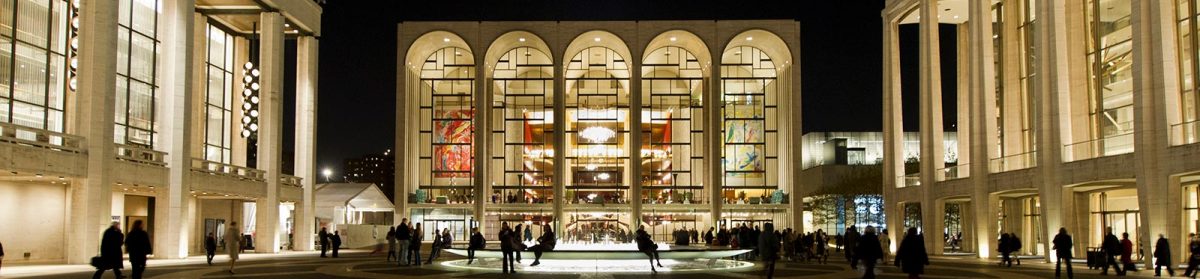
In this 11th year, over ten nights performances from the Met’s Live in HD series will be shown starting with a screening of FUNNY FACE in a special co-presentation with Film at Lincoln Center. Screenings run from August 23 through September 2. There will be 3000 seats in the Plaza in front of the Opera House with an additional standing room area. Cancellations due to thunder/lighting or high wind will not be rescheduled.

MIGNON:Thomas
Original Air Date: 01/27/1945
Pelletier; Stevens, Melton, Benzell, Pinza
MOD Audio SID.19380212
“There are some great tunes in Mignon but I find the opera doesn’t hold up well — I saw it staged in Dallas with Horne (1974), and it was a LONG evening. Pinza is very fine here. Mignon’s last broadcast appearance is 3 years later with Marilyn Cotlow as Philine which is more than 6 decades ago. That Mignon “”farewell”” has not been on Sirius.”
 ,
,
MIGNON:Thomas
Original Air Date: 01/27/1945
Pelletier; Stevens, Melton, Benzell, Pinza
MOD Audio SID.19380642
“There are some great tunes in Mignon but I find the opera doesn’t hold up well — I saw it staged in Dallas with Horne (1974), and it was a LONG evening. Pinza is very fine here. Mignon’s last broadcast appearance is 3 years later with Marilyn Cotlow as Philine which is more than 6 decades ago. That Mignon “”farewell”” has not been on Sirius.”

HAMLET:Thomas
Original Air Date: 03/27/2010
Langrée; Keenlyside, Petersen, Larmore, Morris, Spence
MOD Video SID.19390320
This is the only Met broadcast of the Thomas work. Keenlyside has a commercial DVD in the same production with Dessay from Barcelona 2004. Petersen was a late substitute for Dessay for the whole run. Larmoreis especially vivid as Gertrude, part of her movement into dramatic mezzo/soprano parts.
HAMLET:Thomas
Langrée; Keenlyside, Petersen, Larmore, Morris, Spence
Original Air Date: 03/27/2010
MOD Video
SID.19390637
This is the only Met broadcast of the Thomas work. Keenlyside has a commercial DVD in the same production with Dessay from Barcelona 2004. Petersen was a late substitute for Dessay for the whole run. Larmoreis especially vivid as Gertrude, part of her movement into dramatic mezzo/soprano parts.
HAMLET:Thomas
Langrée; Keenlyside, Petersen, Larmore, Morris, Spence
Original Air Date: 03/27/2010
MOD Video
SID.19390642
This is the only Met broadcast of the Thomas work. Keenlyside has a commercial DVD in the same production with Dessay from Barcelona 2004. Petersen was a late substitute for Dessay for the whole run. Larmoreis especially vivid as Gertrude, part of her movement into dramatic mezzo/soprano parts.

FAUST:Gounod
Beecham; Jobin, Albanese, Pinza, Thomas, Browning
Original Air Date: 01/30/1943
SID.19440211
J Woolf: Pinza is, of course, magnificent and Jobin matches him for much of the time – though not all of the time, which is where Kullman scored over him. Albanese is a character actress of real repute though the voice itself is inclined to take on a slightly mezzo-ish depth. Never mind, she has the dramatic instincts in place. The smaller roles are well taken and that leaves Beecham. Well, he was never rocket propelled in this work and generally encouraged leisurely tempi. Though as he would doubtless be the first to point out, the average ear confuses speed and rhythm – and Beecham’s rhythmic underpinning here is sure, his conception of the work as a whole splendidly realised. Right from the start one can admire his direction of the Act I introduction – so flexible and winning. The Chorus comes in – somewhat distant but adequate for a private recording of this kind. Jobin is first – ringing and declamatory, superb rhythm and articulation of phrases, subtle highlighting of lyric peaks and troughs. Then Pinza, simply wonderful with great depth of tone across his range – characterisation without exaggeration. I wouldn’t make too much of Singher’s problems but he is unsteady in O toi in Act II (and going up in the Invocation). In fact so is another voice – the prompter, I assume, who can be clearly heard – and crikey is he a busy man. Beecham sounds to be enjoying the grand seignorial swagger behind Pinza in the Rondo – though, a warning to those who are expecting the moon; the sound is a bit crude along the way. The Met strings sound on good, spruce Gallic form in Nous nous retrouverons, mes amis and indeed they cultivate a bright and crisp impression all round; the Chorus too sounds well trained for the occasion. As for Jobin’s Salut! Demeure chaste et pure it’s not so bad – it’s not virile in the way Kullman is but more soft grained and intimate; less effusively romantic. No, I don’t think Albanese sounds youthful enough in the Chanson du Roi de Thulé but she shows signs of her impersonation to come later on; careful and clever singing and acting, as well as tonally frequently resplendent on her own terms. Let’s finish with Thelma Votipka and Lucielle Browning who tend to be edged out of discussions given the excellence of the principals. Browning is consistently good and Votipka shows in her Act III Que vois-je, Signeur Dieu! just how strong a cast this was – witty and perfectly characterised.
Read more: www.musicweb-international.com/classrev/2004/Feb04/Gounod_Faust_Beecham.htm#ixzz63cACqnby
FAUST:Gounod
Beecham; Jobin, Albanese, Pinza, Thomas, Browning
Original Air Date: 01/30/1943
SID.19440427
J Woolf: Pinza is, of course, magnificent and Jobin matches him for much of the time – though not all of the time, which is where Kullman scored over him. Albanese is a character actress of real repute though the voice itself is inclined to take on a slightly mezzo-ish depth. Never mind, she has the dramatic instincts in place. The smaller roles are well taken and that leaves Beecham. Well, he was never rocket propelled in this work and generally encouraged leisurely tempi. Though as he would doubtless be the first to point out, the average ear confuses speed and rhythm – and Beecham’s rhythmic underpinning here is sure, his conception of the work as a whole splendidly realised. Right from the start one can admire his direction of the Act I introduction – so flexible and winning. The Chorus comes in – somewhat distant but adequate for a private recording of this kind. Jobin is first – ringing and declamatory, superb rhythm and articulation of phrases, subtle highlighting of lyric peaks and troughs. Then Pinza, simply wonderful with great depth of tone across his range – characterisation without exaggeration. I wouldn’t make too much of Singher’s problems but he is unsteady in O toi in Act II (and going up in the Invocation). In fact so is another voice – the prompter, I assume, who can be clearly heard – and crikey is he a busy man. Beecham sounds to be enjoying the grand seignorial swagger behind Pinza in the Rondo – though, a warning to those who are expecting the moon; the sound is a bit crude along the way. The Met strings sound on good, spruce Gallic form in Nous nous retrouverons, mes amis and indeed they cultivate a bright and crisp impression all round; the Chorus too sounds well trained for the occasion. As for Jobin’s Salut! Demeure chaste et pure it’s not so bad – it’s not virile in the way Kullman is but more soft grained and intimate; less effusively romantic. No, I don’t think Albanese sounds youthful enough in the Chanson du Roi de Thulé but she shows signs of her impersonation to come later on; careful and clever singing and acting, as well as tonally frequently resplendent on her own terms. Let’s finish with Thelma Votipka and Lucielle Browning who tend to be edged out of discussions given the excellence of the principals. Browning is consistently good and Votipka shows in her Act III Que vois-je, Signeur Dieu! just how strong a cast this was – witty and perfectly characterised.
Read more: www.musicweb-international.com/classrev/2004/Feb04/Gounod_Faust_Beecham.htm#ixzz63cACqnby
FAUST:Gounod
Beecham; Jobin, Albanese, Pinza, Thomas, Browning
Original Air Date: 01/30/1943
SID.19440637
J Woolf: Pinza is, of course, magnificent and Jobin matches him for much of the time – though not all of the time, which is where Kullman scored over him. Albanese is a character actress of real repute though the voice itself is inclined to take on a slightly mezzo-ish depth. Never mind, she has the dramatic instincts in place. The smaller roles are well taken and that leaves Beecham. Well, he was never rocket propelled in this work and generally encouraged leisurely tempi. Though as he would doubtless be the first to point out, the average ear confuses speed and rhythm – and Beecham’s rhythmic underpinning here is sure, his conception of the work as a whole splendidly realised. Right from the start one can admire his direction of the Act I introduction – so flexible and winning. The Chorus comes in – somewhat distant but adequate for a private recording of this kind. Jobin is first – ringing and declamatory, superb rhythm and articulation of phrases, subtle highlighting of lyric peaks and troughs. Then Pinza, simply wonderful with great depth of tone across his range – characterisation without exaggeration. I wouldn’t make too much of Singher’s problems but he is unsteady in O toi in Act II (and going up in the Invocation). In fact so is another voice – the prompter, I assume, who can be clearly heard – and crikey is he a busy man. Beecham sounds to be enjoying the grand seignorial swagger behind Pinza in the Rondo – though, a warning to those who are expecting the moon; the sound is a bit crude along the way. The Met strings sound on good, spruce Gallic form in Nous nous retrouverons, mes amis and indeed they cultivate a bright and crisp impression all round; the Chorus too sounds well trained for the occasion. As for Jobin’s Salut! Demeure chaste et pure it’s not so bad – it’s not virile in the way Kullman is but more soft grained and intimate; less effusively romantic. No, I don’t think Albanese sounds youthful enough in the Chanson du Roi de Thulé but she shows signs of her impersonation to come later on; careful and clever singing and acting, as well as tonally frequently resplendent on her own terms. Let’s finish with Thelma Votipka and Lucielle Browning who tend to be edged out of discussions given the excellence of the principals. Browning is consistently good and Votipka shows in her Act III Que vois-je, Signeur Dieu! just how strong a cast this was – witty and perfectly characterised.
Read more: www.musicweb-international.com/classrev/2004/Feb04/Gounod_Faust_Beecham.htm#ixzz63cACqnby
FAUST:Gounod
Beecham; Jobin, Albanese, Pinza, Thomas, Browning
Original Air Date: 01/30/1943
SID.19450101
J Woolf: Pinza is, of course, magnificent and Jobin matches him for much of the time – though not all of the time, which is where Kullman scored over him. Albanese is a character actress of real repute though the voice itself is inclined to take on a slightly mezzo-ish depth. Never mind, she has the dramatic instincts in place. The smaller roles are well taken and that leaves Beecham. Well, he was never rocket propelled in this work and generally encouraged leisurely tempi. Though as he would doubtless be the first to point out, the average ear confuses speed and rhythm – and Beecham’s rhythmic underpinning here is sure, his conception of the work as a whole splendidly realised. Right from the start one can admire his direction of the Act I introduction – so flexible and winning. The Chorus comes in – somewhat distant but adequate for a private recording of this kind. Jobin is first – ringing and declamatory, superb rhythm and articulation of phrases, subtle highlighting of lyric peaks and troughs. Then Pinza, simply wonderful with great depth of tone across his range – characterisation without exaggeration. I wouldn’t make too much of Singher’s problems but he is unsteady in O toi in Act II (and going up in the Invocation). In fact so is another voice – the prompter, I assume, who can be clearly heard – and crikey is he a busy man. Beecham sounds to be enjoying the grand seignorial swagger behind Pinza in the Rondo – though, a warning to those who are expecting the moon; the sound is a bit crude along the way. The Met strings sound on good, spruce Gallic form in Nous nous retrouverons, mes amis and indeed they cultivate a bright and crisp impression all round; the Chorus too sounds well trained for the occasion. As for Jobin’s Salut! Demeure chaste et pure it’s not so bad – it’s not virile in the way Kullman is but more soft grained and intimate; less effusively romantic. No, I don’t think Albanese sounds youthful enough in the Chanson du Roi de Thulé but she shows signs of her impersonation to come later on; careful and clever singing and acting, as well as tonally frequently resplendent on her own terms. Let’s finish with Thelma Votipka and Lucielle Browning who tend to be edged out of discussions given the excellence of the principals. Browning is consistently good and Votipka shows in her Act III Que vois-je, Signeur Dieu! just how strong a cast this was – witty and perfectly characterised.

PARSIFAL:Wagner
Steinberg; Thomas, Martin, Stewart, Macurdy, Meredith. Morris
Original Air Date: 04/20/1974
SID.19450105
This is William Steinberg’s farewell performance (only 25 altogether in four operas). It’s a very solid overall performance, and better conducted than Leopold Ludwig’s wan effort when the production was new. Next time out in 1979, James Levine begins a LONG run as the Parsifal conductor. Why is this performance not on MOoD. The cast is all-American, and except for Antony and Cleopatra, Jess Thomas is not represented on MOoD. 38 years later James Morris is the only survivor still on the Met stage. Not yet heard on Sirius are Hotter’s 2 Parsifal broadcasts (1952 as Amfortas and 1954 as Gurnemanz– his Met farewell). Hotter is well represented from Bayreuth, but worth hearing on Sirius. To me the big gaps are the 1966 Pretre Parsifal with Crespin and Konya under Pretre and the 1971 with Siepi’s classic Gurnemanz. Levine conducted a lot of Parsifal broadcasts in the 1980s, and the surprise omission is the 1985 with Vickers, Rysanek, MollThis is William Steinberg’s farewell performance (only 25 altogether in four operas). It’s a very solid overall performance, and better conducted than Leopold Ludwig’s wan effort when the production was new. Next time out in 1979, James Levine begins a LONG run as the Parsifal conductor. Why is this performance not on MOoD. The cast is all-American, and except for Antony and Cleopatra, Jess Thomas is not represented on MOoD. 38 years later James Morris is the only survivor still on the Met stage. Not yet heard on Sirius are Hotter’s 2 Parsifal broadcasts (1952 as Amfortas and 1954 as Gurnemanz– his Met farewell). Hotter is well represented from Bayreuth, but worth hearing on Sirius. To me the big gaps are the 1966 Pretre Parsifal with Crespin and Konya under Pretre and the 1971 with Siepi’s classic Gurnemanz. Levine conducted a lot of Parsifal broadcasts in the 1980s, and the surprise omission is the 1985 with Vickers, Rysanek, Moll
PARSIFAL:Wagner
Steinberg; Thomas, Martin, Stewart, Macurdy, Meredith. Morris
Original Air Date: 04/20/1974
SID.19450317
This is William Steinberg’s farewell performance (only 25 altogether in four operas). It’s a very solid overall performance, and better conducted than Leopold Ludwig’s wan effort when the production was new. Next time out in 1979, James Levine begins a LONG run as the Parsifal conductor. Why is this performance not on MOoD. The cast is all-American, and except for Antony and Cleopatra, Jess Thomas is not represented on MOoD. 38 years later James Morris is the only survivor still on the Met stage. Not yet heard on Sirius are Hotter’s 2 Parsifal broadcasts (1952 as Amfortas and 1954 as Gurnemanz– his Met farewell). Hotter is well represented from Bayreuth, but worth hearing on Sirius. To me the big gaps are the 1966 Pretre Parsifal with Crespin and Konya under Pretre and the 1971 with Siepi’s classic Gurnemanz. Levine conducted a lot of Parsifal broadcasts in the 1980s, and the surprise omission is the 1985 with Vickers, Rysanek, MollThis is William Steinberg’s farewell performance (only 25 altogether in four operas). It’s a very solid overall performance, and better conducted than Leopold Ludwig’s wan effort when the production was new. Next time out in 1979, James Levine begins a LONG run as the Parsifal conductor. Why is this performance not on MOoD. The cast is all-American, and except for Antony and Cleopatra, Jess Thomas is not represented on MOoD. 38 years later James Morris is the only survivor still on the Met stage. Not yet heard on Sirius are Hotter’s 2 Parsifal broadcasts (1952 as Amfortas and 1954 as Gurnemanz– his Met farewell). Hotter is well represented from Bayreuth, but worth hearing on Sirius. To me the big gaps are the 1966 Pretre Parsifal with Crespin and Konya under Pretre and the 1971 with Siepi’s classic Gurnemanz. Levine conducted a lot of Parsifal broadcasts in the 1980s, and the surprise omission is the 1985 with Vickers, Rysanek, Moll
PARSIFAL:Wagner
Steinberg; Thomas, Martin, Stewart, Macurdy, Meredith. Morris
Original Air Date: 04/20/1974
SID.19450749
This is William Steinberg’s farewell performance (only 25 altogether in four operas). It’s a very solid overall performance, and better conducted than Leopold Ludwig’s wan effort when the production was new. Next time out in 1979, James Levine begins a LONG run as the Parsifal conductor. Why is this performance not on MOoD. The cast is all-American, and except for Antony and Cleopatra, Jess Thomas is not represented on MOoD. 38 years later James Morris is the only survivor still on the Met stage. Not yet heard on Sirius are Hotter’s 2 Parsifal broadcasts (1952 as Amfortas and 1954 as Gurnemanz– his Met farewell). Hotter is well represented from Bayreuth, but worth hearing on Sirius. To me the big gaps are the 1966 Pretre Parsifal with Crespin and Konya under Pretre and the 1971 with Siepi’s classic Gurnemanz. Levine conducted a lot of Parsifal broadcasts in the 1980s, and the surprise omission is the 1985 with Vickers, Rysanek, MollThis is William Steinberg’s farewell performance (only 25 altogether in four operas). It’s a very solid overall performance, and better conducted than Leopold Ludwig’s wan effort when the production was new. Next time out in 1979, James Levine begins a LONG run as the Parsifal conductor. Why is this performance not on MOoD. The cast is all-American, and except for Antony and Cleopatra, Jess Thomas is not represented on MOoD. 38 years later James Morris is the only survivor still on the Met stage. Not yet heard on Sirius are Hotter’s 2 Parsifal broadcasts (1952 as Amfortas and 1954 as Gurnemanz– his Met farewell). Hotter is well represented from Bayreuth, but worth hearing on Sirius. To me the big gaps are the 1966 Pretre Parsifal with Crespin and Konya under Pretre and the 1971 with Siepi’s classic Gurnemanz. Levine conducted a lot of Parsifal broadcasts in the 1980s, and the surprise omission is the 1985 with Vickers, Rysanek, Moll

GÖTTERDÄMMERUNG:Wagner
Ehrling; Nilsson, Thomas, Rundgren, Dooley, Rankin, Reynolds
Original Air Date: 03/29/1975
SID.20050213
This is Nilsson’s final Wagner opera from the Met airwaves. She only has two other Gotterdammerung broadcasts, the first in 1962 when she was in very fresh voice under Leinsdorf (and on Met Opera in Demand (MOoD) and 1963 under Rosenstock — originally planned for Reiner– with extensive cuts. The supporting cast with the exception of possibly Anna Reynolds’ Waltraute don’t offer much help to Nilsson. She is still in much better voice than when she returned to the Met after a 5 year absence in Elektra. Once again a plea for the Rita Hunter Gotterdammerung broadcast from the year before (where she replaces Nilsson) which features her in very fresh voice, and one of the few broadcast appearances of Helge Brilioth as Siegfried, all under Kubelik. Kubelik only has two Met broadcasts (Troyens is the other with Verrett, Ludwig, and Vickers) and neither has been on the Sirius rebroadcast series. But back to Gotterdammerung, Hagen is almost as important as Brunnhilde and Siegfried, and Rundgren is distinctly second grade goods. Thomas Stewart premiered the production in 1974, but Dooley was the Gunther on both the Kubelik and this broadcast, so no broadcast record for one of Stewart’s best roles. Rankin, a well traveled mezzo mostly in the Italian wing, is a curious choice for Gutrune (maybe Kubelik had a fond memory of her Troyens Cassandra when he premiered the opera 15 years earlier at La Scala with Del Monaco and Simionato in Italian. So this Gotterdammerung will be a curiosity, but for me her 1962 broadcast and the two commercial (Decca studio and Philips live from Bayreuth are noble indeed.
GÖTTERDÄMMERUNG:Wagner
Ehrling; Nilsson, Thomas, Rundgren, Dooley, Rankin, Reynolds
Original Air Date: 03/29/1975
SID.20050214
This is Nilsson’s final Wagner opera from the Met airwaves. She only has two other Gotterdammerung broadcasts, the first in 1962 when she was in very fresh voice under Leinsdorf (and on Met Opera in Demand (MOoD) and 1963 under Rosenstock — originally planned for Reiner– with extensive cuts. The supporting cast with the exception of possibly Anna Reynolds’ Waltraute don’t offer much help to Nilsson. She is still in much better voice than when she returned to the Met after a 5 year absence in Elektra. Once again a plea for the Rita Hunter Gotterdammerung broadcast from the year before (where she replaces Nilsson) which features her in very fresh voice, and one of the few broadcast appearances of Helge Brilioth as Siegfried, all under Kubelik. Kubelik only has two Met broadcasts (Troyens is the other with Verrett, Ludwig, and Vickers) and neither has been on the Sirius rebroadcast series. But back to Gotterdammerung, Hagen is almost as important as Brunnhilde and Siegfried, and Rundgren is distinctly second grade goods. Thomas Stewart premiered the production in 1974, but Dooley was the Gunther on both the Kubelik and this broadcast, so no broadcast record for one of Stewart’s best roles. Rankin, a well traveled mezzo mostly in the Italian wing, is a curious choice for Gutrune (maybe Kubelik had a fond memory of her Troyens Cassandra when he premiered the opera 15 years earlier at La Scala with Del Monaco and Simionato in Italian. So this Gotterdammerung will be a curiosity, but for me her 1962 broadcast and the two commercial (Decca studio and Philips live from Bayreuth are noble indeed.
GÖTTERDÄMMERUNG:Wagner
Ehrling; Nilsson, Thomas, Rundgren, Dooley, Rankin, Reynolds
Original Air Date: 03/29/1975
SID.20050532
This is Nilsson’s final Wagner opera from the Met airwaves. She only has two other Gotterdammerung broadcasts, the first in 1962 when she was in very fresh voice under Leinsdorf (and on Met Opera in Demand (MOoD) and 1963 under Rosenstock — originally planned for Reiner– with extensive cuts. The supporting cast with the exception of possibly Anna Reynolds’ Waltraute don’t offer much help to Nilsson. She is still in much better voice than when she returned to the Met after a 5 year absence in Elektra. Once again a plea for the Rita Hunter Gotterdammerung broadcast from the year before (where she replaces Nilsson) which features her in very fresh voice, and one of the few broadcast appearances of Helge Brilioth as Siegfried, all under Kubelik. Kubelik only has two Met broadcasts (Troyens is the other with Verrett, Ludwig, and Vickers) and neither has been on the Sirius rebroadcast series. But back to Gotterdammerung, Hagen is almost as important as Brunnhilde and Siegfried, and Rundgren is distinctly second grade goods. Thomas Stewart premiered the production in 1974, but Dooley was the Gunther on both the Kubelik and this broadcast, so no broadcast record for one of Stewart’s best roles. Rankin, a well traveled mezzo mostly in the Italian wing, is a curious choice for Gutrune (maybe Kubelik had a fond memory of her Troyens Cassandra when he premiered the opera 15 years earlier at La Scala with Del Monaco and Simionato in Italian. So this Gotterdammerung will be a curiosity, but for me her 1962 broadcast and the two commercial (Decca studio and Philips live from Bayreuth are noble indeed.
GÖTTERDÄMMERUNG:Wagner
Ehrling; Nilsson, Thomas, Rundgren, Dooley, Rankin, Reynolds
Original Air Date: 03/29/1975
SID.20050533
This is Nilsson’s final Wagner opera from the Met airwaves. She only has two other Gotterdammerung broadcasts, the first in 1962 when she was in very fresh voice under Leinsdorf (and on Met Opera in Demand (MOoD) and 1963 under Rosenstock — originally planned for Reiner– with extensive cuts. The supporting cast with the exception of possibly Anna Reynolds’ Waltraute don’t offer much help to Nilsson. She is still in much better voice than when she returned to the Met after a 5 year absence in Elektra. Once again a plea for the Rita Hunter Gotterdammerung broadcast from the year before (where she replaces Nilsson) which features her in very fresh voice, and one of the few broadcast appearances of Helge Brilioth as Siegfried, all under Kubelik. Kubelik only has two Met broadcasts (Troyens is the other with Verrett, Ludwig, and Vickers) and neither has been on the Sirius rebroadcast series. But back to Gotterdammerung, Hagen is almost as important as Brunnhilde and Siegfried, and Rundgren is distinctly second grade goods. Thomas Stewart premiered the production in 1974, but Dooley was the Gunther on both the Kubelik and this broadcast, so no broadcast record for one of Stewart’s best roles. Rankin, a well traveled mezzo mostly in the Italian wing, is a curious choice for Gutrune (maybe Kubelik had a fond memory of her Troyens Cassandra when he premiered the opera 15 years earlier at La Scala with Del Monaco and Simionato in Italian. So this Gotterdammerung will be a curiosity, but for me her 1962 broadcast and the two commercial (Decca studio and Philips live from Bayreuth are noble indeed.

ANTONY AND CLEOPATRA:Barber
Schippers; Díaz, Price, Thomas, Flagello, Elias
Original Air Date: 09/16/1966
MOD Audio
SID.20080107
This is the opening of the new Met at Lincoln Center and the world premiere of the opera. Leontyne never sang better than this night, and luckily it is well preserved for all to hear. Lady Bird Johnson and Imelda Marcos were among the dignitaries that night. From MOD: Expectations were high when the Metropolitan Opera announced that the world premiere of Samuel Barber’s Antony and Cleopatra would christen its new house at Lincoln Center in the fall of 1966—a suitably grand work based on Shakespeare’s tragedy and written specifically for Leontyne Price as Cleopatra. A singer himself, the composer knew Price’s voice and what it could do, shaping his conception of the opera’s heroine around this iconic American diva. The 26-year-old Puerto Rican–born bass Justino Díaz starred alongside Price as Antony while Ezio Flagello portrayed Antony’s friend Enobarbus. Tenor Jess Thomas brought his heroic presence to the role of Octavius Caesar, and the beloved mezzo-soprano Rosalind Elias, already a Met veteran in her 30s, sang the role of Cleopatra’s attendant Charmian. Thanks to a Texaco–Metropolitan Opera Radio Network broadcast from the opera’s world premiere, this indelible piece of Met history has been preserved for generations.
ANTONY AND CLEOPATRA:Barber
Schippers; Díaz, Price, Thomas, Flagello, Elias
Original Air Date: 09/16/1966
MOD Audio
SID.20080531
This is the opening of the new Met at Lincoln Center and the world premiere of the opera. Leontyne never sang better than this night, and luckily it is well preserved for all to hear. Lady Bird Johnson and Imelda Marcos were among the dignitaries that night. From MOD: Expectations were high when the Metropolitan Opera announced that the world premiere of Samuel Barber’s Antony and Cleopatra would christen its new house at Lincoln Center in the fall of 1966—a suitably grand work based on Shakespeare’s tragedy and written specifically for Leontyne Price as Cleopatra. A singer himself, the composer knew Price’s voice and what it could do, shaping his conception of the opera’s heroine around this iconic American diva. The 26-year-old Puerto Rican–born bass Justino Díaz starred alongside Price as Antony while Ezio Flagello portrayed Antony’s friend Enobarbus. Tenor Jess Thomas brought his heroic presence to the role of Octavius Caesar, and the beloved mezzo-soprano Rosalind Elias, already a Met veteran in her 30s, sang the role of Cleopatra’s attendant Charmian. Thanks to a Texaco–Metropolitan Opera Radio Network broadcast from the opera’s world premiere, this indelible piece of Met history has been preserved for generations.
ANTONY AND CLEOPATRA:Barber
Schippers; Díaz, Price, Thomas, Flagello, Elias
Original Air Date: 09/16/1966
MOD Audio
SID.20080746
This is the opening of the new Met at Lincoln Center and the world premiere of the opera. Leontyne never sang better than this night, and luckily it is well preserved for all to hear. Lady Bird Johnson and Imelda Marcos were among the dignitaries that night. From MOD: Expectations were high when the Metropolitan Opera announced that the world premiere of Samuel Barber’s Antony and Cleopatra would christen its new house at Lincoln Center in the fall of 1966—a suitably grand work based on Shakespeare’s tragedy and written specifically for Leontyne Price as Cleopatra. A singer himself, the composer knew Price’s voice and what it could do, shaping his conception of the opera’s heroine around this iconic American diva. The 26-year-old Puerto Rican–born bass Justino Díaz starred alongside Price as Antony while Ezio Flagello portrayed Antony’s friend Enobarbus. Tenor Jess Thomas brought his heroic presence to the role of Octavius Caesar, and the beloved mezzo-soprano Rosalind Elias, already a Met veteran in her 30s, sang the role of Cleopatra’s attendant Charmian. Thanks to a Texaco–Metropolitan Opera Radio Network broadcast from the opera’s world premiere, this indelible piece of Met history has been preserved for generations.
 ,
, 
MIGNON:Thomas
Pelletier; Stevens, Melton, Benzell, Pinza
Original Air Date: 01/27/1945
MOD Audio
SID.20130318
RWW: There are some great tunes in Mignon but I find the opera doesn’t hold up well — I saw it staged in Dallas with Horne (1974), and it was a LONG evening. Pinza is very fine here. Mignon’s last broadcast appearance is three years later with Marilyn Cotlow as Philine which is more than 6 decades ago. That Mignon farewell has not been on Sirius.
,
MIGNON:Thomas
Pelletier; Stevens, Melton, Benzell, Pinza
Original Air Date: 01/27/1945
MOD Audio
SID.20130537
RWW: There are some great tunes in Mignon but I find the opera doesn’t hold up well — I saw it staged in Dallas with Horne (1974), and it was a LONG evening. Pinza is very fine here. Mignon’s last broadcast appearance is three years later with Marilyn Cotlow as Philine which is more than 6 decades ago. That Mignon farewell has not been on Sirius.
HAMLET:Thomas
Langrée; Keenlyside, Petersen, Larmore, Morris, Spence
Original Air Date: 03/27/2010
MOD Video
SID.20140216
This is the only Met broadcast of the Thomas work. Keenlyside has a commercial DVD in the same production with Dessay from Barcelona 2004. Petersen was a late substitute for Dessay for the whole run. Larmoreis especially vivid as Gertrude, part of her movement into dramatic mezzo/soprano parts.
HAMLET:Thomas
Langrée; Keenlyside, Petersen, Larmore, Morris, Spence
Original Air Date: 03/27/2010
MOD Video
SID.20140534
This is the only Met broadcast of the Thomas work. Keenlyside has a commercial DVD in the same production with Dessay from Barcelona 2004. Petersen was a late substitute for Dessay for the whole run. Larmoreis especially vivid as Gertrude, part of her movement into dramatic mezzo/soprano parts.
HAMLET:Thomas
Langrée; Keenlyside, Petersen, Larmore, Morris, Spence
Original Air Date: 03/27/2010
MOD Video
SID.20140752
This is the only Met broadcast of the Thomas work. Keenlyside has a commercial DVD in the same production with Dessay from Barcelona 2004. Petersen was a late substitute for Dessay for the whole run. Larmoreis especially vivid as Gertrude, part of her movement into dramatic mezzo/soprano parts.