
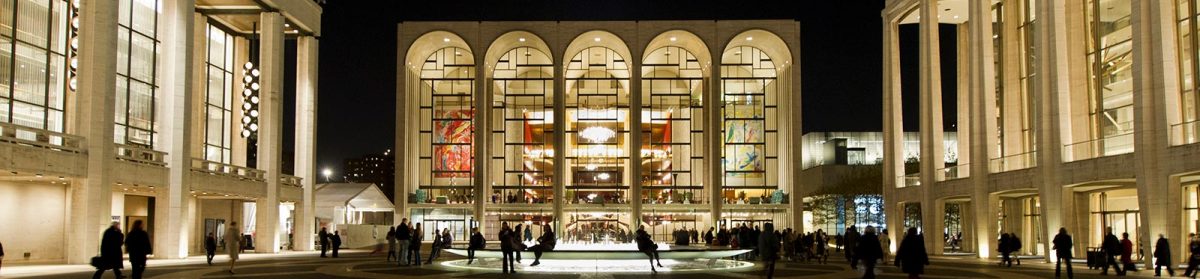
In this 11th year, over ten nights performances from the Met’s Live in HD series will be shown starting with a screening of FUNNY FACE in a special co-presentation with Film at Lincoln Center. Screenings run from August 23 through September 2. There will be 3000 seats in the Plaza in front of the Opera House with an additional standing room area. Cancellations due to thunder/lighting or high wind will not be rescheduled.

MIGNON:Thomas
Original Air Date: 01/27/1945
Pelletier; Stevens, Melton, Benzell, Pinza
MOD Audio SID.19380212
“There are some great tunes in Mignon but I find the opera doesn’t hold up well — I saw it staged in Dallas with Horne (1974), and it was a LONG evening. Pinza is very fine here. Mignon’s last broadcast appearance is 3 years later with Marilyn Cotlow as Philine which is more than 6 decades ago. That Mignon “”farewell”” has not been on Sirius.”
 ,
,
MIGNON:Thomas
Original Air Date: 01/27/1945
Pelletier; Stevens, Melton, Benzell, Pinza
MOD Audio SID.19380642
“There are some great tunes in Mignon but I find the opera doesn’t hold up well — I saw it staged in Dallas with Horne (1974), and it was a LONG evening. Pinza is very fine here. Mignon’s last broadcast appearance is 3 years later with Marilyn Cotlow as Philine which is more than 6 decades ago. That Mignon “”farewell”” has not been on Sirius.”

SAMSON ET DALILA:Saint-Saëns
Abravanel; Maison, Wettergren, Pinza
Original Air Date: 12/26/1936
MOD Audio
SID.19430107
This is the second oldest Met performance to have been rebroadcast on Sirius — the Lawrence/Melchior Gotterdammerung also from 1936 (but previous season) is the oldest. Abravanel is more remembered as longtime conductor of the Utah Symphony, but his three Met seasons beginning with this broadcast showed him as a sure hand in the French and German wings of the repertory. The principals have plenty of profile, and Pinza is an excellent High Priest.
SAMSON ET DALILA:Saint-Saëns
Abravanel; Maison, Wettergren, Pinza
Original Air Date: 12/26/1936
MOD Audio
SID.19430319
This is the second oldest Met performance to have been rebroadcast on Sirius — the Lawrence/Melchior Gotterdammerung also from 1936 (but previous season) is the oldest. Abravanel is more remembered as longtime conductor of the Utah Symphony, but his three Met seasons beginning with this broadcast showed him as a sure hand in the French and German wings of the repertory. The principals have plenty of profile, and Pinza is an excellent High Priest.
SAMSON ET DALILA:Saint-Saëns
Abravanel; Maison, Wettergren, Pinza
Original Air Date: 12/26/1936
MOD Audio
SID.19430637
This is the second oldest Met performance to have been rebroadcast on Sirius — the Lawrence/Melchior Gotterdammerung also from 1936 (but previous season) is the oldest. Abravanel is more remembered as longtime conductor of the Utah Symphony, but his three Met seasons beginning with this broadcast showed him as a sure hand in the French and German wings of the repertory. The principals have plenty of profile, and Pinza is an excellent High Priest.

FAUST:Gounod
Beecham; Jobin, Albanese, Pinza, Thomas, Browning
Original Air Date: 01/30/1943
SID.19440211
J Woolf: Pinza is, of course, magnificent and Jobin matches him for much of the time – though not all of the time, which is where Kullman scored over him. Albanese is a character actress of real repute though the voice itself is inclined to take on a slightly mezzo-ish depth. Never mind, she has the dramatic instincts in place. The smaller roles are well taken and that leaves Beecham. Well, he was never rocket propelled in this work and generally encouraged leisurely tempi. Though as he would doubtless be the first to point out, the average ear confuses speed and rhythm – and Beecham’s rhythmic underpinning here is sure, his conception of the work as a whole splendidly realised. Right from the start one can admire his direction of the Act I introduction – so flexible and winning. The Chorus comes in – somewhat distant but adequate for a private recording of this kind. Jobin is first – ringing and declamatory, superb rhythm and articulation of phrases, subtle highlighting of lyric peaks and troughs. Then Pinza, simply wonderful with great depth of tone across his range – characterisation without exaggeration. I wouldn’t make too much of Singher’s problems but he is unsteady in O toi in Act II (and going up in the Invocation). In fact so is another voice – the prompter, I assume, who can be clearly heard – and crikey is he a busy man. Beecham sounds to be enjoying the grand seignorial swagger behind Pinza in the Rondo – though, a warning to those who are expecting the moon; the sound is a bit crude along the way. The Met strings sound on good, spruce Gallic form in Nous nous retrouverons, mes amis and indeed they cultivate a bright and crisp impression all round; the Chorus too sounds well trained for the occasion. As for Jobin’s Salut! Demeure chaste et pure it’s not so bad – it’s not virile in the way Kullman is but more soft grained and intimate; less effusively romantic. No, I don’t think Albanese sounds youthful enough in the Chanson du Roi de Thulé but she shows signs of her impersonation to come later on; careful and clever singing and acting, as well as tonally frequently resplendent on her own terms. Let’s finish with Thelma Votipka and Lucielle Browning who tend to be edged out of discussions given the excellence of the principals. Browning is consistently good and Votipka shows in her Act III Que vois-je, Signeur Dieu! just how strong a cast this was – witty and perfectly characterised.
Read more: www.musicweb-international.com/classrev/2004/Feb04/Gounod_Faust_Beecham.htm#ixzz63cACqnby
FAUST:Gounod
Beecham; Jobin, Albanese, Pinza, Thomas, Browning
Original Air Date: 01/30/1943
SID.19440427
J Woolf: Pinza is, of course, magnificent and Jobin matches him for much of the time – though not all of the time, which is where Kullman scored over him. Albanese is a character actress of real repute though the voice itself is inclined to take on a slightly mezzo-ish depth. Never mind, she has the dramatic instincts in place. The smaller roles are well taken and that leaves Beecham. Well, he was never rocket propelled in this work and generally encouraged leisurely tempi. Though as he would doubtless be the first to point out, the average ear confuses speed and rhythm – and Beecham’s rhythmic underpinning here is sure, his conception of the work as a whole splendidly realised. Right from the start one can admire his direction of the Act I introduction – so flexible and winning. The Chorus comes in – somewhat distant but adequate for a private recording of this kind. Jobin is first – ringing and declamatory, superb rhythm and articulation of phrases, subtle highlighting of lyric peaks and troughs. Then Pinza, simply wonderful with great depth of tone across his range – characterisation without exaggeration. I wouldn’t make too much of Singher’s problems but he is unsteady in O toi in Act II (and going up in the Invocation). In fact so is another voice – the prompter, I assume, who can be clearly heard – and crikey is he a busy man. Beecham sounds to be enjoying the grand seignorial swagger behind Pinza in the Rondo – though, a warning to those who are expecting the moon; the sound is a bit crude along the way. The Met strings sound on good, spruce Gallic form in Nous nous retrouverons, mes amis and indeed they cultivate a bright and crisp impression all round; the Chorus too sounds well trained for the occasion. As for Jobin’s Salut! Demeure chaste et pure it’s not so bad – it’s not virile in the way Kullman is but more soft grained and intimate; less effusively romantic. No, I don’t think Albanese sounds youthful enough in the Chanson du Roi de Thulé but she shows signs of her impersonation to come later on; careful and clever singing and acting, as well as tonally frequently resplendent on her own terms. Let’s finish with Thelma Votipka and Lucielle Browning who tend to be edged out of discussions given the excellence of the principals. Browning is consistently good and Votipka shows in her Act III Que vois-je, Signeur Dieu! just how strong a cast this was – witty and perfectly characterised.
Read more: www.musicweb-international.com/classrev/2004/Feb04/Gounod_Faust_Beecham.htm#ixzz63cACqnby
FAUST:Gounod
Beecham; Jobin, Albanese, Pinza, Thomas, Browning
Original Air Date: 01/30/1943
SID.19440637
J Woolf: Pinza is, of course, magnificent and Jobin matches him for much of the time – though not all of the time, which is where Kullman scored over him. Albanese is a character actress of real repute though the voice itself is inclined to take on a slightly mezzo-ish depth. Never mind, she has the dramatic instincts in place. The smaller roles are well taken and that leaves Beecham. Well, he was never rocket propelled in this work and generally encouraged leisurely tempi. Though as he would doubtless be the first to point out, the average ear confuses speed and rhythm – and Beecham’s rhythmic underpinning here is sure, his conception of the work as a whole splendidly realised. Right from the start one can admire his direction of the Act I introduction – so flexible and winning. The Chorus comes in – somewhat distant but adequate for a private recording of this kind. Jobin is first – ringing and declamatory, superb rhythm and articulation of phrases, subtle highlighting of lyric peaks and troughs. Then Pinza, simply wonderful with great depth of tone across his range – characterisation without exaggeration. I wouldn’t make too much of Singher’s problems but he is unsteady in O toi in Act II (and going up in the Invocation). In fact so is another voice – the prompter, I assume, who can be clearly heard – and crikey is he a busy man. Beecham sounds to be enjoying the grand seignorial swagger behind Pinza in the Rondo – though, a warning to those who are expecting the moon; the sound is a bit crude along the way. The Met strings sound on good, spruce Gallic form in Nous nous retrouverons, mes amis and indeed they cultivate a bright and crisp impression all round; the Chorus too sounds well trained for the occasion. As for Jobin’s Salut! Demeure chaste et pure it’s not so bad – it’s not virile in the way Kullman is but more soft grained and intimate; less effusively romantic. No, I don’t think Albanese sounds youthful enough in the Chanson du Roi de Thulé but she shows signs of her impersonation to come later on; careful and clever singing and acting, as well as tonally frequently resplendent on her own terms. Let’s finish with Thelma Votipka and Lucielle Browning who tend to be edged out of discussions given the excellence of the principals. Browning is consistently good and Votipka shows in her Act III Que vois-je, Signeur Dieu! just how strong a cast this was – witty and perfectly characterised.
Read more: www.musicweb-international.com/classrev/2004/Feb04/Gounod_Faust_Beecham.htm#ixzz63cACqnby
FAUST:Gounod
Beecham; Jobin, Albanese, Pinza, Thomas, Browning
Original Air Date: 01/30/1943
SID.19450101
J Woolf: Pinza is, of course, magnificent and Jobin matches him for much of the time – though not all of the time, which is where Kullman scored over him. Albanese is a character actress of real repute though the voice itself is inclined to take on a slightly mezzo-ish depth. Never mind, she has the dramatic instincts in place. The smaller roles are well taken and that leaves Beecham. Well, he was never rocket propelled in this work and generally encouraged leisurely tempi. Though as he would doubtless be the first to point out, the average ear confuses speed and rhythm – and Beecham’s rhythmic underpinning here is sure, his conception of the work as a whole splendidly realised. Right from the start one can admire his direction of the Act I introduction – so flexible and winning. The Chorus comes in – somewhat distant but adequate for a private recording of this kind. Jobin is first – ringing and declamatory, superb rhythm and articulation of phrases, subtle highlighting of lyric peaks and troughs. Then Pinza, simply wonderful with great depth of tone across his range – characterisation without exaggeration. I wouldn’t make too much of Singher’s problems but he is unsteady in O toi in Act II (and going up in the Invocation). In fact so is another voice – the prompter, I assume, who can be clearly heard – and crikey is he a busy man. Beecham sounds to be enjoying the grand seignorial swagger behind Pinza in the Rondo – though, a warning to those who are expecting the moon; the sound is a bit crude along the way. The Met strings sound on good, spruce Gallic form in Nous nous retrouverons, mes amis and indeed they cultivate a bright and crisp impression all round; the Chorus too sounds well trained for the occasion. As for Jobin’s Salut! Demeure chaste et pure it’s not so bad – it’s not virile in the way Kullman is but more soft grained and intimate; less effusively romantic. No, I don’t think Albanese sounds youthful enough in the Chanson du Roi de Thulé but she shows signs of her impersonation to come later on; careful and clever singing and acting, as well as tonally frequently resplendent on her own terms. Let’s finish with Thelma Votipka and Lucielle Browning who tend to be edged out of discussions given the excellence of the principals. Browning is consistently good and Votipka shows in her Act III Que vois-je, Signeur Dieu! just how strong a cast this was – witty and perfectly characterised.

LA FORZA DEL DESTINO:Verdi
Walter; Roman, Jagel, Tibbett, Pinza, Petina, Baccaloni
Original Air Date: 01/23/1943
SID.20050106
Roman is particularly impressive, and we don’t have so many surviving Bruno Walter broadcasts that this one is particularly welcome. This is a bit late for Tibbett, but Pinza is wonderful in one of Verdi’s greatest bass roles.
LA FORZA DEL DESTINO:Verdi
Walter; Roman, Jagel, Tibbett, Pinza, Petina, Baccaloni
Original Air Date: 01/23/1943
SID.20050318
Roman is particularly impressive, and we don’t have so many surviving Bruno Walter broadcasts that this one is particularly welcome. This is a bit late for Tibbett, but Pinza is wonderful in one of Verdi’s greatest bass roles.
LA FORZA DEL DESTINO:Verdi
Walter; Roman, Jagel, Tibbett, Pinza, Petina, Baccaloni
Original Air Date: 01/23/1943
SID.20050637
Roman is particularly impressive, and we don’t have so many surviving Bruno Walter broadcasts that this one is particularly welcome. This is a bit late for Tibbett, but Pinza is wonderful in one of Verdi’s greatest bass roles.

LUCIA DI LAMMERMOOR:Donizetti
Papi; Pons, Jagel, Brownlee, Pinza
Original Air Date: 02/27/1937
SID.20130108
RWW: Lily Pons seduced a whole generation of New Yorkers with her glamour, her Gallic presence, and staccati in alt., but I saw her last Lucia in Fort Worth, and never much cared for her recordings. Whatever I think, this is one of the oldest Met broadcasts on Sirius, and Pons’ appeal continues. John Brownlee has a voice that can be passable in Fledermaus, but for me not in Lucia. Ezio Pinza is as good as one gets.
 ,
, 
MIGNON:Thomas
Pelletier; Stevens, Melton, Benzell, Pinza
Original Air Date: 01/27/1945
MOD Audio
SID.20130318
RWW: There are some great tunes in Mignon but I find the opera doesn’t hold up well — I saw it staged in Dallas with Horne (1974), and it was a LONG evening. Pinza is very fine here. Mignon’s last broadcast appearance is three years later with Marilyn Cotlow as Philine which is more than 6 decades ago. That Mignon farewell has not been on Sirius.
LUCIA DI LAMMERMOOR:Donizetti
Papi; Pons, Jagel, Brownlee, Pinza
Original Air Date: 02/27/1937
SID.20130319
RWW: Lily Pons seduced a whole generation of New Yorkers with her glamour, her Gallic presence, and staccati in alt., but I saw her last Lucia in Fort Worth, and never much cared for her recordings. Whatever I think, this is one of the oldest Met broadcasts on Sirius, and Pons’ appeal continues. John Brownlee has a voice that can be passable in Fledermaus, but for me not in Lucia. Ezio Pinza is as good as one gets.
,
MIGNON:Thomas
Pelletier; Stevens, Melton, Benzell, Pinza
Original Air Date: 01/27/1945
MOD Audio
SID.20130537
RWW: There are some great tunes in Mignon but I find the opera doesn’t hold up well — I saw it staged in Dallas with Horne (1974), and it was a LONG evening. Pinza is very fine here. Mignon’s last broadcast appearance is three years later with Marilyn Cotlow as Philine which is more than 6 decades ago. That Mignon farewell has not been on Sirius.
LUCIA DI LAMMERMOOR:Donizetti
Papi; Pons, Jagel, Brownlee, Pinza
Original Air Date: 02/27/1937
SID.20130538
RWW: Lily Pons seduced a whole generation of New Yorkers with her glamour, her Gallic presence, and staccati in alt., but I saw her last Lucia in Fort Worth, and never much cared for her recordings. Whatever I think, this is one of the oldest Met broadcasts on Sirius, and Pons’ appeal continues. John Brownlee has a voice that can be passable in Fledermaus, but for me not in Lucia. Ezio Pinza is as good as one gets.