
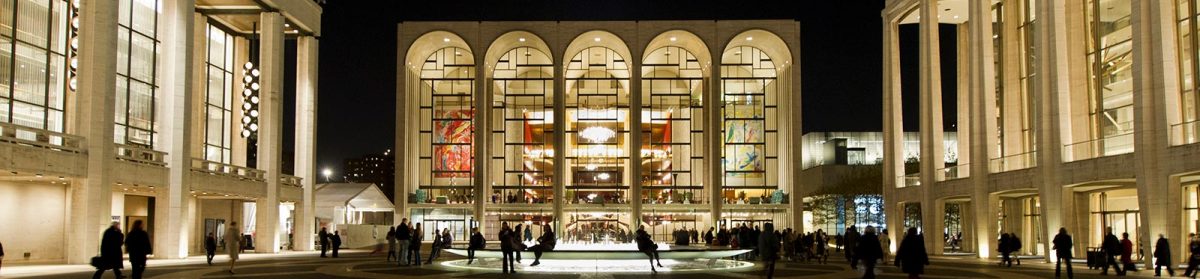
In this 11th year, over ten nights performances from the Met’s Live in HD series will be shown starting with a screening of FUNNY FACE in a special co-presentation with Film at Lincoln Center. Screenings run from August 23 through September 2. There will be 3000 seats in the Plaza in front of the Opera House with an additional standing room area. Cancellations due to thunder/lighting or high wind will not be rescheduled.

FAUST:Gounod
Beecham; Jobin, Albanese, Pinza, Thomas, Browning
Original Air Date: 01/30/1943
SID.19450101
J Woolf: Pinza is, of course, magnificent and Jobin matches him for much of the time – though not all of the time, which is where Kullman scored over him. Albanese is a character actress of real repute though the voice itself is inclined to take on a slightly mezzo-ish depth. Never mind, she has the dramatic instincts in place. The smaller roles are well taken and that leaves Beecham. Well, he was never rocket propelled in this work and generally encouraged leisurely tempi. Though as he would doubtless be the first to point out, the average ear confuses speed and rhythm – and Beecham’s rhythmic underpinning here is sure, his conception of the work as a whole splendidly realised. Right from the start one can admire his direction of the Act I introduction – so flexible and winning. The Chorus comes in – somewhat distant but adequate for a private recording of this kind. Jobin is first – ringing and declamatory, superb rhythm and articulation of phrases, subtle highlighting of lyric peaks and troughs. Then Pinza, simply wonderful with great depth of tone across his range – characterisation without exaggeration. I wouldn’t make too much of Singher’s problems but he is unsteady in O toi in Act II (and going up in the Invocation). In fact so is another voice – the prompter, I assume, who can be clearly heard – and crikey is he a busy man. Beecham sounds to be enjoying the grand seignorial swagger behind Pinza in the Rondo – though, a warning to those who are expecting the moon; the sound is a bit crude along the way. The Met strings sound on good, spruce Gallic form in Nous nous retrouverons, mes amis and indeed they cultivate a bright and crisp impression all round; the Chorus too sounds well trained for the occasion. As for Jobin’s Salut! Demeure chaste et pure it’s not so bad – it’s not virile in the way Kullman is but more soft grained and intimate; less effusively romantic. No, I don’t think Albanese sounds youthful enough in the Chanson du Roi de Thulé but she shows signs of her impersonation to come later on; careful and clever singing and acting, as well as tonally frequently resplendent on her own terms. Let’s finish with Thelma Votipka and Lucielle Browning who tend to be edged out of discussions given the excellence of the principals. Browning is consistently good and Votipka shows in her Act III Que vois-je, Signeur Dieu! just how strong a cast this was – witty and perfectly characterised.

I VESPRI SICILIANI:Verdi
Chaslin; Radvanovsky, Casanova, Nucci, Ramey
Original Air Date: 12/11/2004
MOD Audio
SID.19450102
Elena was a major breakout role for Radvanovsky, and she was the deserved star of this revival. Nucci, who has appeared irregularly but continuously since his debut in 1980 last appeared at the Met in this 2004 broadcast where he is in fine voice as he was on the Nabucco broadcast six months earlier (prior season). His current engagements show him as busy as any Verdi baritone before the public with an appearance in January 2016 at La Scala as Rigoletto with Nadine Sierra, where they encored the Si, vendetta duet (!!!!). Casanova has good style in arguably Verdi’s most challenging tenor part. This revival catches Ramey after the wobble had started to set in (I date at around 2002). He’s still very commanding, but it’s just a bit too late to be top quality. Procida is one of the greatest of Verdi bass roles right up there with Fiesco, if not quite at the level of Filippo II. Chaslin conducts a well prepared performance, and so nice to have this performance in the Sirius rotation. With Radvanovsky’s new status, this performance should be added to MOoD. This is true two years ago, and is still the case.

LE NOZZE DI FIGARO:Mozart
Rudel; Morris, McLaughlin, Fleming, Croft, Bunnell
Original Air Date: 02/12/1994
MOD Audio
SID.19450103
This is is Fleming’s first featured broadcast and it’s one of her best roles. The previous broadcast appearance was in the small role of Rosina (Countess) in Ghosts of Versailles. Fleming’s Countess is rarer than you might think. She only has nine performances since her Met debut (in this role) in 1991. This broadcast is only her third. She premieres the new production with Terfel and Bartoli, but only does the telecast (MOD). Rudel is a fine Mozartean with plenty of fine Figaros over at NYCO before moving over to the Met. He is too often underestimated, but he presided over many a fine Figaro at the NYCO before taking up residence at the Met. Morris and McLaughlin are an interesting servant pair and any performance with Senechal is guaranteed some attention. As for missing historic broadcasts, the original Texaco broadcast with Albanese and Pinza from 1940 should certainly be rebroadcast, and the Countesses of Eleanor Steber (five from 1943-50) and Victoria de los Angeles (1952) with the superb Count of Giuseppe Valdengo. Jarmila Novotna is a superb Cherubino on many of those Steber Countesses.

LA FORZA DEL DESTINO:Verdi
Levine; Price, Domingo, MacNeil, Talvela, Elias, Capecchi
Original Air Date: 03/12/1977
SID.19450104
This performance is available on Met Opera on Demand (MOoD). Likely because this is one of Domingo’s only two broadcasts as Alvaro (the other is with Sharon Sweet). Price is very solid in her upper middle, but her tone is not that of a dramatic, and that is what Leonora is; the additional coloring is exactly what Milanov and Tebaldi have. Domingo is one category too small and lacks the expansiveness of Tucker or Corelli, and for styling, that goes to Bergonzi. Luckily all three gentlemen broadcast Forza from the Met, with Bergonzi and Corelli both opposite Price. Talvela is not the right sound for Guardiano, which has often been in the steady hands of Siepi and Giaiotti. Levine is the champion Forza conductor with 57 performances; amazingly Fausto Cleva never did the work at the Met. The German wing (Bruno Walter, Fritz Stiedry, George Schick) had a tight rein on it in the 40s and 50s.

PARSIFAL:Wagner
Steinberg; Thomas, Martin, Stewart, Macurdy, Meredith. Morris
Original Air Date: 04/20/1974
SID.19450105
This is William Steinberg’s farewell performance (only 25 altogether in four operas). It’s a very solid overall performance, and better conducted than Leopold Ludwig’s wan effort when the production was new. Next time out in 1979, James Levine begins a LONG run as the Parsifal conductor. Why is this performance not on MOoD. The cast is all-American, and except for Antony and Cleopatra, Jess Thomas is not represented on MOoD. 38 years later James Morris is the only survivor still on the Met stage. Not yet heard on Sirius are Hotter’s 2 Parsifal broadcasts (1952 as Amfortas and 1954 as Gurnemanz– his Met farewell). Hotter is well represented from Bayreuth, but worth hearing on Sirius. To me the big gaps are the 1966 Pretre Parsifal with Crespin and Konya under Pretre and the 1971 with Siepi’s classic Gurnemanz. Levine conducted a lot of Parsifal broadcasts in the 1980s, and the surprise omission is the 1985 with Vickers, Rysanek, MollThis is William Steinberg’s farewell performance (only 25 altogether in four operas). It’s a very solid overall performance, and better conducted than Leopold Ludwig’s wan effort when the production was new. Next time out in 1979, James Levine begins a LONG run as the Parsifal conductor. Why is this performance not on MOoD. The cast is all-American, and except for Antony and Cleopatra, Jess Thomas is not represented on MOoD. 38 years later James Morris is the only survivor still on the Met stage. Not yet heard on Sirius are Hotter’s 2 Parsifal broadcasts (1952 as Amfortas and 1954 as Gurnemanz– his Met farewell). Hotter is well represented from Bayreuth, but worth hearing on Sirius. To me the big gaps are the 1966 Pretre Parsifal with Crespin and Konya under Pretre and the 1971 with Siepi’s classic Gurnemanz. Levine conducted a lot of Parsifal broadcasts in the 1980s, and the surprise omission is the 1985 with Vickers, Rysanek, Moll

L’ITALIANA IN ALGERI:Rossini
Levine; Borodina, Flórez, Furlanetto, Patriarco
Original Air Date: 02/28/2004
MOD Audio
SID.19450107
Levine is always ready to take the podium when a major star or a video is handy, even if Rossini does not figure prominently in his normally outsized totals– 6 Barbieres, 12 Cenerentolas, and 19 Italianas (he does the Horne video revival in 1986 and this sunny revival from 2004. Borodina is a delightful Isabella, and Furlanetto brings more than the normal amount of voice to Mustafa. Having Florez and Kwiecien (one of his first major roles with the company) makes sure that this performance will have plenty to please the ear and the eye.

TANNHÄUSER:Wagner
Levine; Cassilly, ZylisGara, Troyanos, Monk, Macurdy
Original Air Date: 03/03/1984
SID.19450208
Tannhauser is one of Levine’s best efforts, and the cast is solid if not especially memorable. Cassilly picked up the lion’s share of the Tannhausers after McCracken’s Met tiff over telecast Otellos.

JENUFA:Janácek
Nelson; Kubiak, Varnay, Vickers, Lewis, Kraft
Original Air Date: 12/21/1974
SID.19450209
This performance is in English, which is a rarity on Sirius since almost no translations are ever heard. The standout performance for me is Jon Vickers as Laca. The giant disappointment was Varnay’s Kostelnicka. Kniplova (native Czech, but singing in German with Hamburg) in this pivotal role, but Varnay was a dud dramatically and vocally. Kubiak’s English is surprisingly adequate, and overall I enjoy listening to this performance.

IDOMENEO:Mozart
Levine; van Rensburg, Röschmann, Deshorties, Kozená. Francis
Original Air Date: 12/09/2006
MOD Audio
SID.19450210
This is Levine’s last run of Idomeneo at the Met, which included several streamed performances before the matinee with Heppner in the title role. Not sure why Rensburg has the last two, but the title role has had Pavarotti, Domingo, and the young Heppner (1991). Deshorties has had not one, but two Elettras, and the part calls for a Vaness (two excellent broadcasts) or Studer (never broadcast from the Met but in a fall series of performances.) Kozena is a quality Idamante, and Levine’s Mozart is among his very best.

ELEKTRA:Strauss
Rosenstock; Borkh, Rysanek, Madeira, Uhde, Vinay
Original Air Date: 03/25/1961
MOD Audio
SID.19450211
Rosenstock appears for the originally scheduled Mitropoulos who had died the previous November. Still, this is a powerful cast in a masterpiece. The whole cast is top drawer, and highly recommended. This is the only Elektra Borkh and Rysanek ever did together, and they are among the very best in these roles. Nice to welcome this performance to MOoD in their 2014 reissues. For me a highlight of the week. Rosenstock comes to the Met first in 1929, and left after one season (poor reviews compared to Bodanzky and Bodanzky returned the following season). Rosenstock returned to Germany, then to Japan for the WHOLE WWII at NHK. He gets back to New York, and starts anew at New York City Opera and succeeds Halasz as director in 1952. After 4 seasons as director, he is replaced by Julius Rudel, and then returns to the Met in 1961 replacing the recently deceased Mitropoulos. He goes on to conduct over 250 Met performances in the next 8 years. including Tosca and Lucia on the Met tour among just about everything. He is a solid conductor, and Borkh in 1961 one of the very great Elektras.

EUGENE ONEGIN:Tchaikovsky
Gergiev; Hvorostovsky, Fleming, Vargas, Zaremba, Aleksashkin
Original Air Date: 02/24/2007
Live in HDMOD AudioMOD Video
SID.19450212
This performance is well known as one of the first season hits from the Met Live in HD. It is available on video in Blu-Ray (not so many of the Met performances are), as well as in MOoD. Gergiev, Hvorostovsky and Fleming deliver on their superstar standing both in audio and video.

LA BOHÈME:Puccini
Schick; de los Angeles, Morell, Krall, Testi, Wilderman
Original Air Date: 03/11/1961
SID.19450213
This is Victoria de los Angeles’ farewell broadcast and also her final season — she alternates Harriet in Martha on tour with Mimi. Paul Jackson in his broadcast reviews and a very big fan of VDLA finds her in mixed form, but surrounded by uninteresting colleagues. Still, for those of you who have never heard her live, there will be some rewards in the listening. Check her studio Boheme recorded in NYC with Bjorling, Merrill, Amara under Beecham, but not official Met sponsorship. Too bad her 1958 Violetta in Traviata has not been broadcast with Campora or her 1959 Manon with Gedda under Morel or the same pair in the 1960 Pelleas.

MOURNING BECOMES ELECTRA:Levy
Mehta; Lear, Reardon, Collier, Milnes, Macurdy
Original Air Date: 04/01/1967
SID.19450214
Whatever the musical limitations, Cacoyannis’ direction and the searing performances of Lear and Collier as Lavinia and Christine Mannon and maybe the best thing Reardon and Milnes ever did. Michael Cacoyannis’ staging and a cast rehearsed to a fare thee well by Mehta overcome the limitations of O’Neill and Levy. It was quite an effective evening in the theatre. Lear and Collier even in such rarefied company stood out. This is from first season in the new house. Sad that we didn’t have cameras whirring in those days – probably the performance of the 1960s most regret not being on video, because video might have caught some of the enormous electricity that was simply not in Levy’s music. Surprisingly, this piece lingers on the edge of the repertory, exceeded only by Vanessa in terms of repeat performances for recent Met world premieres.

CARMEN:Bizet
Pelletier; Swarthout, Kullman, Albanese, Warren
Original Air Date: 03/15/1941
MOD Audio
SID.19450315
This performance is on MOoD. Swarthout was certainly a media creation of the 30s and 40s and lasted into the 50s as an occasional panelist on What’s my line? Albanese and Warren are heard in less familiar roles. Warren does not do Escamillo after 1944, and Albanese has no Met Micaelas after 1949. There are many Met performances from the 40s more deserving than this one, but it has its curiosities.

FRANCESCA DA RIMINI:Zandonai
Santi; Scotto, Mauro, MacNeil, Lewis
Original Air Date: 02/22/1986
SID.19450316
This performance is Kabaivanska’s Met farewell. Well cast and well conducted, there are two broadcasts of Onegin in 1979 (but different seasons),both with Mazurok and Plishka the only repeats from one to another. This is slightly better. For those who have never encountered Mazurok, his voice is as velvety as Hvorostovsky, and an upper register that definitely has squillo. Wish the Met would transfer one of these Mazurok Onegins to MOoD. Glad that it at least gets a regular Sirius re-hearing. The highlights of this opera are very exciting indeed, and if there is filler along the way, the Met put out one of its most sumptuous productions. Domingo did the first year broadcast and appears on the Met Player video (also on DVD). MacNeil gives a quite over the top performance that could not be replicated– think of Rigoletto on steroids. It’s a small part but you will notice him.
PARSIFAL:Wagner
Steinberg; Thomas, Martin, Stewart, Macurdy, Meredith. Morris
Original Air Date: 04/20/1974
SID.19450317
This is William Steinberg’s farewell performance (only 25 altogether in four operas). It’s a very solid overall performance, and better conducted than Leopold Ludwig’s wan effort when the production was new. Next time out in 1979, James Levine begins a LONG run as the Parsifal conductor. Why is this performance not on MOoD. The cast is all-American, and except for Antony and Cleopatra, Jess Thomas is not represented on MOoD. 38 years later James Morris is the only survivor still on the Met stage. Not yet heard on Sirius are Hotter’s 2 Parsifal broadcasts (1952 as Amfortas and 1954 as Gurnemanz– his Met farewell). Hotter is well represented from Bayreuth, but worth hearing on Sirius. To me the big gaps are the 1966 Pretre Parsifal with Crespin and Konya under Pretre and the 1971 with Siepi’s classic Gurnemanz. Levine conducted a lot of Parsifal broadcasts in the 1980s, and the surprise omission is the 1985 with Vickers, Rysanek, MollThis is William Steinberg’s farewell performance (only 25 altogether in four operas). It’s a very solid overall performance, and better conducted than Leopold Ludwig’s wan effort when the production was new. Next time out in 1979, James Levine begins a LONG run as the Parsifal conductor. Why is this performance not on MOoD. The cast is all-American, and except for Antony and Cleopatra, Jess Thomas is not represented on MOoD. 38 years later James Morris is the only survivor still on the Met stage. Not yet heard on Sirius are Hotter’s 2 Parsifal broadcasts (1952 as Amfortas and 1954 as Gurnemanz– his Met farewell). Hotter is well represented from Bayreuth, but worth hearing on Sirius. To me the big gaps are the 1966 Pretre Parsifal with Crespin and Konya under Pretre and the 1971 with Siepi’s classic Gurnemanz. Levine conducted a lot of Parsifal broadcasts in the 1980s, and the surprise omission is the 1985 with Vickers, Rysanek, Moll
L’ITALIANA IN ALGERI:Rossini
Levine; Borodina, Flórez, Furlanetto, Patriarco
Original Air Date: 02/28/2004
MOD Audio
SID.19450319
Levine is always ready to take the podium when a major star or a video is handy, even if Rossini does not figure prominently in his normally outsized totals– 6 Barbieres, 12 Cenerentolas, and 19 Italianas (he does the Horne video revival in 1986 and this sunny revival from 2004. Borodina is a delightful Isabella, and Furlanetto brings more than the normal amount of voice to Mustafa. Having Florez and Kwiecien (one of his first major roles with the company) makes sure that this performance will have plenty to please the ear and the eye.

Various:Various
Various Artists
Original Air Date: 01/01/9999
SID.19450320

MADAMA BUTTERFLY:Puccini
Morandi; He, DeShong, Caré, Domingo
Original Air Date: 11/06/2019
SID.19450321
Leading sopranos Hui He and Ana María Martínez share the heartbreaking title role of the doomed geisha, with tenors Piero Pretti and Andrea Carè as the American naval officer who abandons her. Paulo Szot and Markus Brück share the role of Sharpless, and Elizabeth DeShong is Suzuki, alternating with Maria Zifchak. Pier Giorgio Morandi is on the podium for Anthony Minghella’s sweeping production, a perennial audience favorite.
LE NOZZE DI FIGARO:Mozart
Rudel; Morris, McLaughlin, Fleming, Croft, Bunnell
Original Air Date: 02/12/1994
MOD Audio
SID.19450422
This is is Fleming’s first featured broadcast and it’s one of her best roles. The previous broadcast appearance was in the small role of Rosina (Countess) in Ghosts of Versailles. Fleming’s Countess is rarer than you might think. She only has nine performances since her Met debut (in this role) in 1991. This broadcast is only her third. She premieres the new production with Terfel and Bartoli, but only does the telecast (MOD). Rudel is a fine Mozartean with plenty of fine Figaros over at NYCO before moving over to the Met. He is too often underestimated, but he presided over many a fine Figaro at the NYCO before taking up residence at the Met. Morris and McLaughlin are an interesting servant pair and any performance with Senechal is guaranteed some attention. As for missing historic broadcasts, the original Texaco broadcast with Albanese and Pinza from 1940 should certainly be rebroadcast, and the Countesses of Eleanor Steber (five from 1943-50) and Victoria de los Angeles (1952) with the superb Count of Giuseppe Valdengo. Jarmila Novotna is a superb Cherubino on many of those Steber Countesses.
LA FORZA DEL DESTINO:Verdi
Levine; Price, Domingo, MacNeil, Talvela, Elias, Capecchi
Original Air Date: 03/12/1977
SID.19450423
This performance is available on Met Opera on Demand (MOoD). Likely because this is one of Domingo’s only two broadcasts as Alvaro (the other is with Sharon Sweet). Price is very solid in her upper middle, but her tone is not that of a dramatic, and that is what Leonora is; the additional coloring is exactly what Milanov and Tebaldi have. Domingo is one category too small and lacks the expansiveness of Tucker or Corelli, and for styling, that goes to Bergonzi. Luckily all three gentlemen broadcast Forza from the Met, with Bergonzi and Corelli both opposite Price. Talvela is not the right sound for Guardiano, which has often been in the steady hands of Siepi and Giaiotti. Levine is the champion Forza conductor with 57 performances; amazingly Fausto Cleva never did the work at the Met. The German wing (Bruno Walter, Fritz Stiedry, George Schick) had a tight rein on it in the 40s and 50s.
TANNHÄUSER:Wagner
Levine; Cassilly, ZylisGara, Troyanos, Monk, Macurdy
Original Air Date: 03/03/1984
SID.19450424
Tannhauser is one of Levine’s best efforts, and the cast is solid if not especially memorable. Cassilly picked up the lion’s share of the Tannhausers after McCracken’s Met tiff over telecast Otellos.
I VESPRI SICILIANI:Verdi
Chaslin; Radvanovsky, Casanova, Nucci, Ramey
Original Air Date: 12/11/2004
MOD Audio
SID.19450425
Elena was a major breakout role for Radvanovsky, and she was the deserved star of this revival. Nucci, who has appeared irregularly but continuously since his debut in 1980 last appeared at the Met in this 2004 broadcast where he is in fine voice as he was on the Nabucco broadcast six months earlier (prior season). His current engagements show him as busy as any Verdi baritone before the public with an appearance in January 2016 at La Scala as Rigoletto with Nadine Sierra, where they encored the Si, vendetta duet (!!!!). Casanova has good style in arguably Verdi’s most challenging tenor part. This revival catches Ramey after the wobble had started to set in (I date at around 2002). He’s still very commanding, but it’s just a bit too late to be top quality. Procida is one of the greatest of Verdi bass roles right up there with Fiesco, if not quite at the level of Filippo II. Chaslin conducts a well prepared performance, and so nice to have this performance in the Sirius rotation. With Radvanovsky’s new status, this performance should be added to MOoD. This is true two years ago, and is still the case.
IDOMENEO:Mozart
Levine; van Rensburg, Röschmann, Deshorties, Kozená. Francis
Original Air Date: 12/09/2006
MOD Audio
SID.19450426
This is Levine’s last run of Idomeneo at the Met, which included several streamed performances before the matinee with Heppner in the title role. Not sure why Rensburg has the last two, but the title role has had Pavarotti, Domingo, and the young Heppner (1991). Deshorties has had not one, but two Elettras, and the part calls for a Vaness (two excellent broadcasts) or Studer (never broadcast from the Met but in a fall series of performances.) Kozena is a quality Idamante, and Levine’s Mozart is among his very best.
CARMEN:Bizet
Pelletier; Swarthout, Kullman, Albanese, Warren
Original Air Date: 03/15/1941
MOD Audio
SID.19450427
This performance is on MOoD. Swarthout was certainly a media creation of the 30s and 40s and lasted into the 50s as an occasional panelist on What’s my line? Albanese and Warren are heard in less familiar roles. Warren does not do Escamillo after 1944, and Albanese has no Met Micaelas after 1949. There are many Met performances from the 40s more deserving than this one, but it has its curiosities.
EUGENE ONEGIN:Tchaikovsky
Gergiev; Hvorostovsky, Fleming, Vargas, Zaremba, Aleksashkin
Original Air Date: 02/24/2007
Live in HDMOD AudioMOD Video
SID.19450428
This performance is well known as one of the first season hits from the Met Live in HD. It is available on video in Blu-Ray (not so many of the Met performances are), as well as in MOoD. Gergiev, Hvorostovsky and Fleming deliver on their superstar standing both in audio and video.
JENUFA:Janácek
Nelson; Kubiak, Varnay, Vickers, Lewis, Kraft
Original Air Date: 12/21/1974
SID.19450529
This performance is in English, which is a rarity on Sirius since almost no translations are ever heard. The standout performance for me is Jon Vickers as Laca. The giant disappointment was Varnay’s Kostelnicka. Kniplova (native Czech, but singing in German with Hamburg) in this pivotal role, but Varnay was a dud dramatically and vocally. Kubiak’s English is surprisingly adequate, and overall I enjoy listening to this performance.
ELEKTRA:Strauss
Rosenstock; Borkh, Rysanek, Madeira, Uhde, Vinay
Original Air Date: 03/25/1961
MOD Audio
SID.19450530
Rosenstock appears for the originally scheduled Mitropoulos who had died the previous November. Still, this is a powerful cast in a masterpiece. The whole cast is top drawer, and highly recommended. This is the only Elektra Borkh and Rysanek ever did together, and they are among the very best in these roles. Nice to welcome this performance to MOoD in their 2014 reissues. For me a highlight of the week. Rosenstock comes to the Met first in 1929, and left after one season (poor reviews compared to Bodanzky and Bodanzky returned the following season). Rosenstock returned to Germany, then to Japan for the WHOLE WWII at NHK. He gets back to New York, and starts anew at New York City Opera and succeeds Halasz as director in 1952. After 4 seasons as director, he is replaced by Julius Rudel, and then returns to the Met in 1961 replacing the recently deceased Mitropoulos. He goes on to conduct over 250 Met performances in the next 8 years. including Tosca and Lucia on the Met tour among just about everything. He is a solid conductor, and Borkh in 1961 one of the very great Elektras.
EUGENE ONEGIN:Tchaikovsky
Gergiev; Hvorostovsky, Fleming, Vargas, Zaremba, Aleksashkin
Original Air Date: 02/24/2007
Live in HDMOD AudioMOD Video
SID.19450531
This performance is well known as one of the first season hits from the Met Live in HD. It is available on video in Blu-Ray (not so many of the Met performances are), as well as in MOoD. Gergiev, Hvorostovsky and Fleming deliver on their superstar standing both in audio and video.
LA BOHÈME:Puccini
Schick; de los Angeles, Morell, Krall, Testi, Wilderman
Original Air Date: 03/11/1961
SID.19450532
This is Victoria de los Angeles’ farewell broadcast and also her final season — she alternates Harriet in Martha on tour with Mimi. Paul Jackson in his broadcast reviews and a very big fan of VDLA finds her in mixed form, but surrounded by uninteresting colleagues. Still, for those of you who have never heard her live, there will be some rewards in the listening. Check her studio Boheme recorded in NYC with Bjorling, Merrill, Amara under Beecham, but not official Met sponsorship. Too bad her 1958 Violetta in Traviata has not been broadcast with Campora or her 1959 Manon with Gedda under Morel or the same pair in the 1960 Pelleas.