
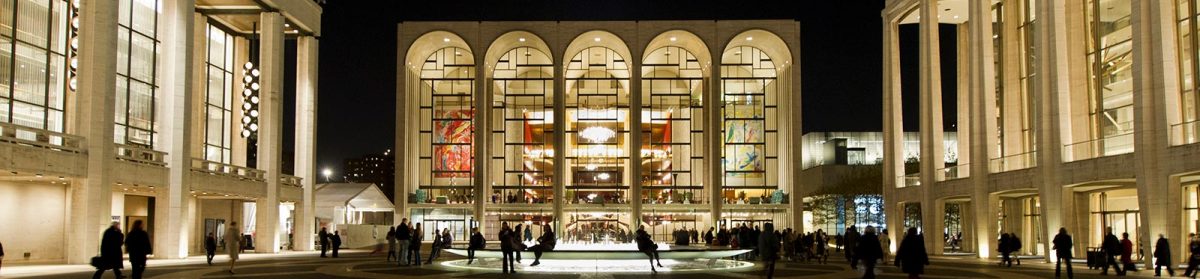
In this 11th year, over ten nights performances from the Met’s Live in HD series will be shown starting with a screening of FUNNY FACE in a special co-presentation with Film at Lincoln Center. Screenings run from August 23 through September 2. There will be 3000 seats in the Plaza in front of the Opera House with an additional standing room area. Cancellations due to thunder/lighting or high wind will not be rescheduled.

L’ELISIR D’AMORE:Donizetti
Rudolf; Pavarotti, Blegen, Flagello, Reardon
Original Air Date: 04/06/1974
MOD Audio
SID.19440104
“NY Post S Jenkins: In last night’s “”L’Elisir d’Amore”” the Metropolitan Opera pulled off the equivalent of a grand slam home run: a performance that must have delighted the tired businessman, satisfied the opera buff and absolutely satiated the voice lover. And all this wonder came from the musical and dramatic ability of the two leads: Judith Blegen and Luciano Pavarotti.
Gaetano Donizetti’s “”L’Elisir,”” though one of the most popular of Italian comic operas, does not play itself. To be successful, the principals must constantly work to make the audience see that these are real people caught in a comic situation.
Brilliantly crafted by Felice Romani, the librettist of “”Norma,”” “”L’Elisir’s”” book contains the classic tear through a smile: several moments when all the buffoonery is ripped away and the audience sees that Nemorino really loves Adina, and she returns his love.
Miss Blegen and Mr. Pavarotti never ceased to create their characters. Though they sang superlatively, their greatest triumph lay in their complete believability.
Pavarotti, now tipping the scales at around 300, moves on stage with the lightness of a man a quarter of his size, and his marvelously expressive face constantly emotes. Nemorino’s frustrations, his joy and his ultimate victory passed as a motion picture on the. tenor’s countenance.
And what do you say about Miss Blegen except that she is just about the prettiest girl to appear on the Met stage, ever. She also manages to be a coquette without ever once being overcute or too coy. The face, the figure, the attractiveness, how lucky is opera not to have lost her to Broadway!
Vocally, Pavarotti proved himself again the emperor of lyric tenors. Style, finesse, musical taste and a faultless vocal instrument all coalesced in his Nemorino. Some roles fit even a great voice better than others, and from first to last Nemorino is his property. In “”Una furtiva lagrima”” the sheen of his voice seemed to be encircled in a column of air, and his concluding high C in the “”Venti Scudi”” duet sang with ease.
Miss Blegen, whose tone is bright where a more Italianate soprano might be mellow, sang with such authority and finesse that she silenced any possible caviling. Her “”Prendi per me sei libero”” in the last scene, with its descending two-octave run from a high C, glistened as does dew on summer grass.
Mario Sereni contributed his familiar Belcore, one of the baritone’s best roles at the Met, and Ezio Flagello offered up his Dulcamara. Though he sings more of the role than some others who perform it, he has little humor in his voice or presence. It is a solid performance, but lacks the element that makes the old quack really lovable.
The greatest tributes to the brilliance of Miss Blegen, who learned her role in Italian in about 10 days, and Pavarotti were that they overcame the heavyhanded, rather Germanic but solid performance by Max Rudolf. A distinguished maestro with many great performances at the Met in the early Bing years, Rudolf was never known for his Donizetti.
And in almost every way, he seemed to try to knock the bubbles out of the singer’s champagne. With this cast he couldn’t, and there were no unhappy patrons visible.”

ROMÉO ET JULIETTE:Gounod
Molinari-Pradelli; Gedda, Freni, Macurdy, Baldwin, Reardon
Original Air Date: 04/13/1968
SID.19440209
Molinari-Pradelli is an improvement on Domingo in the pit, but others are still much better. Gedda and Freni are not ideal, but it’s a wonderful memory of her youthful singing at the Met, and she is more alive on the broadcast than in the studio (and many performances) with Corelli.
L’ELISIR D’AMORE:Donizetti
Rudolf; Pavarotti, Blegen, Flagello, Reardon
Original Air Date: 04/06/1974
MOD Audio
SID.19440320
“NY Post S Jenkins: In last night’s “”L’Elisir d’Amore”” the Metropolitan Opera pulled off the equivalent of a grand slam home run: a performance that must have delighted the tired businessman, satisfied the opera buff and absolutely satiated the voice lover. And all this wonder came from the musical and dramatic ability of the two leads: Judith Blegen and Luciano Pavarotti.
Gaetano Donizetti’s “”L’Elisir,”” though one of the most popular of Italian comic operas, does not play itself. To be successful, the principals must constantly work to make the audience see that these are real people caught in a comic situation.
Brilliantly crafted by Felice Romani, the librettist of “”Norma,”” “”L’Elisir’s”” book contains the classic tear through a smile: several moments when all the buffoonery is ripped away and the audience sees that Nemorino really loves Adina, and she returns his love.
Miss Blegen and Mr. Pavarotti never ceased to create their characters. Though they sang superlatively, their greatest triumph lay in their complete believability.
Pavarotti, now tipping the scales at around 300, moves on stage with the lightness of a man a quarter of his size, and his marvelously expressive face constantly emotes. Nemorino’s frustrations, his joy and his ultimate victory passed as a motion picture on the. tenor’s countenance.
And what do you say about Miss Blegen except that she is just about the prettiest girl to appear on the Met stage, ever. She also manages to be a coquette without ever once being overcute or too coy. The face, the figure, the attractiveness, how lucky is opera not to have lost her to Broadway!
Vocally, Pavarotti proved himself again the emperor of lyric tenors. Style, finesse, musical taste and a faultless vocal instrument all coalesced in his Nemorino. Some roles fit even a great voice better than others, and from first to last Nemorino is his property. In “”Una furtiva lagrima”” the sheen of his voice seemed to be encircled in a column of air, and his concluding high C in the “”Venti Scudi”” duet sang with ease.
Miss Blegen, whose tone is bright where a more Italianate soprano might be mellow, sang with such authority and finesse that she silenced any possible caviling. Her “”Prendi per me sei libero”” in the last scene, with its descending two-octave run from a high C, glistened as does dew on summer grass.
Mario Sereni contributed his familiar Belcore, one of the baritone’s best roles at the Met, and Ezio Flagello offered up his Dulcamara. Though he sings more of the role than some others who perform it, he has little humor in his voice or presence. It is a solid performance, but lacks the element that makes the old quack really lovable.
The greatest tributes to the brilliance of Miss Blegen, who learned her role in Italian in about 10 days, and Pavarotti were that they overcame the heavyhanded, rather Germanic but solid performance by Max Rudolf. A distinguished maestro with many great performances at the Met in the early Bing years, Rudolf was never known for his Donizetti.
And in almost every way, he seemed to try to knock the bubbles out of the singer’s champagne. With this cast he couldn’t, and there were no unhappy patrons visible.”
ROMÉO ET JULIETTE:Gounod
Molinari-Pradelli; Gedda, Freni, Macurdy, Baldwin, Reardon
Original Air Date: 04/13/1968
SID.19440425
Molinari-Pradelli is an improvement on Domingo in the pit, but others are still much better. Gedda and Freni are not ideal, but it’s a wonderful memory of her youthful singing at the Met, and she is more alive on the broadcast than in the studio (and many performances) with Corelli.
L’ELISIR D’AMORE:Donizetti
Rudolf; Pavarotti, Blegen, Flagello, Reardon
Original Air Date: 04/06/1974
MOD Audio
SID.19440530
“NY Post S Jenkins: In last night’s “”L’Elisir d’Amore”” the Metropolitan Opera pulled off the equivalent of a grand slam home run: a performance that must have delighted the tired businessman, satisfied the opera buff and absolutely satiated the voice lover. And all this wonder came from the musical and dramatic ability of the two leads: Judith Blegen and Luciano Pavarotti.
Gaetano Donizetti’s “”L’Elisir,”” though one of the most popular of Italian comic operas, does not play itself. To be successful, the principals must constantly work to make the audience see that these are real people caught in a comic situation.
Brilliantly crafted by Felice Romani, the librettist of “”Norma,”” “”L’Elisir’s”” book contains the classic tear through a smile: several moments when all the buffoonery is ripped away and the audience sees that Nemorino really loves Adina, and she returns his love.
Miss Blegen and Mr. Pavarotti never ceased to create their characters. Though they sang superlatively, their greatest triumph lay in their complete believability.
Pavarotti, now tipping the scales at around 300, moves on stage with the lightness of a man a quarter of his size, and his marvelously expressive face constantly emotes. Nemorino’s frustrations, his joy and his ultimate victory passed as a motion picture on the. tenor’s countenance.
And what do you say about Miss Blegen except that she is just about the prettiest girl to appear on the Met stage, ever. She also manages to be a coquette without ever once being overcute or too coy. The face, the figure, the attractiveness, how lucky is opera not to have lost her to Broadway!
Vocally, Pavarotti proved himself again the emperor of lyric tenors. Style, finesse, musical taste and a faultless vocal instrument all coalesced in his Nemorino. Some roles fit even a great voice better than others, and from first to last Nemorino is his property. In “”Una furtiva lagrima”” the sheen of his voice seemed to be encircled in a column of air, and his concluding high C in the “”Venti Scudi”” duet sang with ease.
Miss Blegen, whose tone is bright where a more Italianate soprano might be mellow, sang with such authority and finesse that she silenced any possible caviling. Her “”Prendi per me sei libero”” in the last scene, with its descending two-octave run from a high C, glistened as does dew on summer grass.
Mario Sereni contributed his familiar Belcore, one of the baritone’s best roles at the Met, and Ezio Flagello offered up his Dulcamara. Though he sings more of the role than some others who perform it, he has little humor in his voice or presence. It is a solid performance, but lacks the element that makes the old quack really lovable.
The greatest tributes to the brilliance of Miss Blegen, who learned her role in Italian in about 10 days, and Pavarotti were that they overcame the heavyhanded, rather Germanic but solid performance by Max Rudolf. A distinguished maestro with many great performances at the Met in the early Bing years, Rudolf was never known for his Donizetti.
And in almost every way, he seemed to try to knock the bubbles out of the singer’s champagne. With this cast he couldn’t, and there were no unhappy patrons visible.”
L’ELISIR D’AMORE:Donizetti
Rudolf; Pavarotti, Blegen, Flagello, Reardon
Original Air Date: 04/06/1974
MOD Audio
SID.19440640
“NY Post S Jenkins: In last night’s “”L’Elisir d’Amore”” the Metropolitan Opera pulled off the equivalent of a grand slam home run: a performance that must have delighted the tired businessman, satisfied the opera buff and absolutely satiated the voice lover. And all this wonder came from the musical and dramatic ability of the two leads: Judith Blegen and Luciano Pavarotti.
Gaetano Donizetti’s “”L’Elisir,”” though one of the most popular of Italian comic operas, does not play itself. To be successful, the principals must constantly work to make the audience see that these are real people caught in a comic situation.
Brilliantly crafted by Felice Romani, the librettist of “”Norma,”” “”L’Elisir’s”” book contains the classic tear through a smile: several moments when all the buffoonery is ripped away and the audience sees that Nemorino really loves Adina, and she returns his love.
Miss Blegen and Mr. Pavarotti never ceased to create their characters. Though they sang superlatively, their greatest triumph lay in their complete believability.
Pavarotti, now tipping the scales at around 300, moves on stage with the lightness of a man a quarter of his size, and his marvelously expressive face constantly emotes. Nemorino’s frustrations, his joy and his ultimate victory passed as a motion picture on the. tenor’s countenance.
And what do you say about Miss Blegen except that she is just about the prettiest girl to appear on the Met stage, ever. She also manages to be a coquette without ever once being overcute or too coy. The face, the figure, the attractiveness, how lucky is opera not to have lost her to Broadway!
Vocally, Pavarotti proved himself again the emperor of lyric tenors. Style, finesse, musical taste and a faultless vocal instrument all coalesced in his Nemorino. Some roles fit even a great voice better than others, and from first to last Nemorino is his property. In “”Una furtiva lagrima”” the sheen of his voice seemed to be encircled in a column of air, and his concluding high C in the “”Venti Scudi”” duet sang with ease.
Miss Blegen, whose tone is bright where a more Italianate soprano might be mellow, sang with such authority and finesse that she silenced any possible caviling. Her “”Prendi per me sei libero”” in the last scene, with its descending two-octave run from a high C, glistened as does dew on summer grass.
Mario Sereni contributed his familiar Belcore, one of the baritone’s best roles at the Met, and Ezio Flagello offered up his Dulcamara. Though he sings more of the role than some others who perform it, he has little humor in his voice or presence. It is a solid performance, but lacks the element that makes the old quack really lovable.
The greatest tributes to the brilliance of Miss Blegen, who learned her role in Italian in about 10 days, and Pavarotti were that they overcame the heavyhanded, rather Germanic but solid performance by Max Rudolf. A distinguished maestro with many great performances at the Met in the early Bing years, Rudolf was never known for his Donizetti.
And in almost every way, he seemed to try to knock the bubbles out of the singer’s champagne. With this cast he couldn’t, and there were no unhappy patrons visible.”
ROMÉO ET JULIETTE:Gounod
Molinari-Pradelli; Gedda, Freni, Macurdy, Baldwin, Reardon
Original Air Date: 04/13/1968
SID.19440641
Molinari-Pradelli is an improvement on Domingo in the pit, but others are still much better. Gedda and Freni are not ideal, but it’s a wonderful memory of her youthful singing at the Met, and she is more alive on the broadcast than in the studio (and many performances) with Corelli.

MOURNING BECOMES ELECTRA:Levy
Mehta; Lear, Reardon, Collier, Milnes, Macurdy
Original Air Date: 04/01/1967
SID.19450214
Whatever the musical limitations, Cacoyannis’ direction and the searing performances of Lear and Collier as Lavinia and Christine Mannon and maybe the best thing Reardon and Milnes ever did. Michael Cacoyannis’ staging and a cast rehearsed to a fare thee well by Mehta overcome the limitations of O’Neill and Levy. It was quite an effective evening in the theatre. Lear and Collier even in such rarefied company stood out. This is from first season in the new house. Sad that we didn’t have cameras whirring in those days – probably the performance of the 1960s most regret not being on video, because video might have caught some of the enormous electricity that was simply not in Levy’s music. Surprisingly, this piece lingers on the edge of the repertory, exceeded only by Vanessa in terms of repeat performances for recent Met world premieres.
MOURNING BECOMES ELECTRA:Levy
Mehta; Lear, Reardon, Collier, Milnes, Macurdy
Original Air Date: 04/01/1967
SID.19450533
Whatever the musical limitations, Cacoyannis’ direction and the searing performances of Lear and Collier as Lavinia and Christine Mannon and maybe the best thing Reardon and Milnes ever did. Michael Cacoyannis’ staging and a cast rehearsed to a fare thee well by Mehta overcome the limitations of O’Neill and Levy. It was quite an effective evening in the theatre. Lear and Collier even in such rarefied company stood out. This is from first season in the new house. Sad that we didn’t have cameras whirring in those days – probably the performance of the 1960s most regret not being on video, because video might have caught some of the enormous electricity that was simply not in Levy’s music. Surprisingly, this piece lingers on the edge of the repertory, exceeded only by Vanessa in terms of repeat performances for recent Met world premieres.
MOURNING BECOMES ELECTRA:Levy
Mehta; Lear, Reardon, Collier, Milnes, Macurdy
Original Air Date: 04/01/1967
SID.19450744
Whatever the musical limitations, Cacoyannis’ direction and the searing performances of Lear and Collier as Lavinia and Christine Mannon and maybe the best thing Reardon and Milnes ever did. Michael Cacoyannis’ staging and a cast rehearsed to a fare thee well by Mehta overcome the limitations of O’Neill and Levy. It was quite an effective evening in the theatre. Lear and Collier even in such rarefied company stood out. This is from first season in the new house. Sad that we didn’t have cameras whirring in those days – probably the performance of the 1960s most regret not being on video, because video might have caught some of the enormous electricity that was simply not in Levy’s music. Surprisingly, this piece lingers on the edge of the repertory, exceeded only by Vanessa in terms of repeat performances for recent Met world premieres.
ROMÉO ET JULIETTE:Gounod
Molinari-Pradelli; Gedda, Freni, Macurdy, Baldwin, Reardon
Original Air Date: 04/13/1968
MOD Audio
SID.20080102
Molinari-Pradelli is an improvement on Domingo in the pit, but others are still much better. Gedda and Freni are not ideal, but it’s a wonderful memory of her youthful singing at the Met, and she is more alive on the broadcast than in the studio (and many performances) with Corelli.
ROMÉO ET JULIETTE:Gounod
Molinari-Pradelli; Gedda, Freni, Macurdy, Baldwin, Reardon
Original Air Date: 04/13/1968
MOD Audio
SID.20080318
Molinari-Pradelli is an improvement on Domingo in the pit, but others are still much better. Gedda and Freni are not ideal, but it’s a wonderful memory of her youthful singing at the Met, and she is more alive on the broadcast than in the studio (and many performances) with Corelli.
ROMÉO ET JULIETTE:Gounod
Molinari-Pradelli; Gedda, Freni, Macurdy, Baldwin, Reardon
Original Air Date: 04/13/1968
MOD Audio
SID.20080534
Molinari-Pradelli is an improvement on Domingo in the pit, but others are still much better. Gedda and Freni are not ideal, but it’s a wonderful memory of her youthful singing at the Met, and she is more alive on the broadcast than in the studio (and many performances) with Corelli.
ROMÉO ET JULIETTE:Gounod
Molinari-Pradelli; Gedda, Freni, Macurdy, Baldwin, Reardon
Original Air Date: 04/13/1968
MOD Audio
SID.20080749
Molinari-Pradelli is an improvement on Domingo in the pit, but others are still much better. Gedda and Freni are not ideal, but it’s a wonderful memory of her youthful singing at the Met, and she is more alive on the broadcast than in the studio (and many performances) with Corelli.