
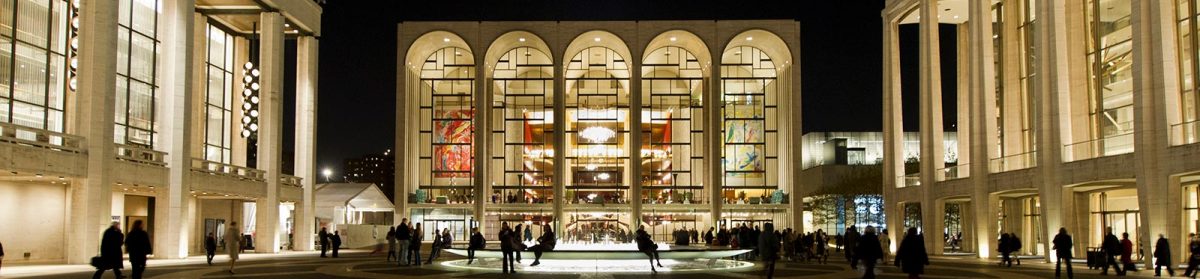
In this 11th year, over ten nights performances from the Met’s Live in HD series will be shown starting with a screening of FUNNY FACE in a special co-presentation with Film at Lincoln Center. Screenings run from August 23 through September 2. There will be 3000 seats in the Plaza in front of the Opera House with an additional standing room area. Cancellations due to thunder/lighting or high wind will not be rescheduled.

LOHENGRIN:Wagner
Original Air Date: 02/01/1964
Rosenstock; Kónya, Crespin, Rankin, Cassel, Wiemann
SID.19350315
Bing generally avoided broadcasts as the first performance in a run, and this one could certainly have done with a few performances for the ensemble to gel. More cuts than we are used to, and Rosenstock is not the most inspiring leader. Konya is in excellent voice, and stands up to the best of the Lohengrins ever. Crespin is one of my favorites, and already by 1964 she could be uneven. Still I like an Elsa with metal for the second act confrontation with Ortrud and also the full throated singing she and Konya bring to the Bridal Chamber. Rankin and Cassel are up to the vocal demands if not always the distinction one would like, and Wiemann was an excellent house bass ready for all the Wagner roles. His phrasing is often a good deal more pleasing than Hines who had more significant vocal equipment. *** Bing generally avoided first performances of repertory as broadcasts, and sometimes things go rather bumpily (most infamously the Schwarzkopf Don Giovanni and the Moffo Lucia). This one does not find Crespin (a huge personal favorite) at her most settled, but she has her moments. Konya really is a fine Lohengrin and for a solid decade #1. The performance has some cuts as well, but by the middle of the second act, things are starting to fall into place.
LOHENGRIN:Wagner
Original Air Date: 02/01/1964
Rosenstock; Kónya, Crespin, Rankin, Cassel, Wiemann
SID.19350531
Bing generally avoided broadcasts as the first performance in a run, and this one could certainly have done with a few performances for the ensemble to gel. More cuts than we are used to, and Rosenstock is not the most inspiring leader. Konya is in excellent voice, and stands up to the best of the Lohengrins ever. Crespin is one of my favorites, and already by 1964 she could be uneven. Still I like an Elsa with metal for the second act confrontation with Ortrud and also the full throated singing she and Konya bring to the Bridal Chamber. Rankin and Cassel are up to the vocal demands if not always the distinction one would like, and Wiemann was an excellent house bass ready for all the Wagner roles. His phrasing is often a good deal more pleasing than Hines who had more significant vocal equipment. *** Bing generally avoided first performances of repertory as broadcasts, and sometimes things go rather bumpily (most infamously the Schwarzkopf Don Giovanni and the Moffo Lucia). This one does not find Crespin (a huge personal favorite) at her most settled, but she has her moments. Konya really is a fine Lohengrin and for a solid decade #1. The performance has some cuts as well, but by the middle of the second act, things are starting to fall into place.
LOHENGRIN:Wagner
Original Air Date: 02/01/1964
Rosenstock; Kónya, Crespin, Rankin, Cassel, Wiemann
SID.19350747
Bing generally avoided broadcasts as the first performance in a run, and this one could certainly have done with a few performances for the ensemble to gel. More cuts than we are used to, and Rosenstock is not the most inspiring leader. Konya is in excellent voice, and stands up to the best of the Lohengrins ever. Crespin is one of my favorites, and already by 1964 she could be uneven. Still I like an Elsa with metal for the second act confrontation with Ortrud and also the full throated singing she and Konya bring to the Bridal Chamber. Rankin and Cassel are up to the vocal demands if not always the distinction one would like, and Wiemann was an excellent house bass ready for all the Wagner roles. His phrasing is often a good deal more pleasing than Hines who had more significant vocal equipment. *** Bing generally avoided first performances of repertory as broadcasts, and sometimes things go rather bumpily (most infamously the Schwarzkopf Don Giovanni and the Moffo Lucia). This one does not find Crespin (a huge personal favorite) at her most settled, but she has her moments. Konya really is a fine Lohengrin and for a solid decade #1. The performance has some cuts as well, but by the middle of the second act, things are starting to fall into place.

ELEKTRA:Strauss
Rosenstock; Borkh, Rysanek, Madeira, Uhde, Vinay
Original Air Date: 03/25/1961
MOD Audio
SID.19450211
Rosenstock appears for the originally scheduled Mitropoulos who had died the previous November. Still, this is a powerful cast in a masterpiece. The whole cast is top drawer, and highly recommended. This is the only Elektra Borkh and Rysanek ever did together, and they are among the very best in these roles. Nice to welcome this performance to MOoD in their 2014 reissues. For me a highlight of the week. Rosenstock comes to the Met first in 1929, and left after one season (poor reviews compared to Bodanzky and Bodanzky returned the following season). Rosenstock returned to Germany, then to Japan for the WHOLE WWII at NHK. He gets back to New York, and starts anew at New York City Opera and succeeds Halasz as director in 1952. After 4 seasons as director, he is replaced by Julius Rudel, and then returns to the Met in 1961 replacing the recently deceased Mitropoulos. He goes on to conduct over 250 Met performances in the next 8 years. including Tosca and Lucia on the Met tour among just about everything. He is a solid conductor, and Borkh in 1961 one of the very great Elektras.
ELEKTRA:Strauss
Rosenstock; Borkh, Rysanek, Madeira, Uhde, Vinay
Original Air Date: 03/25/1961
MOD Audio
SID.19450530
Rosenstock appears for the originally scheduled Mitropoulos who had died the previous November. Still, this is a powerful cast in a masterpiece. The whole cast is top drawer, and highly recommended. This is the only Elektra Borkh and Rysanek ever did together, and they are among the very best in these roles. Nice to welcome this performance to MOoD in their 2014 reissues. For me a highlight of the week. Rosenstock comes to the Met first in 1929, and left after one season (poor reviews compared to Bodanzky and Bodanzky returned the following season). Rosenstock returned to Germany, then to Japan for the WHOLE WWII at NHK. He gets back to New York, and starts anew at New York City Opera and succeeds Halasz as director in 1952. After 4 seasons as director, he is replaced by Julius Rudel, and then returns to the Met in 1961 replacing the recently deceased Mitropoulos. He goes on to conduct over 250 Met performances in the next 8 years. including Tosca and Lucia on the Met tour among just about everything. He is a solid conductor, and Borkh in 1961 one of the very great Elektras.
ELEKTRA:Strauss
Rosenstock; Borkh, Rysanek, Madeira, Uhde, Vinay
Original Air Date: 03/25/1961
MOD Audio
SID.19450743
Rosenstock appears for the originally scheduled Mitropoulos who had died the previous November. Still, this is a powerful cast in a masterpiece. The whole cast is top drawer, and highly recommended. This is the only Elektra Borkh and Rysanek ever did together, and they are among the very best in these roles. Nice to welcome this performance to MOoD in their 2014 reissues. For me a highlight of the week. Rosenstock comes to the Met first in 1929, and left after one season (poor reviews compared to Bodanzky and Bodanzky returned the following season). Rosenstock returned to Germany, then to Japan for the WHOLE WWII at NHK. He gets back to New York, and starts anew at New York City Opera and succeeds Halasz as director in 1952. After 4 seasons as director, he is replaced by Julius Rudel, and then returns to the Met in 1961 replacing the recently deceased Mitropoulos. He goes on to conduct over 250 Met performances in the next 8 years. including Tosca and Lucia on the Met tour among just about everything. He is a solid conductor, and Borkh in 1961 one of the very great Elektras.

TANNHÄUSER:Wagner
Rosenstock; Nuoti, Nilsson, Stewart, Macurdy
Original Air Date: 03/26/1966
SID.20140102
Originally the title role was to have been taken by Windgassen, but he cancelled his run a week before the performances. Nilsson does both Elisabeth and Venus (scheduled as such) and this 1966 revival is the last time the Dresden version of Tannhauser has been heard at the Met; the Dresden had only come in the 1954 new production under Szell. Another Hungarian, Georg Solti had brought the Paris version back to the Met in the 1960 revival, and when Levine did a new production in 1977, Paris became the house standard for choice of versions. Nuotio was not much more than a placeholder, and I think the Met had better repetiteurs than Rosenstock so overall this run doesn’t have much to recommend itself except Nilsson’s generous voicing of both roles, and Thomas Stewart’s Wolfram in his debut Met season.
TANNHÄUSER:Wagner
Rosenstock; Nuoti, Nilsson, Stewart, Macurdy
Original Air Date: 03/26/1966
SID.20140319
Originally the title role was to have been taken by Windgassen, but he cancelled his run a week before the performances. Nilsson does both Elisabeth and Venus (scheduled as such) and this 1966 revival is the last time the Dresden version of Tannhauser has been heard at the Met; the Dresden had only come in the 1954 new production under Szell. Another Hungarian, Georg Solti had brought the Paris version back to the Met in the 1960 revival, and when Levine did a new production in 1977, Paris became the house standard for choice of versions. Nuotio was not much more than a placeholder, and I think the Met had better repetiteurs than Rosenstock so overall this run doesn’t have much to recommend itself except Nilsson’s generous voicing of both roles, and
Thomas Stewart’s Wolfram in his debut Met season.
TANNHÄUSER:Wagner
Rosenstock; Nuoti, Nilsson, Stewart, Macurdy
Original Air Date: 03/26/1966
SID.20140640
Originally the title role was to have been taken by Windgassen, but he cancelled his run a week before the performances. Nilsson does both Elisabeth and Venus (scheduled as such) and this 1966 revival is the last time the Dresden version of Tannhauser has been heard at the Met; the Dresden had only come in the 1954 new production under Szell. Another Hungarian, Georg Solti had brought the Paris version back to
the Met in the 1960 revival, and when Levine did a new production in 1977, Paris became the house standard for choice of versions. Nuotio was not much more than a placeholder, and I think the Met had better repetiteurs than Rosenstock so overall this run doesn’t have much to recommend itself except Nilsson’s generous voicing of both roles, and Thomas Stewart’s Wolfram in his debut Met season.
TANNHÄUSER:Wagner
Rosenstock; Nuoti, Nilsson, Stewart, Macurdy
Original Air Date: 03/26/1966
SID.20140753
Originally the title role was to have been taken by Windgassen, but he cancelled his run a week before the performances. Nilsson does both Elisabeth and Venus (scheduled as such) and this 1966 revival is the last time the Dresden version of Tannhauser has been heard at the Met; the Dresden had only come in the 1954 new production under Szell. Another Hungarian, Georg Solti had brought the Paris version back to the Met in the 1960 revival, and when Levine did a new production in 1977, Paris became the house standard for choice of versions. Nuotio was not much more than a placeholder, and I think the Met had better repetiteurs than Rosenstock so overall this run doesn’t have much to recommend itself except Nilsson’s generous voicing of both roles, and Thomas Stewart’s Wolfram in his debut Met season.

MACBETH:Verdi
Rosenstock; Colzani, Rysanek, Tozzi, Bergonzi
Original Air Date: 03/24/1962
SID.20170318
Rosenstock picked up much of the conducting load previously assigned to Leinsdorf, who had decamped to the Boston Symphony as Music Director. Rosenstock had debuted at the Met in 1929 with six appearances not to reappear again until 1961 when he began a 248 performance run at the Met ending in 1969 with Meistersinger which he had premiered in November 1962 in a new production by Robert O’Hearn and Nathaniel Merrill. In other repertory most of this late career could be described as correct, and nowhere at the level of Bohm, Leinsdorf, or Stiedry.This is Rysanek’s third and last Lady Macbeth performance, and she is not in the form of her debut 4 years earlier, nor is Rosenstock as up to the task as Leinsdorf who replaced the orgiinally scheduled Mitropoulos in 1958. Colzani can be a bit rough hewn, but that works as Macbeth, and Bergonzi is as classy as it gets; Tozzi I prefer to HInes, but I prefer Giaiotti to either– a role Siepi never did at the Met (and don’t notice it elsewhere either).
MACBETH:Verdi
Rosenstock; Colzani, Rysanek, Tozzi, Bergonzi
Original Air Date: 03/24/1962
SID.20170536
Rosenstock picked up much of the conducting load previously assigned to Leinsdorf, who had decamped to the Boston Symphony as Music Director. Rosenstock had debuted at the Met in 1929 with six appearances not to reappear again until 1961 when he began a 248 performance run at the Met ending in 1969 with Meistersinger which he had premiered in November 1962 in a new production by Robert O’Hearn and Nathaniel Merrill. In other repertory most of this late career could be described as correct, and nowhere at the level of Bohm, Leinsdorf, or Stiedry. This is Rysanek’s third and last Lady Macbeth performance, and she is not in the form of her debut 4 years earlier, nor is Rosenstock as up to the task as Leinsdorf who replaced the orgiinally scheduled Mitropoulos in 1958. Colzani can be a bit rough hewn, but that works as Macbeth, and Bergonzi is as classy as it gets; Tozzi I prefer to HInes, but I prefer Giaiotti to either– a role Siepi never did at the Met (and don’t notice it elsewhere either).