
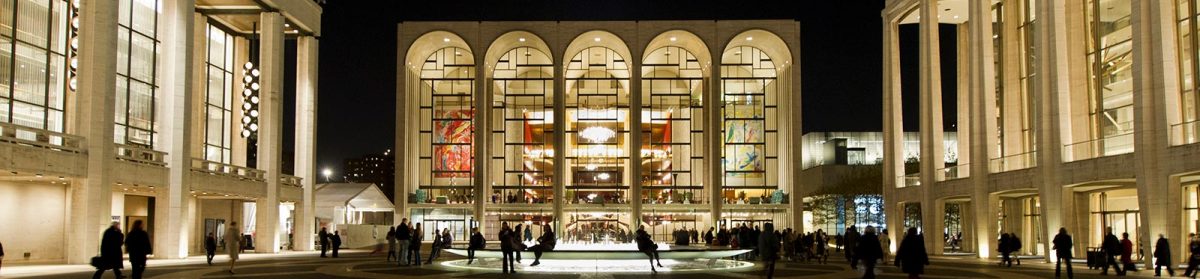
In this 11th year, over ten nights performances from the Met’s Live in HD series will be shown starting with a screening of FUNNY FACE in a special co-presentation with Film at Lincoln Center. Screenings run from August 23 through September 2. There will be 3000 seats in the Plaza in front of the Opera House with an additional standing room area. Cancellations due to thunder/lighting or high wind will not be rescheduled.

DIE ZAUBERFLÖTE:Mozart
Original Air Date: 03/04/1967
Krips; Raskin, Shirley, Uppman, Peters, Macurdy
MOD Audio SID.19390315
First year in the new house, the Chagall production premiered with the Europeans (Lorengar, Popp, Gedda, Prey) plus Hines, but the Americans in the cast above got the broadcast. I liked Krips conducting very much. Popp did broadcast her Queen 3 years later, but this performance has not been on Sirius. Skrowacewski is the conductor, Zylis-Gara is the Pamina, but Popp, Gedda, Prey are all picked up from the premiere cast, and it’s the only German broadcasts of their roles. Sirius should definitely fill in this gap. In 1967 Macurdy was actually fresher of voice than Hines, but mostly this cast was definitely second class.
DIE ZAUBERFLÖTE:Mozart
Original Air Date: 03/04/1967
Krips; Raskin, Shirley, Uppman, Peters, Macurdy
MOD Audio SID.19390531
First year in the new house, the Chagall production premiered with the Europeans (Lorengar, Popp, Gedda, Prey) plus Hines, but the Americans in the cast above got the broadcast. I liked Krips conducting very much. Popp did broadcast her Queen 3 years later, but this performance has not been on Sirius. Skrowacewski is the conductor, Zylis-Gara is the Pamina, but Popp, Gedda, Prey are all picked up from the premiere cast, and it’s the only German broadcasts of their roles. Sirius should definitely fill in this gap. In 1967 Macurdy was actually fresher of voice than Hines, but mostly this cast was definitely second class.
DIE ZAUBERFLÖTE:Mozart
Krips; Raskin, Shirley, Uppman, Peters, Macurdy
Original Air Date: 03/04/1967
MOD Audio
SID.19400101
First year in the new house, the Chagall production premiered with the Europeans (Lorengar, Popp, Gedda, Prey) plus Hines, but the Americans in the cast above got the broadcast. I liked Krips conducting very much. Popp did broadcast her Queen 3 years later, but this performance has not been on Sirius. Skrowacewski is the conductor, Zylis-Gara is the Pamina, but Popp, Gedda, Prey are all picked up from the premiere cast, and it’s the only German broadcasts of their roles. Sirius should definitely fill in this gap. In 1967 Macurdy was actually fresher of voice than Hines, but mostly this cast was definitely second class.

CARMEN:Bizet
Mehta; Resnik, Tucker, Raskin, Díaz
Original Air Date: 03/15/1969
SID.19410103
This is Resnik’s only Carmen broadcast, and Mehta is plenty fiery. Although he had premiered the production with Bumbry, the first season broadcast went to Lombard conducting Bumbry with Tucker and Freni). Resnik’s tone, even for Carmen was a bit worn in 1969, but very stylish. Bing almost could not think of Carmen without Tucker. He has four broadcasts during the 1950s and indeed the first two of the new production in 1968 and 1969. My enjoyment of Tucker’s Jose was always limited by the fact that dramatically Domingo and Vickers were far more satisfying. That he sang one more Jose broadcast in 1972– excepting a Domingo replacement for Vickers in 1972 would have had Tucker as the only Jose on the airwaves from 1958 till 1972 (admittedly Bing took Carmen out of the repertoire from 1960-1967). Certainly few other tenors could have supported such an extended string, and been as strong vocally in 1969 as he was in 1952. I like his excellence in other roles more. It is worth noting here that for Tucker’s 99th birthday, there was supposedly some promise of major Sirius broadcasting. Guess Resnik won that battle this week. Raskin is an ordinary Micaela without the magic that attended her Nannetta or her Mozart at City Opera and her career was cut short by illness and an early passing. Diaz is a replacement for the originally scheduled Merrill, and is OK. Mehta (conductor for life of the Israel Philharmonic, though Zoroastrian) makes this a very Kosher Carmen indeed.
CARMEN:Bizet
Mehta; Resnik, Tucker, Raskin, Díaz
Original Air Date: 03/15/1969
SID.19410318
This is Resnik’s only Carmen broadcast, and Mehta is plenty fiery. Although he had premiered the production with Bumbry, the first season broadcast went to Lombard conducting Bumbry with Tucker and Freni). Resnik’s tone, even for Carmen was a bit worn in 1969, but very stylish. Bing almost could not think of Carmen without Tucker. He has four broadcasts during the 1950s and indeed the first two of the new production in 1968 and 1969. My enjoyment of Tucker’s Jose was always limited by the fact that dramatically Domingo and Vickers were far more satisfying. That he sang one more Jose broadcast in 1972– excepting a Domingo replacement for Vickers in 1972 would have had Tucker as the only Jose on the airwaves from 1958 till 1972 (admittedly Bing took Carmen out of the repertoire from 1960-1967). Certainly few other tenors could have supported such an extended string, and been as strong vocally in 1969 as he was in 1952. I like his excellence in other roles more. It is worth noting here that for Tucker’s 99th birthday, there was supposedly some promise of major Sirius broadcasting. Guess Resnik won that battle this week. Raskin is an ordinary Micaela without the magic that attended her Nannetta or her Mozart at City Opera and her career was cut short by illness and an early passing. Diaz is a replacement for the originally scheduled Merrill, and is OK. Mehta (conductor for life of the Israel Philharmonic, though Zoroastrian) makes this a very Kosher Carmen indeed.
CARMEN:Bizet
Mehta; Resnik, Tucker, Raskin, Díaz
Original Air Date: 03/15/1969
SID.19410534
This is Resnik’s only Carmen broadcast, and Mehta is plenty fiery. Although he had premiered the production with Bumbry, the first season broadcast went to Lombard conducting Bumbry with Tucker and Freni). Resnik’s tone, even for Carmen was a bit worn in 1969, but very stylish. Bing almost could not think of Carmen without Tucker. He has four broadcasts during the 1950s and indeed the first two of the new production in 1968 and 1969. My enjoyment of Tucker’s Jose was always limited by the fact that dramatically Domingo and Vickers were far more satisfying. That he sang one more Jose broadcast in 1972– excepting a Domingo replacement for Vickers in 1972 would have had Tucker as the only Jose on the airwaves from 1958 till 1972 (admittedly Bing took Carmen out of the repertoire from 1960-1967). Certainly few other tenors could have supported such an extended string, and been as strong vocally in 1969 as he was in 1952. I like his excellence in other roles more. It is worth noting here that for Tucker’s 99th birthday, there was supposedly some promise of major Sirius broadcasting. Guess Resnik won that battle this week. Raskin is an ordinary Micaela without the magic that attended her Nannetta or her Mozart at City Opera and her career was cut short by illness and an early passing. Diaz is a replacement for the originally scheduled Merrill, and is OK. Mehta (conductor for life of the Israel Philharmonic, though Zoroastrian) makes this a very Kosher Carmen indeed.

DER ROSENKAVALIER:Strauss
Schippers; Della Casa, Schwarzkopf, Edelmann, Raskin, Dönch
Original Air Date: 12/19/1964
MOD Audio
SID.20030102
Della Casa, a famous Marschallin in her own right, does her first Octavian with the Met in this series of performances. It’s not quite an ideal fit even if very starry. Schwarzkopf was certainly the most famous postwar Marschallin and is here in one of her only two Met broadcast appearances– the latter an unintentional Met farewell in a most unsatisfactory Donna Elvira two years later.
DER ROSENKAVALIER:Strauss
Schippers; Della Casa, Schwarzkopf, Edelmann, Raskin, Dönch
Original Air Date: 12/19/1964
MOD Audio
SID.20030425
Della Casa, a famous Marschallin in her own right, does her first Octavian with the Met in this series of performances. It’s not quite an ideal fit even if very starry. Schwarzkopf was certainly the most famous postwar Marschallin and is here in one of her only two Met broadcast appearances– the latter an unintentional Met farewell in a most unsatisfactory Donna Elvira two years later.
DER ROSENKAVALIER:Strauss
Schippers; Della Casa, Schwarzkopf, Edelmann, Raskin, Dönch
Original Air Date: 12/19/1964
MOD Audio
SID.20030641
Della Casa, a famous Marschallin in her own right, does her first Octavian with the Met in this series of performances. It’s not quite an ideal fit even if very starry. Schwarzkopf was certainly the most famous postwar Marschallin and is here in one of her only two Met broadcast appearances– the latter an unintentional Met farewell in a most unsatisfactory Donna Elvira two years later.

FALSTAFF:Verdi
Amaducci; Flagello, Curtin, Guarrera, Barbieri, Raskin, Alva
Original Air Date: 12/16/1967
MOD Audio
SID.20130106
RWW: Barbieri, Guarrera, and Alva are veterans of many Falstaffs, and Flagello features a lot of voice for a bass Falstaff. Amaducci, by memory, didn’t have much sparkle. High praise for Alva and Barbieri; she is a characterful Quickly, and he a perfect Fenton, but Amaducci is possibly the weakest Falstaff conductor in Met history(certainly on broadcasts). The 1964 Bernstein has never been on Sirius, and though the Met Database records the 1972 as having been on Sirius with Gobbi, Tebaldi, and Paskalis under von Dohnanyi, it has not been on more than once, and should be heard again. Both of these performances belong in MOoD not this performance. Flagello who had one of the great voices in a time when the Met’s bass cabinet was chock full sings the part very well, but for this work, you must have a conductor to work with you, and that he doesn’t have. Alas, Falstaff is about ensemble, not individual efforts.
FALSTAFF:Verdi
Amaducci; Flagello, Curtin, Guarrera, Barbieri, Raskin, Alva
Original Air Date: 12/16/1967
MOD Audio
SID.20130425
RWW: Barbieri, Guarrera, and Alva are veterans of many Falstaffs, and Flagello features a lot of voice for a bass Falstaff. Amaducci, by memory, didn’t have much sparkle. High praise for Alva and Barbieri; she is a characterful Quickly, and he a perfect Fenton, but Amaducci is possibly the weakest Falstaff conductor in Met history(certainly on broadcasts). The 1964 Bernstein has never been on Sirius, and though the Met Database records the 1972 as having been on Sirius with Gobbi, Tebaldi, and Paskalis under von Dohnanyi, it has not been on more than once, and should be heard again. Both of these performances belong in MOoD not this performance. Flagello who had one of the great voices in a time when the Met’s bass cabinet was chock full sings the part very well, but for this work, you must have a conductor to work with you, and that he doesn’t have. Alas, Falstaff is about ensemble, not individual efforts.
FALSTAFF:Verdi
Amaducci; Flagello, Curtin, Guarrera, Barbieri, Raskin, Alva
Original Air Date: 12/16/1967
MOD Audio
SID.20130757
RWW: Barbieri, Guarrera, and Alva are veterans of many Falstaffs, and Flagello features a lot of voice for a bass Falstaff. Amaducci, by memory, didn’t have much sparkle. High praise for Alva and Barbieri; she is a characterful Quickly, and he a perfect Fenton, but Amaducci is possibly the weakest Falstaff conductor in Met history(certainly on broadcasts). The 1964 Bernstein has never been on Sirius, and though the Met Database records the 1972 as having been on Sirius with Gobbi, Tebaldi, and Paskalis under von Dohnanyi, it has not been on more than once, and should be heard again. Both of these performances belong in MOoD not this performance. Flagello who had one of the great voices in a time when the Met’s bass cabinet was chock full sings the part very well, but for this work, you must have a conductor to work with you, and that he doesn’t have. Alas, Falstaff is about ensemble, not individual efforts.