
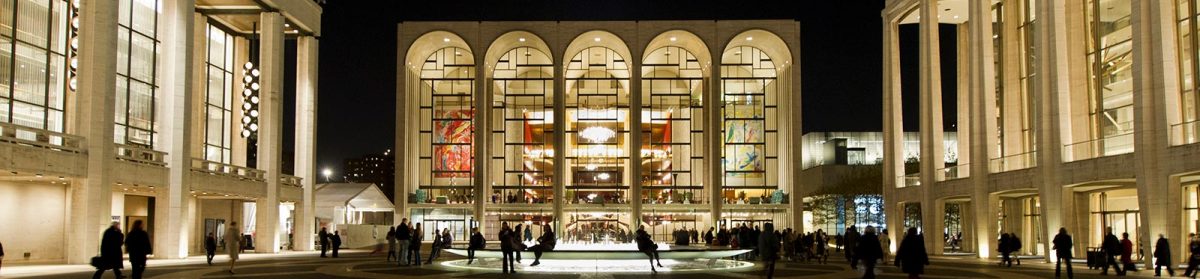
In this 11th year, over ten nights performances from the Met’s Live in HD series will be shown starting with a screening of FUNNY FACE in a special co-presentation with Film at Lincoln Center. Screenings run from August 23 through September 2. There will be 3000 seats in the Plaza in front of the Opera House with an additional standing room area. Cancellations due to thunder/lighting or high wind will not be rescheduled.

SALOME:Strauss
Original Air Date: 12/15/1990
Conlon; Behrens, Clark, Dernesch, Wlaschiha, Baker
SID.19360107
Hildegard Behrens burst on the scene when she appeared with Karajan in his EMI recording of Salome, and subsequent Salzburg production in 1977-1978. Twelve years between her historic recording and her live broadcast from the Met wouldn’t be so long if one were say 35, but Behrens was 41, so this Met broadcast comes at the age of 53. For 53, it is OK, but what was perfection 13 years earlier in the studio is now careful and studied. At a much younger age, Welitsch had the same occurrence. In 1949 she had New York on its heel with her Salome under Reiner at the Met; three years later, it’s a different world; the 1952 Salome is a pale shadow of 1949. Welitsch is 36 in 1949 and 39 in 1952. Three Salomes live were Birgit Nilsson March 1965 (broadcast a few days later) when she was 47. What is remarkable is that she was capable of a concert Salome with Chicago Symphony nine years later in 1974 when she was 56. Tales are told in both Chicago and New York about these concert Salomes. Eva Marton (also heard on a Met broadcast. Not as ideal as Nilsson vocally, she still made quite an impact, and she was 46 for her Met Salome. Last but definitely not least was Karita Mattila who does rank as the most sizzling Salome who could also sing. In 2004, when she was 44, it was filmed by the Met but has never been shown. Four years later she did the work for the HD cameras and she is OK, but now not at the pinnacle (and the HD and the production concept do not reward a Salome that is a bit too ripe.) But prime Nilsson, prime Marton, and prime Mattila, all three captured on Met Saturday matinee microphones are the touchstones. Elektra, in addition to be a more interesting work, allows its heroine more latitude, and Nilsson and Marton as well as Varnay, Jones, and Behrens are all distinguished Elektras. The Met missed Marton as Elektra which is a huge omission. Salome does not yield such pleasure on immediate repetition. Just a little too late for almost everyone. Wlaschiha who is not quite smooth enough for Jokanaan, but a fine Alberich. Cassilly did the first thre Herods (and the last was his Met farewell); Graham Clark did the remaining five.
SALOME:Strauss
Original Air Date: 12/15/1990
Conlon; Behrens, Clark, Dernesch, Wlaschiha, Baker
SID.19360317
Hildegard Behrens burst on the scene when she appeared with Karajan in his EMI recording of Salome, and subsequent Salzburg production in 1977-1978. Twelve years between her historic recording and her live broadcast from the Met wouldn’t be so long if one were say 35, but Behrens was 41, so this Met broadcast comes at the age of 53. For 53, it is OK, but what was perfection 13 years earlier in the studio is now careful and studied. At a much younger age, Welitsch had the same occurrence. In 1949 she had New York on its heel with her Salome under Reiner at the Met; three years later, it’s a different world; the 1952 Salome is a pale shadow of 1949. Welitsch is 36 in 1949 and 39 in 1952. Three Salomes live were Birgit Nilsson March 1965 (broadcast a few days later) when she was 47. What is remarkable is that she was capable of a concert Salome with Chicago Symphony nine years later in 1974 when she was 56. Tales are told in both Chicago and New York about these concert Salomes. Eva Marton (also heard on a Met broadcast. Not as ideal as Nilsson vocally, she still made quite an impact, and she was 46 for her Met Salome. Last but definitely not least was Karita Mattila who does rank as the most sizzling Salome who could also sing. In 2004, when she was 44, it was filmed by the Met but has never been shown. Four years later she did the work for the HD cameras and she is OK, but now not at the pinnacle (and the HD and the production concept do not reward a Salome that is a bit too ripe.) But prime Nilsson, prime Marton, and prime Mattila, all three captured on Met Saturday matinee microphones are the touchstones. Elektra, in addition to be a more interesting work, allows its heroine more latitude, and Nilsson and Marton as well as Varnay, Jones, and Behrens are all distinguished Elektras. The Met missed Marton as Elektra which is a huge omission. Salome does not yield such pleasure on immediate repetition. Just a little too late for almost everyone. Wlaschiha who is not quite smooth enough for Jokanaan, but a fine Alberich. Cassilly did the first thre Herods (and the last was his Met farewell); Graham Clark did the remaining five.
SALOME:Strauss
Original Air Date: 12/15/1990
Conlon; Behrens, Clark, Dernesch, Wlaschiha, Baker
SID.19360533
Hildegard Behrens burst on the scene when she appeared with Karajan in his EMI recording of Salome, and subsequent Salzburg production in 1977-1978. Twelve years between her historic recording and her live broadcast from the Met wouldn’t be so long if one were say 35, but Behrens was 41, so this Met broadcast comes at the age of 53. For 53, it is OK, but what was perfection 13 years earlier in the studio is now careful and studied. At a much younger age, Welitsch had the same occurrence. In 1949 she had New York on its heel with her Salome under Reiner at the Met; three years later, it’s a different world; the 1952 Salome is a pale shadow of 1949. Welitsch is 36 in 1949 and 39 in 1952. Three Salomes live were Birgit Nilsson March 1965 (broadcast a few days later) when she was 47. What is remarkable is that she was capable of a concert Salome with Chicago Symphony nine years later in 1974 when she was 56. Tales are told in both Chicago and New York about these concert Salomes. Eva Marton (also heard on a Met broadcast. Not as ideal as Nilsson vocally, she still made quite an impact, and she was 46 for her Met Salome. Last but definitely not least was Karita Mattila who does rank as the most sizzling Salome who could also sing. In 2004, when she was 44, it was filmed by the Met but has never been shown. Four years later she did the work for the HD cameras and she is OK, but now not at the pinnacle (and the HD and the production concept do not reward a Salome that is a bit too ripe.) But prime Nilsson, prime Marton, and prime Mattila, all three captured on Met Saturday matinee microphones are the touchstones. Elektra, in addition to be a more interesting work, allows its heroine more latitude, and Nilsson and Marton as well as Varnay, Jones, and Behrens are all distinguished Elektras. The Met missed Marton as Elektra which is a huge omission. Salome does not yield such pleasure on immediate repetition. Just a little too late for almost everyone. Wlaschiha who is not quite smooth enough for Jokanaan, but a fine Alberich. Cassilly did the first thre Herods (and the last was his Met farewell); Graham Clark did the remaining five.

DER ROSENKAVALIER:Strauss
Kout; Ziegler, Gessendorf, Haugland, Kilduff, Meredith
Original Air Date: 03/09/1991
SID.19420106
Part of the draw is certainly Pavarotti, but this mostly low voltage marquee cast is very solid. Gessendorf has a second Marschallin four years later under Levine with von Otter and Hawlata which has also been on Sirius. I saw Gessendorf several times in the house, and though not a dramatic house of fire, I like her very much, and find she fills the “big lyric” German roles very well. She’s definitely worth a listen. 7/2/11 Gessendorf is one of those singers who flew under the radar during her Met career. This is the first of her two broadcast Marschallins, and I highly recommend. I think she is even better served on the second one in 1995 with von Otter and Hawlata under Levine. Her Senta broadcast is on Met Player, and her Walkure Sieglinde was also broadcast (Ludwig’s farewell, and G. Jones as the Brunnhilde). She has a number of other Met performances, but alas only these four broadcasts.
DER ROSENKAVALIER:Strauss
Kout; Ziegler, Gessendorf, Haugland, Kilduff, Meredith
Original Air Date: 03/09/1991
SID.19420317
Part of the draw is certainly Pavarotti, but this mostly low voltage marquee cast is very solid. Gessendorf has a second Marschallin four years later under Levine with von Otter and Hawlata which has also been on Sirius. I saw Gessendorf several times in the house, and though not a dramatic house of fire, I like her very much, and find she fills the “big lyric” German roles very well. She’s definitely worth a listen. 7/2/11 Gessendorf is one of those singers who flew under the radar during her Met career. This is the first of her two broadcast Marschallins, and I highly recommend. I think she is even better served on the second one in 1995 with von Otter and Hawlata under Levine. Her Senta broadcast is on Met Player, and her Walkure Sieglinde was also broadcast (Ludwig’s farewell, and G. Jones as the Brunnhilde). She has a number of other Met performances, but alas only these four broadcasts.
DER ROSENKAVALIER:Strauss
Kout; Ziegler, Gessendorf, Haugland, Kilduff, Meredith
Original Air Date: 03/09/1991
SID.19420535
Part of the draw is certainly Pavarotti, but this mostly low voltage marquee cast is very solid. Gessendorf has a second Marschallin four years later under Levine with von Otter and Hawlata which has also been on Sirius. I saw Gessendorf several times in the house, and though not a dramatic house of fire, I like her very much, and find she fills the “big lyric” German roles very well. She’s definitely worth a listen. 7/2/11 Gessendorf is one of those singers who flew under the radar during her Met career. This is the first of her two broadcast Marschallins, and I highly recommend. I think she is even better served on the second one in 1995 with von Otter and Hawlata under Levine. Her Senta broadcast is on Met Player, and her Walkure Sieglinde was also broadcast (Ludwig’s farewell, and G. Jones as the Brunnhilde). She has a number of other Met performances, but alas only these four broadcasts.

FIDELIO:Beethoven
Perick; Connell, Lakes, Welker, Moll, Donath, Kaasch
Original Air Date: 02/16/1991
SID.20020210
This revival comes in for some harsh words from Tim Page, and this broadcast marks the late Elizabeth Connell’s farewell to the Met. She has a more considerable overall career than her appearances at the Met show, but this Fidelio does not help much. Moll and Donath are the two members of the A team, but Rocco and Marzelline are not the essential casting for Fidelio, though I certainly appreciate good singers in the canon quartet.
FIDELIO:Beethoven
Perick; Connell, Lakes, Welker, Moll, Donath, Kaasch
Original Air Date: 02/16/1991
SID.20020426
This revival comes in for some harsh words from Tim Page, and this broadcast marks the late Elizabeth Connell’s farewell to the Met. She has a more considerable overall career than her appearances at the Met show, but this Fidelio does not help much. Moll and Donath are the two members of the A team, but Rocco and Marzelline are not the essential casting for Fidelio, though I certainly appreciate good singers in the canon quartet.
FIDELIO:Beethoven
Perick; Connell, Lakes, Welker, Moll, Donath, Kaasch
Original Air Date: 02/16/1991
SID.20020743
This revival comes in for some harsh words from Tim Page, and this broadcast marks the late Elizabeth Connell’s farewell to the Met. She has a more considerable overall career than her appearances at the Met show, but this Fidelio does not help much. Moll and Donath are the two members of the A team, but Rocco and Marzelline are not the essential casting for Fidelio, though I certainly appreciate good singers in the canon quartet.
Mozart
Levine; Kaasch, Troyanos, Alexander, Bunnell, Hong
Original Air Date: 04/20/1991
SID.20040106
I generally prefer Idomeneo to Clemenza di Tito. Troyanos contribution and this is her last of 3 Sesto broadcasts (her 1985 broadcast is on Met Player) also features Roberta Alexander’s farewell Met performance as Vitelia; together they and Levine’s transparent conducting make the afternoon worthwhile..
Mozart
Levine; Kaasch, Troyanos, Alexander, Bunnell, Hong
Original Air Date: 04/20/1991
SID.20040318
I generally prefer Idomeneo to Clemenza di Tito. Troyanos contribution and this is her last of 3 Sesto broadcasts (her 1985 broadcast is on Met Player) also features Roberta Alexander’s farewell Met performance as Vitelia; together they and Levine’s transparent conducting make the afternoon worthwhile..
Mozart
Levine; Kaasch, Troyanos, Alexander, Bunnell, Hong
Original Air Date: 04/20/1991
SID.20040638
I generally prefer Idomeneo to Clemenza di Tito. Troyanos contribution and this is her last of 3 Sesto broadcasts (her 1985 broadcast is on Met Player) also features Roberta Alexander’s farewell Met performance as Vitelia; together they and Levine’s transparent conducting make the afternoon worthwhile..

LUISA MILLER:Verdi
Santi; Esperian, Pavarotti, Nucci, Plishka, Koptchak, White
Original Air Date: 03/02/1991
SID.20100214
Luisa Miller has done well on the air, although not entering the broadcast repertory of the Met until 1968. The title role has been taken on the airwaves by Caballe, Maliponte (not yet on Sirius!), Scotto, Ricciarelli, and Millo prior to this broadcast; for the tenor role, Tucker, Domingo, Pavarotti (in 1982 with Ricciarelli) led the way. The 1982 performance is also conducted by Santi and features Nucci and Plishka as well. The 1982 performance is on MOoD and I am listening to Tu puniscimi right now. The question is whether Esperian is to be preferred. For my money what I want to hear is either Caballe or Millo or Maliponte who simply have more of a measure of the music than Ricciarelli who has the right equipment, but not sure if she has the right technique. Esperian is even less gifted singer. Either way, Santi’s conducting is too lax for my taste as it was in the house. Levine is a far better Luisa conductor. For my money Act 3 of Luisa Miller is among the greatest acts in the Verdi canon This is the second of Pavarotti’s two broadcast Rodolfos. His 1982 also with Santi ( NO) and Nucci has Ricciarelli in the title role. It’s her most congenial role for a singer who had a short prime but not a short career. The 1982 version with KR is available on MOoD. It’s a good role for Pavarotti, but better to hear the earlier version; one of my favorite early Verdi works, and the last act is as good as anything he ever wrote. — Better to hear Pavarotti with Ricciarelli nine years earlier, also with Nucci and Santi and that is on Met Player.
LUISA MILLER:Verdi
Santi; Esperian, Pavarotti, Nucci, Plishka, Koptchak, White
Original Air Date: 03/02/1991
SID.20100531
Luisa Miller has done well on the air, although not entering the broadcast repertory of the Met until 1968. The title role has been taken on the airwaves by Caballe, Maliponte (not yet on Sirius!), Scotto, Ricciarelli, and Millo prior to this broadcast; for the tenor role, Tucker, Domingo, Pavarotti (in 1982 with Ricciarelli) led the way. The 1982 performance is also conducted by Santi and features Nucci and Plishka as well. The 1982 performance is on MOoD and I am listening to Tu puniscimi right now. The question is whether Esperian is to be preferred. For my money what I want to hear is either Caballe or Millo or Maliponte who simply have more of a measure of the music than Ricciarelli who has the right equipment, but not sure if she has the right technique. Esperian is even less gifted singer. Either way, Santi’s conducting is too lax for my taste as it was in the house. Levine is a far better Luisa conductor. For my money Act 3 of Luisa Miller is among the greatest acts in the Verdi canon This is the second of Pavarotti’s two broadcast Rodolfos. His 1982 also with Santi ( NO) and Nucci has Ricciarelli in the title role. It’s her most congenial role for a singer who had a short prime but not a short career. The 1982 version with KR is available on MOoD. It’s a good role for Pavarotti, but better to hear the earlier version; one of my favorite early Verdi works, and the last act is as good as anything he ever wrote. — Better to hear Pavarotti with Ricciarelli nine years earlier, also with Nucci and Santi and that is on Met Player.
LUISA MILLER:Verdi
Santi; Esperian, Pavarotti, Nucci, Plishka, Koptchak, White
Original Air Date: 03/02/1991
SID.20100746
Luisa Miller has done well on the air, although not entering the broadcast repertory of the Met until 1968. The title role has been taken on the airwaves by Caballe, Maliponte (not yet on Sirius!), Scotto, Ricciarelli, and Millo prior to this broadcast; for the tenor role, Tucker, Domingo, Pavarotti (in 1982 with Ricciarelli) led the way. The 1982 performance is also conducted by Santi and features Nucci and Plishka as well. The 1982 performance is on MOoD and I am listening to Tu puniscimi right now. The question is whether Esperian is to be preferred. For my money what I want to hear is either Caballe or Millo or Maliponte who simply have more of a measure of the music than Ricciarelli who has the right equipment, but not sure if she has the right technique. Esperian is even less gifted singer. Either way, Santi’s conducting is too lax for my taste as it was in the house. Levine is a far better Luisa conductor. For my money Act 3 of Luisa Miller is among the greatest acts in the Verdi canon This is the second of Pavarotti’s two broadcast Rodolfos. His 1982 also with Santi ( NO) and Nucci has Ricciarelli in the title role. It’s her most congenial role for a singer who had a short prime but not a short career. The 1982 version with KR is available on MOoD. It’s a good role for Pavarotti, but better to hear the earlier version; one of my favorite early Verdi works, and the last act is as good as anything he ever wrote. — Better to hear Pavarotti with Ricciarelli nine years earlier, also with Nucci and Santi and that is on Met Player.

ANDREA CHÉNIER:Giordano
Rudel; Martinucci, Millo, Milnes, Kesling, Castle, Johnson
Original Air Date: 12/22/1990
MOD Audio
SID.20120105
This performance marks the 25th anniversary of Milnes’ Met debut, and he goes on to 1997. Millo and Martinucci are authentic Italianate performances with voices well suited to the roles, This is actually some of the best casting of the last 25 years for this opera.
ANDREA CHÉNIER:Giordano
Rudel; Martinucci, Millo, Milnes, Kesling, Castle, Johnson
Original Air Date: 12/22/1990
MOD Audio
SID.20120321
This performance marks the 25th anniversary of Milnes’ Met debut, and he goes on to 1997. Millo and Martinucci are authentic Italianate performances with voices well suited to the roles, This is actually some of the best casting of the last 25 years for this opera.
ANDREA CHÉNIER:Giordano
Rudel; Martinucci, Millo, Milnes, Kesling, Castle, Johnson
Original Air Date: 12/22/1990
MOD Audio
SID.20120638
This performance marks the 25th anniversary of Milnes’ Met debut, and he goes on to 1997. Millo and Martinucci are authentic Italianate performances with voices well suited to the roles, This is actually some of the best casting of the last 25 years for this opera.
 ,
, 
I PURITANI:Bellini
Bonynge; Gruberova, Merritt, Gavanelli, Plishka
Original Air Date: 03/30/1991
MOD Audio
SID.20150212
This is primarily for Gruberova fans. She doesn’t sing in USA much so just as well since she only has two Met broadcasts, this Puritani and Zerbinetta in Ariadne auf Naxos. Of greater interest would be her Queen of the Night (Met debut) and the new production of Traviata with Kleiber and Shicoff (neither broadcast; in today’s world of live Sirius, we would likely be hearing both)

DIE ZAUBERFLÖTE:Mozart
Levine; Battle, Araiza, Hemm, Serra, Moll
Original Air Date: 02/09/1991
SID.20150317
This is the simultaneous broadcast/telecast of the new David Hockney production (based on a Glyndebourne original). The video has been on DVD also. Serra’s tone is a bit white, but very accurate, and the overall casting is of high quality.
,
I PURITANI:Bellini
Bonynge; Gruberova, Merritt, Gavanelli, Plishka
Original Air Date: 03/30/1991
MOD Audio
SID.20150430
This is primarily for Gruberova fans. She doesn’t sing in USA much so just as well since she only has two Met broadcasts, this Puritani and Zerbinetta in Ariadne auf Naxos. Of greater interest would be her Queen of the Night (Met debut) and the new production of Traviata with Kleiber and Shicoff (neither broadcast; in today’s world of live Sirius, we would likely be hearing both)
DIE ZAUBERFLÖTE:Mozart
Levine; Battle, Araiza, Hemm, Serra, Moll
Original Air Date: 02/09/1991
SID.20150535
This is the simultaneous broadcast/telecast of the new David Hockney production (based on a Glyndebourne original). The video has been on DVD also. Serra’s tone is a bit white, but very accurate, and the overall casting is of high quality.
,
I PURITANI:Bellini
Bonynge; Gruberova, Merritt, Gavanelli, Plishka
Original Air Date: 03/30/1991
MOD Audio
SID.20150643
This is primarily for Gruberova fans. She doesn’t sing in USA much so just as well since she only has two Met broadcasts, this Puritani and Zerbinetta in Ariadne auf Naxos. Of greater interest would be her Queen of the Night (Met debut) and the new production of Traviata with Kleiber and Shicoff (neither broadcast; in today’s world of live Sirius, we would likely be hearing both)
DIE ZAUBERFLÖTE:Mozart
Levine; Battle, Araiza, Hemm, Serra, Moll
Original Air Date: 02/09/1991
SID.20150752
This is the simultaneous broadcast/telecast of the new David Hockney production (based on a Glyndebourne original). The video has been on DVD also. Serra’s tone is a bit white, but very accurate, and the overall casting is of high quality.